THE CLASSIC COLLECTION✦An outlaw’s diary: the CommuneCLASSIC FREE BOOKS
An outlaw’s diary: the Commune
Cécile Tormay
THE CLASSIC COLLECTION · 1900
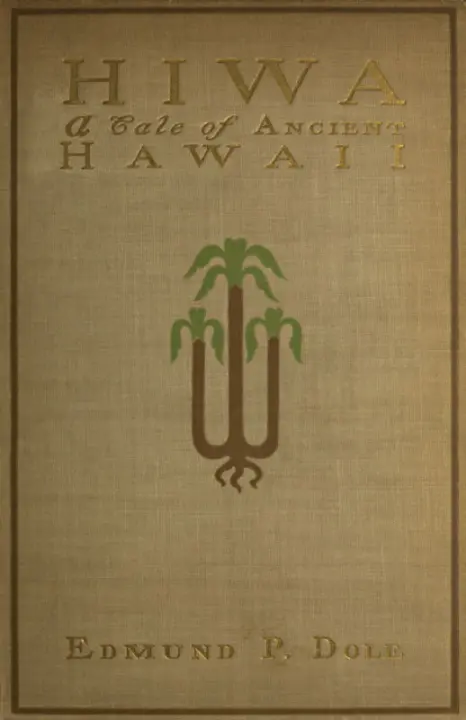
"Hiwa: A Tale of Ancient Hawaii" by Edmund P. Dole is a historical novel written in the late 19th century. The story unfolds in ancient Hawaii, focusing on the life of Hiwa, a goddess-queen, and her struggles against the formidable high-priest Aa amidst themes of love, loyalty, and sacrifice. The narrative follows Hiwa's quest for her son Aelani, who is fated to become a ruler, and her turmoil surrounding her vow to the god Ku, which threatens both her life and the fate of the kingdom. The opening of the tale introduces readers to a lush and vibrant Waipio Valley, where the royal court lies in revelry after a night of indulgence. Hiwa, in her desperate flight from enemies, encounters Eaeakai, a fisherman who unwittingly aids her while fearing the repercussions of his actions. As the narrative progresses, Hiwa's regal background and her complicated relationship with both her lover, Kaanaana, and the treacherous Aa become clear. She ultimately seeks to protect her child and uphold her divine legacy, all while grappling with the consequences of her past actions as she strives to fulfill her vow in a world rife with danger and political intrigue. This rich tapestry of myth and profound destiny sets the stage for an epic story that promises love, conflict, and the harsh demands of a ruler's duty.
Introduction adapted from the source catalogue; source summaries may be automatically generated.
Free to read · English · 19,136 words · No account needed
MAKE TIME FOR A GOOD BOOK
On by default. Untick to stop anonymous reading totals. Each page counts after 10 seconds in view. How this works.
Anonymous counting is on unless you have switched it off.
Hiwa's bones and Kaanaana's were hidden in a cave, at dead of night, by Aelani himself, for he would not intrust this pious duty to meaner hands, that touch of mortal might not profane them so long as the world should endure. Hiwa had made such atonement, lifting Ku's curse from all the people, that they revered her memory and worshipped her as a goddess even as if she had not committed that great sin.
Aloha, Hiwa! She was nobler than a goddess-queen, for she was one of God's noblest creatures--a noble woman. Her frailties were those of human nature and of the remote and barbarous land in which she lived. Her virtues were those of a brave, generous, and lovable people.
Aloha, Hiwa! Aloha, nui!
THE spelling of Hawaiian words is in the main phonetic, according to what is known as the continental method, with the limitation that there are only twelve letters, instead of twenty-six, in the alphabet. Hiwa, for example, is pronounced, approximately, Hé-vä, and Aelani, I-lä´-ny.
The following rules for pronunciation are taken from Prof. William D. Alexander's Brief History of the Hawaiian People:
The original Hawaiian alphabet, adopted by the first missionaries, contained but twelve letters, five of which were vowels, and seven consonants, viz.: a, e, i, o, u, h, k, l, m, n, p, and w. The number of distinct sounds are about sixteen.
No distinction was formerly made between the sounds of k and t, or between those of l and r. In poetry, however, the sound of t was preferred to that of k. The letter w generally sounds like v between the penult and the final syllable of a word.
A is sounded as in father, e as in they, i as in marine, o as in note, u as in rule, or as oo in moon.
Ai, when sounded as a diphthong, resembles the English ay, and au, the English ou in loud.
Besides the sounds mentioned above, there is in many words a guttural break between two vowels, which is represented by an apostrophe in a few common words, to distinguish their meaning, as Kina'u.
Every word and every syllable must end in a vowel, and no two consonants occur without a vowel sound between them.
The accent of about five-sixths of the words in the language is on the penult. A few of the proper names are accented on the final syllable, as Paki´, Kiwalao´ and Namakeha´.
Aa--the word has a variety of meanings, among which are a spiteful person, a raging flame, a rock of rough broken lava.
Your reading position is saved on this browser. Take it to another device with a library code. Reading pages adapt to text, rather than matching a printed edition.
BEHIND THE BOOK
This eBook is for the use of anyone anywhere in the United States and most other parts of the world at no cost and with almost no restrictions whatsoever. You may copy it, give it away or re-use it under the terms of the Project Gutenberg License included with this eBook or online at www.gutenberg.org. If you are not located in the United States, you will have to check the laws of the country where you are located before using this eBook. Read the source licence.
The original source file, including credits and licence, is retained by this library. Request an original-format copy at no charge. Please include the book title and Project Gutenberg identifier #61148.
KEEP YOUR CURIOSITY GOING
Cécile Tormay

Moritz Busch
Coulson Kernahan
John L. Ransom

Maurice Baring
Frances Wright