THE CLASSIC COLLECTION✦An outlaw’s diary: the CommuneCLASSIC FREE BOOKS
An outlaw’s diary: the Commune
Cécile Tormay
THE CLASSIC COLLECTION · 1851
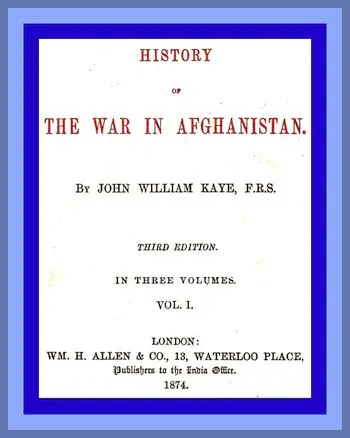
"History of the War in Afghanistan, Vol. 1 (of 3)" by Sir John William Kaye is a historical account written in the mid-19th century. The book delves into the complexities, events, and figures surrounding the tumultuous Afghan War, providing detailed insights into the political and military context of the time. It examines the dynamics of power among Afghan rulers and the British Empire's interests in the region. The opening of this volume sets the stage for the historical narrative by introducing Shah Zemaun and the Douranee Empire at the dawn of the 19th century. It discusses Zemaun Shah's ambitions to invade Hindostan and the resulting unrest that troubled British India. The section lays the groundwork for understanding the rivalries and alliances among Afghan tribes, the impact of foreign influences—particularly from France and Russia—and the British response to perceived threats in Central Asia. Ultimately, the narrative establishes a backdrop of political intrigue and military maneuvers that exemplifies the period's volatility, foreshadowing the conflicts and consequences that will unfold throughout the subsequent chapters.
Introduction adapted from the source catalogue; source summaries may be automatically generated.
Free to read · English · 171,500 words · No account needed
MAKE TIME FOR A GOOD BOOK
On by default. Untick to stop anonymous reading totals. Each page counts after 10 seconds in view. How this works.
Anonymous counting is on unless you have switched it off.
The brother-in-law of the late envoy lost no time in offering his services to fill the place of the deceased. The name of this man was Aga Nebee Khan. He was the son, by a second connexion, of the mistress of Mr. Douglas, chief of the Bussorah factory, and had been Mr. Jones’s moonshee, on a monthly salary of thirty rupees. The Hadjee himself had been a person of no consideration. Half-minister and half-merchant, he had thought more of trading upon his appointment than of advancing the interests of the state; and Nebee Khan, who had embarked with him in his commercial speculations, now lusted to succeed his murdered relative in his diplomatic office, as well as in the senior partnership of the mercantile concern. And he succeeded at last. It cost him time, and it cost him money to accomplish his purpose; but partly by bribery, partly by cajolery, he eventually secured the object of his ambition.[29] It was not, however, till three full years had passed away since the death of the Hadjee, that his brother-in-law reached Calcutta, “not exactly to fill his relative’s place, but to exercise the triple functions of minister, merchant, and claimant of blood-money, which he roundly assessed at twenty lakhs of rupees.”
And in those three years a great change had come over the Supreme Government of India. A long war, prosecuted with extraordinary vigour, had exhausted the financial resources of the state. The reign of India’s most magnificent satrap—the “sultanised” Governor-General—was at an end. A new ruler had been sent from England to carry out a new policy; and that policy was fatal to the pretensions of such a man as Nebee Khan.
He had fallen, indeed, upon evil times. Those were not days when moneyed compensations were likely to be granted even to ambassadors, or when there was any greater likelihood of an Indian statesman embarrassing himself with distant engagements which might compel him to advance an army into unknown regions, or send a fleet into foreign seas. So there was nothing but disappointment in store for Nebee Khan. In the month of October, 1805, the vessel bearing the ambassador sailed into the harbour of Bombay. He was welcomed with all the formalities befitting his station, and with every demonstration of respect. But a series of untoward circumstances, like those which, in the reign of our second James, delayed the public audience of Lord Castlemaine at Rome, postponed, for the space of many months, the reception of Nebee Khan at Calcutta. At length, on the 28th of April, 1806, the ceremony of presentation took place. Sir George Barlow was then at the head of the Indian Government. The Governor-General lined the public way with soldiers, and sent the leading officers of the state to conduct the merchant-minister to his presence. It was an imposing spectacle, and a solemn farce. The Persian elchee knew that he had come to Calcutta not to treat of politics, but of pice; and the English governor, while publicly honouring the Persian, secretly despised him as a sordid adventurer, and was bent upon baffling his schemes. At the private interviews which took place between the British functionaries and Nebee Khan, there was little mention of political affairs. There was a long outstanding money account between the parties, and the settlement of the account-current was the grand object of the mission. The Persian, who thought that he had only to ask, found that times had changed since the commencement of the century, and was overwhelmed with dismay when the British secretary demonstrated to him that he was a debtor to our government of more than a lakh of rupees. Satisfied with existing relations of friendship between Persia and Great Britain, and never at any time disposed to embarrass himself with unnecessary treaties, Barlow declined to enter into new political negotiations, or to satisfy the exorbitant personal claims of the representative of the Persian Court. Nebee Khan left Calcutta a disappointed man. The speculation had not answered. The investment had been a bad one. He had toiled for four long years; he had wasted his time and wasted his money only to be told at last, by an officious secretary, that he owed the British-Indian Government a lakh and seven thousand rupees. In January, 1807, carrying back a portfolio, not more full of political than his purse of financial results, the ambassador left Calcutta. Neither the merchant nor the minister had played a winning game. Compensation and treaties were alike refused him; and he went back with empty hands.
Your reading position is saved on this browser. Take it to another device with a library code. Reading pages adapt to text, rather than matching a printed edition.
BEHIND THE BOOK
This eBook is for the use of anyone anywhere in the United States and most other parts of the world at no cost and with almost no restrictions whatsoever. You may copy it, give it away or re-use it under the terms of the Project Gutenberg License included with this eBook or online at www.gutenberg.org. If you are not located in the United States, you will have to check the laws of the country where you are located before using this eBook. Read the source licence.
The original source file, including credits and licence, is retained by this library. Request an original-format copy at no charge. Please include the book title and Project Gutenberg identifier #48083.
KEEP YOUR CURIOSITY GOING
Cécile Tormay

Moritz Busch
John L. Ransom
Frances Wright
Cécile Tormay

Mabel Potter Daggett