THE CLASSIC COLLECTION✦An outlaw’s diary: the CommuneCLASSIC FREE BOOKS
An outlaw’s diary: the Commune
Cécile Tormay
THE CLASSIC COLLECTION · 1851
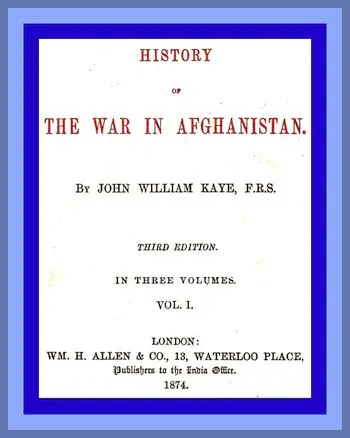
"History of the War in Afghanistan, Vol. 1 (of 3)" by Sir John William Kaye is a historical account written in the mid-19th century. The book delves into the complexities, events, and figures surrounding the tumultuous Afghan War, providing detailed insights into the political and military context of the time. It examines the dynamics of power among Afghan rulers and the British Empire's interests in the region. The opening of this volume sets the stage for the historical narrative by introducing Shah Zemaun and the Douranee Empire at the dawn of the 19th century. It discusses Zemaun Shah's ambitions to invade Hindostan and the resulting unrest that troubled British India. The section lays the groundwork for understanding the rivalries and alliances among Afghan tribes, the impact of foreign influences—particularly from France and Russia—and the British response to perceived threats in Central Asia. Ultimately, the narrative establishes a backdrop of political intrigue and military maneuvers that exemplifies the period's volatility, foreshadowing the conflicts and consequences that will unfold throughout the subsequent chapters.
Introduction adapted from the source catalogue; source summaries may be automatically generated.
Free to read · English · 171,500 words · No account needed
MAKE TIME FOR A GOOD BOOK
On by default. Untick to stop anonymous reading totals. Each page counts after 10 seconds in view. How this works.
Anonymous counting is on unless you have switched it off.
III. The mutual despatch of the Vakeels of both Governments, namely, the British Government and Sindhian Government, shall always continue.
IV. The Government of Sindh will not allow the establishment of the tribe of the French in Sindh.
Written on the 10th of the month of Rujeeb-ool-Moorujub, in the year of the Hegira, 1224, corresponding with the 22nd of August, 1809.
[Vol. I., p. 144.]
Definitive Treaty with Persia, concluded at Teheran, by Messrs. Morier and Ellis, on the 25th November, 1814.
Praise be to God, the all-perfect and all-sufficient.
These happy leaves are a nosegay plucked from the thornless Garden of Concord, and tied by the hands of the Plenipotentiaries of the two great states in the form of a definitive treaty, in which the articles of friendship and amity are blended.
Previously to this period, the high in station, Sir Harford Jones, Baronet, Envoy Extraordinary from the English Government, came to this Court, to form an amicable alliance, and in conjunction with the Plenipotentiaries of Persia, their Excellencies (titles) Meerza Mahomed Sheffeeh and Hajee Mahomed Hussein Khan, concluded a preliminary treaty, the particulars of which were to be detailed and arranged in a definitive treaty; and the above-mentioned treaty, according to its articles, was ratified by the British Government.
Afterwards, when His Excellency Sir Gore Ouseley, Ambassador Extraordinary from His Britannic Majesty, arrived at this exalted and illustrious Court, for the purpose of completing the relations of amity between the two states, and was invested with full powers by his own government to arrange all the important affairs of friendship, the ministers of this victorious state, with the advice and approbation of the above-mentioned Ambassador, concluded a definitive treaty, consisting of fixed articles and stipulations.
That treaty having been submitted to the British Government, certain changes in its articles and provisions, consistent with friendship, appeared necessary, and Henry Ellis, Esquire, was accordingly despatched to this court, in charge of a letter explanatory of the above-mentioned alterations. Therefore, their Excellencies Meerza Mahomed Sheffeeh, Prime Minister, Meerza Bozoork, Caimacan (titles), and Meerza Abdul Wahab, Principal Secretary of State (titles), were duly appointed, and invested with full powers to negotiate with the Plenipotentiaries of His Britannic Majesty, James Morier, Esquire, recently appointed minister at this court, and the above-mentioned Henry Ellis, Esquire. These Plenipotentiaries having consulted on the terms most advisable for this alliance, have comprised them in eleven articles. What relates to commerce, trade, and other affairs, will be drawn up and concluded in a separate commercial treaty.
Your reading position is saved on this browser. Take it to another device with a library code. Reading pages adapt to text, rather than matching a printed edition.
BEHIND THE BOOK
This eBook is for the use of anyone anywhere in the United States and most other parts of the world at no cost and with almost no restrictions whatsoever. You may copy it, give it away or re-use it under the terms of the Project Gutenberg License included with this eBook or online at www.gutenberg.org. If you are not located in the United States, you will have to check the laws of the country where you are located before using this eBook. Read the source licence.
The original source file, including credits and licence, is retained by this library. Request an original-format copy at no charge. Please include the book title and Project Gutenberg identifier #48083.
KEEP YOUR CURIOSITY GOING
Cécile Tormay

Moritz Busch
John L. Ransom
Frances Wright
Cécile Tormay

Mabel Potter Daggett