THE CLASSIC COLLECTION✦An outlaw’s diary: the CommuneCLASSIC FREE BOOKS
An outlaw’s diary: the Commune
Cécile Tormay
THE CLASSIC COLLECTION · 1889
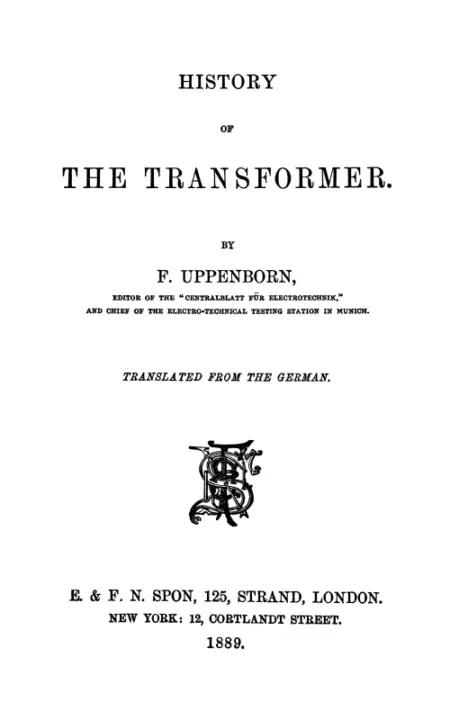
"History of the Transformer" by Friedrich Uppenborn is a scientific publication written in the late 19th century. This book provides a detailed exploration of the evolution of the transformer, focusing on its invention and the key concepts underlying electromagnetic induction. The author, who served as the editor of the "Centralblatt für Elektrotechnik" and was chief of the electro-technical testing station in Munich, aims to clarify the developments leading to the transformer’s design and significance in electrical engineering. In the book, Uppenborn traces the origins and advancements in transformer technology, beginning with Michael Faraday's foundational discoveries in electromagnetic induction. He discusses various inventions and patents by key figures in the field, including those of Professor Page, Ruhmkorff, and the important contributions of Zipernowsky, Déri, and Bláthy in establishing a self-regulating transformer system. The narrative emphasizes the progression in understanding electromotive force and the eventual shift from series to parallel connections of transformers for effective current distribution in electrical lighting. Uppenborn's account serves not only to document the technological advancements but also to address misconceptions surrounding the invention's priority and applications.
Introduction adapted from the source catalogue; source summaries may be automatically generated.
Free to read · English · 11,440 words · No account needed
MAKE TIME FOR A GOOD BOOK
On by default. Untick to stop anonymous reading totals. Each page counts after 10 seconds in view. How this works.
Anonymous counting is on unless you have switched it off.
It would have been thought that after the direct distribution of current to glow-lamps had taken up a determined position, it would not have been difficult to discover a self-regulating system of distribution with transformers. However, the fact shows this was not the case, for after the Edison lighting system was long known, we find such electricians as Haitzema Enuma, Gaulard, and Kennedy, experimenting with the series system of connection; indeed the last of these even deters his colleagues from the attempt to run transformers in parallel, because he openly held the opinion that this method of connection was impracticable.
We have here the development of current distribution by means of transformers, as it completed itself in Europe. The American electricians however, made the matter somewhat easier. They quietly waited until the invention gave useful results in Europe, and then simply imported it.
The field to-day belongs to the parallel method of connection, and after the installation in the alkali works at Aschersleben was destroyed by flooding, there only remains a single installation with series connection, as far as we know; this is that which was fitted up in Tivoli near Rome in the year 1886. This installation however, serves only to feed an invariable number of street-lamps, and can therefore have no claim to the designation of an installation for the distribution of electric currents by means of transformers.
LONDON: PRINTED BY WILLIAM CLOWES AND SONS, LIMITED, STAMFORD STREET AND CHARING CROSS.
[1] See also ‘Scientific American,’ 5th April, 1879, p. 212.
[2] Avernarius, Centralblatt für Elektrotechnik, vol. iii. p. 323.
[3] At that time a customary and very characteristic expression.
[4] Comptes Rendues, 1881, p. 872.
[5] The ‘Electrical Engineer,’ 17th Feb., 1888.
[6] La ‘Lumière électrique,’ vol. xvii. p. 145—148, 1885.
[7] La ‘Lumière électrique,’ vol. x. p. 496, 1883.
[8] La ‘Lumière électrique,’ vol. xiv. p. 45.
[9] ‘Electricien,’ 7th March, 1885.
[10] ‘Natura,’ 25th January, 1885, p. 60.
[11] Elektricitätsverteilung aus Centralstationen, System Zipernowsky-Déri, Centralbl. f. Elektrotechnik Bd. VII. S. 422.
[12] ‘Electrical Review,’ vol. xvii. p. 157.
[13] ‘Elektrotechnische Zeitschrift,’ September, 1885.
End of Project Gutenberg's History of the Transformer, by F. Uppenborn
Your reading position is saved on this browser. Take it to another device with a library code. Reading pages adapt to text, rather than matching a printed edition.
BEHIND THE BOOK
This eBook is for the use of anyone anywhere in the United States and most other parts of the world at no cost and with almost no restrictions whatsoever. You may copy it, give it away or re-use it under the terms of the Project Gutenberg License included with this eBook or online at www.gutenberg.org. If you are not located in the United States, you will have to check the laws of the country where you are located before using this eBook. Read the source licence.
The original source file, including credits and licence, is retained by this library. Request an original-format copy at no charge. Please include the book title and Project Gutenberg identifier #56365.
KEEP YOUR CURIOSITY GOING
Cécile Tormay

Moritz Busch
John L. Ransom
Frances Wright
Cécile Tormay

Mabel Potter Daggett