THE CLASSIC COLLECTION✦An outlaw’s diary: the CommuneCLASSIC FREE BOOKS
An outlaw’s diary: the Commune
Cécile Tormay
THE CLASSIC COLLECTION · 1912
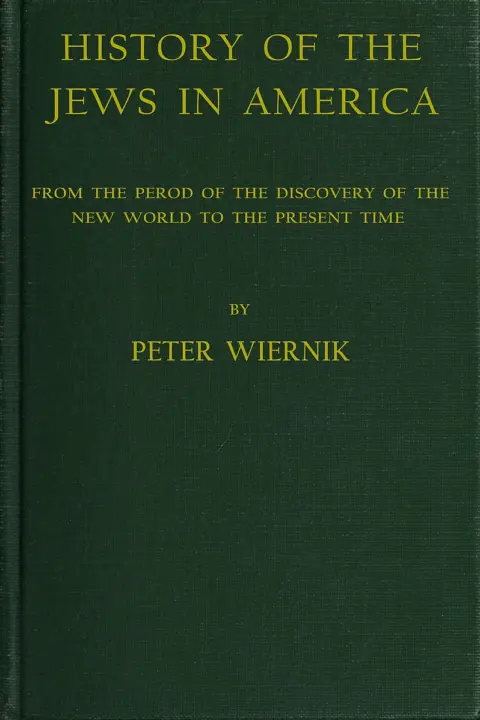
"History of the Jews in America" by Peter Wiernik is a historical account written in the early 20th century. The book chronicles the journey and experiences of Jews from the discovery of the New World through significant events in American history, highlighting their struggles for identity, religious freedom, and acceptance. With a focus on the growth of Jewish communities, it provides insight into their contributions to American society and culture. The opening of this work introduces the significant context of the Jewish presence in America, beginning with their expulsion from Spain and Portugal and the beginnings of Jewish migration to the New World. Wiernik outlines the early experiences of Jews, noting that less than ten thousand Jews resided in the New World three centuries after its discovery. The text emphasizes the transformation of Jewish communities, their struggles against discrimination, and the importance of maintaining their religious identities amidst various economic and social challenges. By establishing a foundation of historical significance, the author sets the stage for a deeper exploration of Jewish history in America throughout the subsequent chapters.
Introduction adapted from the source catalogue; source summaries may be automatically generated.
Free to read · English · 134,713 words · No account needed
MAKE TIME FOR A GOOD BOOK
On by default. Untick to stop anonymous reading totals. Each page counts after 10 seconds in view. How this works.
Anonymous counting is on unless you have switched it off.
Dist. XII: New York: Joseph Barondess, Samuel Dorf, Bernard Drachman, Harry Fischel, William Fishman, Israel Friedlaender, Samuel B. Hamburger, Maurice H. Harris, Samuel I. Hyman, S. Jarmulowsky, Leon Kamaiky, Philip Klein, Nathan Lamport, Adolph Lewisohn, J. L. Magnes, M. Z. Margolies, Louis Marshall, H. Pereire Mendes, Solomon Neumann, Jacob H. Schiff, Bernard Semel, P. A. Siegelstein, Joseph Silverman, Cyrus L. Sulzberger, Felix M. Warburg: 25 members.
Dist. XIII: New York (exclusive of the city), 2 members: Abram J. Katz, Rochester; Simon W. Rosendale, Albany.
Members-at-large: Nathan Bijur, New York City; Isidor Straus, New York
City.
The officers are: Mayer Sulzberger, President; Julian W. Mack and Jacob H. Hollander, Vice-Presidents; Isaac W. Bernheim, Treasurer; Herbert Friedenwald, Secretary. The Executive Committee consists of Cyrus Adler, Harry Cutler, Samuel Dorf, J. L. Magnes, Louis Marshall, Julius Rosenwald, Jacob H. Schiff, Isadore Sobel, Cyrus L. Sulzberger and A. Leo Weil.
The strength of the committee consists mainly in its personnel, as it comprises the most influential as well as the most active Jewish communal leaders of the country. The membership from the large centers of population, like New York, Philadelphia and Chicago, includes also representatives of the immigrants of the last period, and the plan of the Jewish Alliance of twenty years ago[58] to bring together the older and the younger portions of the community is, to some extent, consummated in this Committee. It has made some valuable efforts on behalf of the suffering Jews in other countries, and also in the interest of a speedy solution of the vexed Russian passport question, and it is becoming recognized as the representative Jewish body in the United States.
When the Jewish community or “Kehillah” was formed in New York in 1909, consisting of the representatives of congregations, fraternal and educational organizations, the plans of those who wanted to have the American Jewish Committee re-organized on a more democratic basis, and to make it the elected and authorized representative of the Jewish masses, was partially carried out. The twenty-five members of the Executive Committee of the New York “Kehillah” are the New York members of the American-Jewish Committee. The Jews of Philadelphia have now also formed a “Kehillah” on the same basis of representation. But these new forms of amalgamating the large communities and forming authoritative Jewish central bodies is yet in the experimental stage, and several years, perhaps several decades, will have to pass before their permanent existence will be assured and justified. The great difference between the Committee and the “Kehillahs” is, that in the first men of power and authority who worked effectively for Jewish interests before, individually or as leaders of communal bodies, have united to work together in the same direction. The “Kehillahs” on the other hand, have yet to create the forces which are to sustain them and make them formidable. Their chief value consists of their being symptoms of the times, indicating the approach of the end of the period of chaos in general Jewish affairs, and an inclination to submit to representative authority in communal matters. The most conspicuous act of the New York “Kehillah” was its foundation of a Bureau of Education under the direction of the well-known Jewish educator, Dr. Samson Benderly (b. in Safed, Palestine, 1876), who conducted Jewish schools in Baltimore with marked success and is now working out his original plans in educating Jewish teachers who should be capable of suitably performing their duties to the coming generation. But the soundness and the practicability of his plans are as problematical as that of the “Kehillah” itself.
Your reading position is saved on this browser. Take it to another device with a library code. Reading pages adapt to text, rather than matching a printed edition.
BEHIND THE BOOK
This eBook is for the use of anyone anywhere in the United States and most other parts of the world at no cost and with almost no restrictions whatsoever. You may copy it, give it away or re-use it under the terms of the Project Gutenberg License included with this eBook or online at www.gutenberg.org. If you are not located in the United States, you will have to check the laws of the country where you are located before using this eBook. Read the source licence.
The original source file, including credits and licence, is retained by this library. Request an original-format copy at no charge. Please include the book title and Project Gutenberg identifier #64574.
KEEP YOUR CURIOSITY GOING
Cécile Tormay

Moritz Busch
John L. Ransom
Frances Wright
Cécile Tormay

Mabel Potter Daggett