THE CLASSIC COLLECTION✦An outlaw’s diary: the CommuneCLASSIC FREE BOOKS
An outlaw’s diary: the Commune
Cécile Tormay
THE CLASSIC COLLECTION · 1912
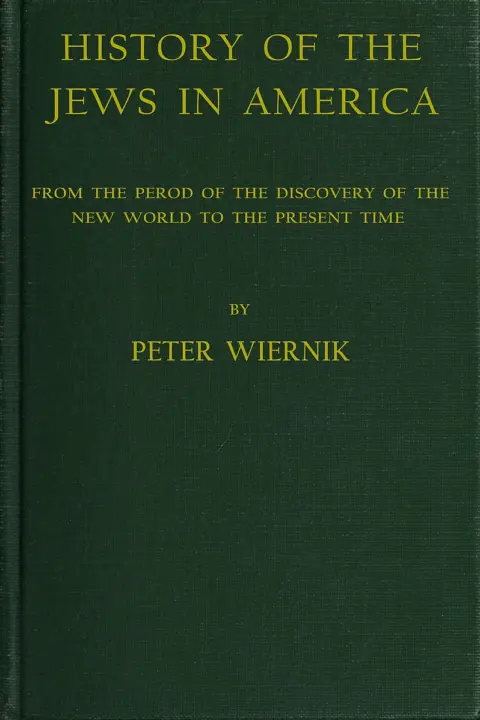
"History of the Jews in America" by Peter Wiernik is a historical account written in the early 20th century. The book chronicles the journey and experiences of Jews from the discovery of the New World through significant events in American history, highlighting their struggles for identity, religious freedom, and acceptance. With a focus on the growth of Jewish communities, it provides insight into their contributions to American society and culture. The opening of this work introduces the significant context of the Jewish presence in America, beginning with their expulsion from Spain and Portugal and the beginnings of Jewish migration to the New World. Wiernik outlines the early experiences of Jews, noting that less than ten thousand Jews resided in the New World three centuries after its discovery. The text emphasizes the transformation of Jewish communities, their struggles against discrimination, and the importance of maintaining their religious identities amidst various economic and social challenges. By establishing a foundation of historical significance, the author sets the stage for a deeper exploration of Jewish history in America throughout the subsequent chapters.
Introduction adapted from the source catalogue; source summaries may be automatically generated.
Free to read · English · 134,713 words · No account needed
MAKE TIME FOR A GOOD BOOK
On by default. Untick to stop anonymous reading totals. Each page counts after 10 seconds in view. How this works.
Anonymous counting is on unless you have switched it off.
The American-Jewish Committee was organized with sixty members, and adopted a constitution (November 11, 1906), which begins: “The purpose of this committee is to prevent infringement of the civil and religious rights of the Jews, and to alleviate the consequences of persecution. In the event of a threatened or actual denial or invasion of such rights, or when conditions calling for relief from calamities affecting Jews exist anywhere, correspondence may be entered into with those familiar with the situation, and if the persons on the spot feel themselves able to cope with the situation, no action need be taken; if, on the other hand, they request aid, steps shall be taken to furnish it.” The Committee was later again increased on account of the enlargement of the representation from New York City, owing to the organization of the “Kehillah,” and last year consisted of the following, representing the thirteen districts into which the country was divided for that purpose:
Dist. I: Florida, Georgia, North Carolina, South Carolina, 2 members: Ceasar Cone, Greensboro, N. C.; Montague Triest, Charleston, S. C.
Dist. II: Alabama, Mississippi, Tennessee, 2 members: Jacques Loeb, Montgomery, Ala.; Nathan Cohn, Nashville, Tenn.
Dist. III: Arizona, Louisiana, New Mexico, Texas, 2 members: Maurice Stern, New Orleans, La.; Isaac H. Kempner, Galveston, Tex.
Dist. IV: Arkansas, Colorado, Kansas, Missouri, 3 members: Morris M. Cohen, Little Rock, Ark.; David S. Lehman, Denver, Col.; Elias Michael, St. Louis, Mo.
Dist. V: California, Idaho, Nevada, Oregon, Utah, Washington, 3 members: Max C. Sloss, San Francisco, Cal.; Harris Weinstock, Sacramento, Cal.; Ben. Selling, Portland, Ore.
Illustration: Hon. Benjamin Selling.
Photo by Trover-Weigel, Salem, Oregon.
Dist. VI: Iowa, Michigan, Minnesota, Montana, Nebraska, North Dakota, South Dakota, Wisconsin, Wyoming, 4 members: Henry M. Butzel, Detroit, Mich.; Emanuel Cohen, Minneapolis, Minn.; Victor Rosewater, Omaha, Neb.; Max Landauer, Milwaukee, Wis.
Dist. VII: Illinois, 7 members: Edwin G. Foreman, M. E. Greenebaum, B. Horwich, Julian W. Mack, Julius Rosenwald, Joseph Stolz, all of Chicago, Ill.; Samuel Woolner (deceased), Peoria, Ill.
Dist. VIII: Indiana, Kentucky, Ohio, West Virginia, 5 members: Louis Newberger, Indianapolis, Ind.; Isaac W. Bernheim, Louisville, Ky.; David Philipson, Cincinnati, O.; J. Walter Freiberg, Cincinnati, O.; E. M. Baker, Cleveland, O.
Dist. IX: New Jersey, Pennsylvania, 9 members: Cyrus Adler, Philadelphia, Pa.; Isaac W. Frank, Pittsburg, Pa.; Wm. B. Hackenburg, B. L. Levinthal, M. Rosenbaum, all of Philadelphia, Pa.; Isadore Sobel, Erie, Pa.; Mayer Sulzberger, Philadelphia, Pa.; A. Leo Weil, Pittsburg, Pa.; Benjamin Wolf, Philadelphia, Pa.
Dist. X: Delaware, District of Columbia, Maryland, Virginia, 2 members: Harry Friedenwald, Baltimore, Md.; Jacob H. Hollander, Baltimore, Md.
Dist. XI: Connecticut, Maine, Massachusetts, New Hampshire, Rhode Island, Vermont, 3 members: Isaac M. Ullman, New Haven, Conn.; Lee M. Friedman, Boston, Mass.; Harry Cutler, Providence, R. I.
Your reading position is saved on this browser. Take it to another device with a library code. Reading pages adapt to text, rather than matching a printed edition.
BEHIND THE BOOK
This eBook is for the use of anyone anywhere in the United States and most other parts of the world at no cost and with almost no restrictions whatsoever. You may copy it, give it away or re-use it under the terms of the Project Gutenberg License included with this eBook or online at www.gutenberg.org. If you are not located in the United States, you will have to check the laws of the country where you are located before using this eBook. Read the source licence.
The original source file, including credits and licence, is retained by this library. Request an original-format copy at no charge. Please include the book title and Project Gutenberg identifier #64574.
KEEP YOUR CURIOSITY GOING
Cécile Tormay

Moritz Busch
John L. Ransom
Frances Wright
Cécile Tormay

Mabel Potter Daggett