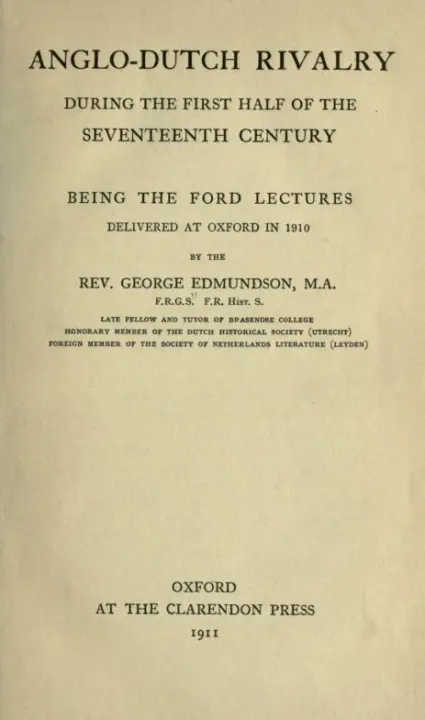
Anglo-Dutch Rivalry During the First Half of the Seventeenth Century being the Ford lectures delivered at Oxford in 1910
George Edmundson
THE CLASSIC COLLECTION · 1922
"History of Holland" by George Edmundson is a historical account likely written in the early 20th century. The book explores the significant events and transformations in the maritime province of Holland, particularly during its War of Independence and the subsequent historical developments of the Dutch state and people. It appears to provide a comprehensive overview of the socio-political landscape of Holland, reflecting on its feudal history and the enduring resilience of its people against various foreign dominations. At the start of "History of Holland," Edmundson outlines the context for the historical narrative, detailing the unique geographic characteristics of the region and their influence on the character of the Dutch people. He introduces key historical figures, including the Counts of Holland and the prominent role that the province played during the Burgundian period and beyond. The narrative establishes a foundation for understanding the complexities of Holland's governance, the emergence of factional conflicts like those between the Hooks and the Cods, and the impactful dynastic competitions that shaped its historical trajectory. The beginning not only sets the stage for a detailed exploration of Holland's history but also highlights the social and economic dynamics that contributed to its eventual independence and national identity.
Introduction adapted from the source catalogue; source summaries may be automatically generated.
Free to read · English · 179,579 words · No account needed
MAKE TIME FOR A GOOD BOOK
On by default. Untick to stop anonymous reading totals. Each page counts after 10 seconds in view. How this works.
Anonymous counting is on unless you have switched it off.
William himself exercised the powers with which Holland and Zeeland had invested him in the name of the king, whose stadholder he was, even when waging war against him. After the Abjuration this pretence could no longer be maintained. The Estates of Holland and Zeeland had indeed petitioned Orange to become their count, but he refused the title, fearing to give umbrage to Anjou. Finding, however, the two provinces resolute in their opposition to the Valois prince, he consented, July 24, 1581, to exercise provisionally, as if he were count, the powers of "high supremacy," which had already been conferred upon him. Meanwhile Anjou was dallying in England, but on receiving through Ste Aldegonde an intimation that the States could brook no further delay, he set sail and landed at Flushing. Lord Leicester and a brilliant English escort accompanied him; and Elizabeth asked the States to receive her suitor as "her own self." At Antwerp, where he took up his residence, Anjou was (February 19) solemnly invested with the duchy of Brabant, and received the homage of his new subjects. He was far from popular, and William remained at his side to give him support and counsel. On March 18 (Anjou's birthday) an untoward event occurred, which threatened to have most disastrous consequences. As Orange was leaving the dinner-table, a young Biscayan, Juan Jaureguy by name, attempted his assassination, by firing a pistol at him. The ball entered the head by the right ear and passed through the palate. Jaureguy was instantly killed and it was afterwards found that he had, for the sake of the reward, been instigated to the deed by his master, a merchant named Caspar Anastro. Anjou, who was at first suspected of being accessory to the crime, was thus exculpated. It was a terrible wound and William's life was for some time in great danger; but by the assiduous care of his physicians and nurses he very slowly recovered, and was strong enough, on May 2, to attend a solemn service of thanksgiving. The shock of the event and the long weeks of anxiety were however too heavy a strain upon his wife, Charlotte de Bourbon, who had recently given birth to their sixth daughter. Her death, on May 5, was deeply grieved by the prince, for Charlotte had been a most devoted helpmeet and adviser to him throughout the anxious years of their married life. During the whole of the summer and autumn William remained at Antwerp, patiently trying to smooth away the difficulties caused by the dislike and suspicion felt by the Netherlanders for the man whom they were asked to recognise as their sovereign. It was an arduous task, but William, at the cost of his own popularity, succeeded in getting the duke acknowledged in July as Lord of Friesland and Duke of Gelderland, and in August Anjou was solemnly installed at Bruges, as Count of Flanders. Meanwhile he was planning, with the help of the large French force which Anjou had undertaken to bring into the Netherlands, to take the offensive against Parma. The truth is that he and Anjou were really playing at cross-purposes. Orange wished Anjou to be the roi-fainéant of a United Netherland state of which he himself should be the real ruler, but Anjou had no intention of being treated as a second Matthias. He secretly determined to make himself master of Antwerp by a sudden attack and, this achieved, to proceed to seize by force of arms some of the other principal cities and to make himself sovereign in reality as well as in name. He resented his dependence upon Orange and was resolved to rid himself of it. With shameless treachery in the early morning of January 17, 1583, he paid a visit to the prince in Antwerp, and, with the object of gaining possession of his person, tried to persuade him to attend a review of the French regiments who were encamped outside the town. The suspicions of William had however been aroused, and he pleaded some excuse for declining the invitation. At midday some thousands of Anjou's troops rushed into the city at the dinner-hour with loud cries of "Ville gagnée! Tue! Tue!" But the citizens flew to arms; barricades were erected; and finally the French were driven out with heavy loss, leaving some 1500 prisoners in the hands of the town-guard. Many French nobles perished, and the "French Fury," as it was called, was an ignominious and ghastly failure. Indignation was wide and deep throughout the provinces; and William's efforts to calm the excitement and patch up some fresh agreement with the false Valois, though for the moment partially successful, only added to his own growing unpopularity.
Your reading position is saved on this browser. Take it to another device with a library code. Reading pages adapt to text, rather than matching a printed edition.
BEHIND THE BOOK
This eBook is for the use of anyone anywhere in the United States and most other parts of the world at no cost and with almost no restrictions whatsoever. You may copy it, give it away or re-use it under the terms of the Project Gutenberg License included with this eBook or online at www.gutenberg.org. If you are not located in the United States, you will have to check the laws of the country where you are located before using this eBook. Read the source licence.
The original source file, including credits and licence, is retained by this library. Request an original-format copy at no charge. Please include the book title and Project Gutenberg identifier #14971.
KEEP YOUR CURIOSITY GOING
Cécile Tormay

Moritz Busch
John L. Ransom
Frances Wright
Cécile Tormay

Mabel Potter Daggett