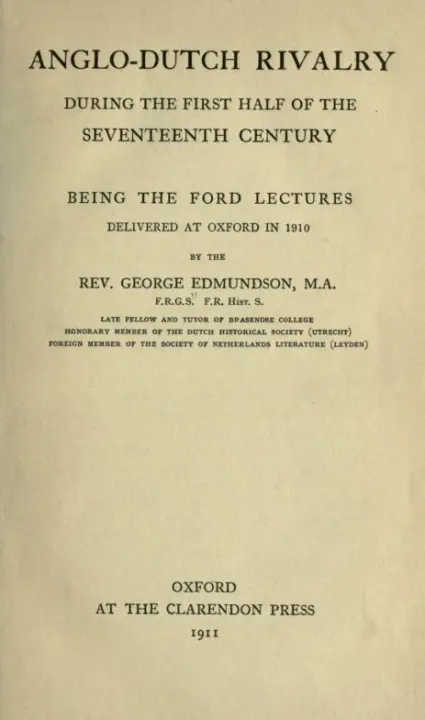
Anglo-Dutch Rivalry During the First Half of the Seventeenth Century being the Ford lectures delivered at Oxford in 1910
George Edmundson
THE CLASSIC COLLECTION · 1922
"History of Holland" by George Edmundson is a historical account likely written in the early 20th century. The book explores the significant events and transformations in the maritime province of Holland, particularly during its War of Independence and the subsequent historical developments of the Dutch state and people. It appears to provide a comprehensive overview of the socio-political landscape of Holland, reflecting on its feudal history and the enduring resilience of its people against various foreign dominations. At the start of "History of Holland," Edmundson outlines the context for the historical narrative, detailing the unique geographic characteristics of the region and their influence on the character of the Dutch people. He introduces key historical figures, including the Counts of Holland and the prominent role that the province played during the Burgundian period and beyond. The narrative establishes a foundation for understanding the complexities of Holland's governance, the emergence of factional conflicts like those between the Hooks and the Cods, and the impactful dynastic competitions that shaped its historical trajectory. The beginning not only sets the stage for a detailed exploration of Holland's history but also highlights the social and economic dynamics that contributed to its eventual independence and national identity.
Introduction adapted from the source catalogue; source summaries may be automatically generated.
Free to read · English · 179,579 words · No account needed
MAKE TIME FOR A GOOD BOOK
On by default. Untick to stop anonymous reading totals. Each page counts after 10 seconds in view. How this works.
Anonymous counting is on unless you have switched it off.
No account of modern Holland would be complete without a notice of the great revival of Dutch painting, which has taken place in the past half century. Without exaggeration it may indeed be said that this modern renascence of painting in Holland is not unworthy to be compared with that of the days of Rembrandt. The names of Joseph Israels, Hendrik Mesdag, Vincent van Gogh, Anton Maure, and, not least, of the three talented brothers Maris, have attained a wide and well-deserved reputation. And to these must be added others of high merit: Bilders, Scheffer, Bosboom, Rochussen, Bakhuysen, Du Chattel, De Haas and Haverman. The traditional representation of the Dutchman as stolid, unemotional, wholly absorbed in trade and material interests, is a caricature. These latter-day artists, like those of the 17th century, conclusively prove that the Dutch race is singularly sensitive to the poetry of form and colour, and that it possesses an inherited capacity and power for excelling in the technical qualities of the painter's art.
[Footnote 1: Hollandais, Holländer, Olandesi, Olandeses,
etc.]
[Footnote 2: In French books and documents, Jacqueline.]
[Footnote 3: Bois-le-duc.]
[Footnote 4: By English and French writers generally
translated Grand Pensionary.]
[Footnote 5: It must be remembered that the States-General and the Holland Estates sat in the same building.]
[Footnote 6: Adam Smith, Wealth of Nations, I, 101.]
[Footnote 7: Busken Huet, Land van Rembrant, III, 175.]
[Footnote 8: Acte van Seclusie.]
[Footnote 9: Nassauischer Erbverein.]
[Footnote 10: Charles White, The Belgic Revolution, 1835,
vol. 1, p. 106.]
[Footnote 11: Correspondence sécrète des Pays-Bas. Julian received his report of the conversation direct from Count Bylandt by permission of the king.]
[Footnote 12: From Van Maanen's private papers. See Colenbrander's Belgische Omwenteling, p. 139.]
[Footnote 13: The ratification by the Powers took place on the following dates:--France and Great Britain, January 31; Austria and Prussia, April 18; Russia, May 4, 1832.]
[Footenote 14: The Prince of Orange had married Anna Paulovna, sister of Alexander I, in 1816.]
[Footnote 15: The Belgian coal field extends into Dutch
Limburg.]
(a) ARCHIVALIA. BOOKS OF REFERENCE
AA, A.J. VAN DER. Biographisch woordenboek d. Nederlanden bevatt. levensbeschrijvingen der personen, die zich in ons vaderland hebben vermaard gemacht, voortgezet door K.J.R. v. Harderwijk en G.D.J. Schotel. 27 vols. Haarlem. 1851-70.
BERGH, L. PH.C. VAN DEN. Over MSS betr. onze geschiedenis in het Britsch Museum bewaard. Arnhem. 1858.
BLOK, P.J. Onze archieven. Amsterdam. 1891. Verslag aangaande een onderzoek in Duitschland naar Archivalia, belangrijk voor de geschiedenis van Nederland. 2 vols. The Hague. 1888-9. Verslag aangaande een voorloopig onderzoek in Engelandt naar Archivalia, belangrijk voor de gesch. v.N. The Hague. 1891. Verslag aangaande een voorloopig onderzoek in Parijs naar Archivalia, belangrijk voor de gesch. v.N. The Hague. 1897.
Your reading position is saved on this browser. Take it to another device with a library code. Reading pages adapt to text, rather than matching a printed edition.
BEHIND THE BOOK
This eBook is for the use of anyone anywhere in the United States and most other parts of the world at no cost and with almost no restrictions whatsoever. You may copy it, give it away or re-use it under the terms of the Project Gutenberg License included with this eBook or online at www.gutenberg.org. If you are not located in the United States, you will have to check the laws of the country where you are located before using this eBook. Read the source licence.
The original source file, including credits and licence, is retained by this library. Request an original-format copy at no charge. Please include the book title and Project Gutenberg identifier #14971.
KEEP YOUR CURIOSITY GOING
Cécile Tormay

Moritz Busch
John L. Ransom
Frances Wright
Cécile Tormay

Mabel Potter Daggett