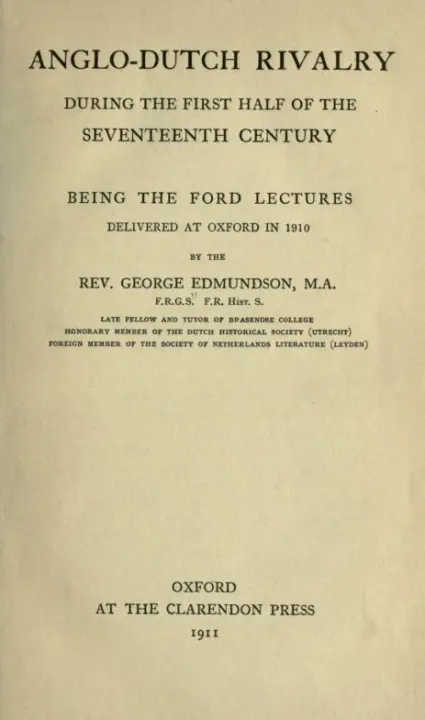
Anglo-Dutch Rivalry During the First Half of the Seventeenth Century being the Ford lectures delivered at Oxford in 1910
George Edmundson
THE CLASSIC COLLECTION · 1922
"History of Holland" by George Edmundson is a historical account likely written in the early 20th century. The book explores the significant events and transformations in the maritime province of Holland, particularly during its War of Independence and the subsequent historical developments of the Dutch state and people. It appears to provide a comprehensive overview of the socio-political landscape of Holland, reflecting on its feudal history and the enduring resilience of its people against various foreign dominations. At the start of "History of Holland," Edmundson outlines the context for the historical narrative, detailing the unique geographic characteristics of the region and their influence on the character of the Dutch people. He introduces key historical figures, including the Counts of Holland and the prominent role that the province played during the Burgundian period and beyond. The narrative establishes a foundation for understanding the complexities of Holland's governance, the emergence of factional conflicts like those between the Hooks and the Cods, and the impactful dynastic competitions that shaped its historical trajectory. The beginning not only sets the stage for a detailed exploration of Holland's history but also highlights the social and economic dynamics that contributed to its eventual independence and national identity.
Introduction adapted from the source catalogue; source summaries may be automatically generated.
Free to read · English · 179,579 words · No account needed
MAKE TIME FOR A GOOD BOOK
On by default. Untick to stop anonymous reading totals. Each page counts after 10 seconds in view. How this works.
Anonymous counting is on unless you have switched it off.
A new administration therefore came into office (May, 1894) under the presidency of Jonkheer Johan Roëll with Van Houten as minister of the interior. On Van Houten's shoulders fell the task of preparing a new electoral law. His proposals were finally approved in 1896. Before this took place the minister of finance, Spenger van Eyk, had succeeded in relieving the treasury by the conversion of the public debt from a 3-1/2 to a 3 per cent, security. The Van Houten reform of the franchise was very complicated, as there were six different categories of persons entitled to exercise the suffrage: (1) payers of at least one guilder in direct taxation; (2) householders or lodgers paying a certain minimum rent and having a residential qualification; (3) proprietors or hirers of vessels of 24 tons at least; (4) earners of a certain specified wage or salary; (5) investors of 100 guilders in the public funds or of 50 guilders in a savings bank; (6) persons holding certain educational diplomas. This very wide and comprehensive franchise raised the number of electors to about 700,000.
The election of 1897, after first promising a victory to the more conservative groups, ended by giving a small majority to the liberals, the progressive section winning a number of seats, and the socialists increasing their representation in the Chamber. A liberal-concentration cabinet took the place of the Roell-Van Houten ministry, its leading members being Pierson (finance) and Goeman-Borgesius (interior). For a right understanding of the parliamentary situation at this time and during the years that follow, a brief account of the groups and sections of groups into which political parties in Holland were divided, must here interrupt the narrative of events.
It has already been told that the deaths of Thorbecke and Groen van Prinsterer led to a breaking up of the old parties and the formation of new groups. The Education Act of 1878 brought about an alliance of the two parties, who made the question of religious education in the primary schools the first article of their political programme--the anti-revolutionaries led by the ex-Calvinist pastor Dr Abraham Kuyper and the Catholics by Dr Schaepman, a Catholic priest. Kuyper and Schaepman were alike able journalists, and used the press with conspicuous success for the propagation of their views, both being advocates of social reform on democratic lines. The anti-revolutionaries, however, did not, as a body, follow the lead of Kuyper. An aristocratic section, whose principles were those of Groen van Prinsterer, "orthodox" and "conservative," under the appellation of "Historical Christians," were opposed to the democratic ideas of Kuyper, and were by tradition anti-Catholic. Their leader was Jonkheer Savornin Lohman. For some years there was a separate Frisian group of "Historical Christians," but these finally amalgamated with the larger body. The liberals meanwhile had split up into three groups: (1) the Old Independent (vrij) Liberals; (2) the Liberal Progressive Union (Unie van vooruitstrevende Liberalen); (3) Liberal-Democrats (vrijzinnig-democratischen Bond). The socialist party was a development of the Algemeene Nederlandsche Werklieden Verbond founded in 1871. Ten years later, by the activities of the fiery agitator, Domela Nieuwenhuis, the Social-Democratic Bond was formed; and the socialists became a political party. The loss of Nieuwenhuis' seat in 1891 had the effect of making him abandon constitutional methods for a revolutionary and anti-religious crusade. The result of this was a split in the socialist party and the formation, under the leadership of Troelstra, Van Kol and Van der Goes, of the "Social-Democratic Workmen's Party," which aimed at promoting the welfare of the proletariat on socialistic lines, but by parliamentary means. The followers of Domela Nieuwenhuis, whose openly avowed principles were "the destruction of actual social conditions by all means legal and illegal," were after 1894 known as "the Socialist Bond." This anarchical party, who took as their motto "neither God nor master," rapidly decreased in number; their leader, discouraged by his lack of success in 1898, withdrew finally from the political arena; and the Socialist Bond was dissolved. This gave an accession of strength to the "Social-Democratic Workmen's Party," which has since the beginning of the present century gradually acquired an increasing hold upon the electorate.
Your reading position is saved on this browser. Take it to another device with a library code. Reading pages adapt to text, rather than matching a printed edition.
BEHIND THE BOOK
This eBook is for the use of anyone anywhere in the United States and most other parts of the world at no cost and with almost no restrictions whatsoever. You may copy it, give it away or re-use it under the terms of the Project Gutenberg License included with this eBook or online at www.gutenberg.org. If you are not located in the United States, you will have to check the laws of the country where you are located before using this eBook. Read the source licence.
The original source file, including credits and licence, is retained by this library. Request an original-format copy at no charge. Please include the book title and Project Gutenberg identifier #14971.
KEEP YOUR CURIOSITY GOING
Cécile Tormay

Moritz Busch
John L. Ransom
Frances Wright
Cécile Tormay

Mabel Potter Daggett