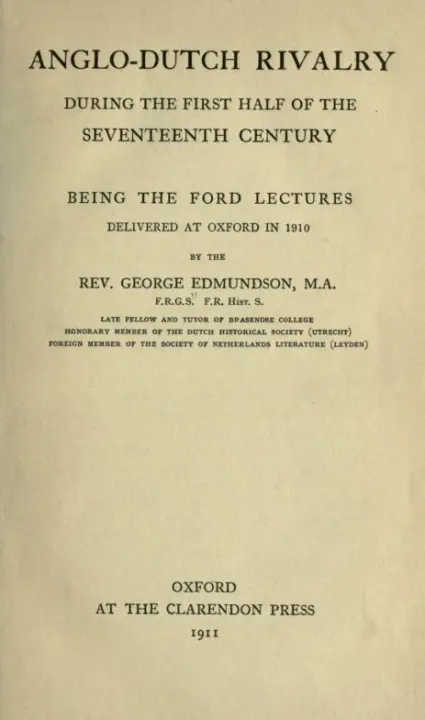
Anglo-Dutch Rivalry During the First Half of the Seventeenth Century being the Ford lectures delivered at Oxford in 1910
George Edmundson
THE CLASSIC COLLECTION · 1922
"History of Holland" by George Edmundson is a historical account likely written in the early 20th century. The book explores the significant events and transformations in the maritime province of Holland, particularly during its War of Independence and the subsequent historical developments of the Dutch state and people. It appears to provide a comprehensive overview of the socio-political landscape of Holland, reflecting on its feudal history and the enduring resilience of its people against various foreign dominations. At the start of "History of Holland," Edmundson outlines the context for the historical narrative, detailing the unique geographic characteristics of the region and their influence on the character of the Dutch people. He introduces key historical figures, including the Counts of Holland and the prominent role that the province played during the Burgundian period and beyond. The narrative establishes a foundation for understanding the complexities of Holland's governance, the emergence of factional conflicts like those between the Hooks and the Cods, and the impactful dynastic competitions that shaped its historical trajectory. The beginning not only sets the stage for a detailed exploration of Holland's history but also highlights the social and economic dynamics that contributed to its eventual independence and national identity.
Introduction adapted from the source catalogue; source summaries may be automatically generated.
Free to read · English · 179,579 words · No account needed
MAKE TIME FOR A GOOD BOOK
On by default. Untick to stop anonymous reading totals. Each page counts after 10 seconds in view. How this works.
Anonymous counting is on unless you have switched it off.
The appeal of William to the signatory Powers had immediate effect; and representatives of Austria, Prussia, Russia and Great Britain, to whom a representative of France was now added, met at London on November 4. This course of action was far from what the king expected or wished. Their first step was to impose an armistice; their next to make it clear that their intervention would be confined to negotiating a settlement on the basis of separation. A Whig ministry in England had (November 16) taken the place of that of Wellington; and Lord Palmerston, the new Foreign Secretary, was well-disposed to Belgium and found himself able to work in accord with Talleyrand, the French plenipotentiary. Austria and Russia were too much occupied with their own internal difficulties to think of supporting the Dutch king by force of arms; and Prussia, despite the close family connection, did not venture to oppose the determination of the two western Powers to work for a peaceful settlement. While they were deliberating, the National Congress had met at Brussels, and important decisions had been taken. By overwhelming majorities (November 18) Belgium was declared to be an independent State; and four days later, after vigorous debates, the Congress (by 174 votes to 13) resolved that the new State should be a constitutional monarchy and (by 161 votes to 28) that the house of Orange-Nassau be for ever excluded from the throne. A committee was appointed to draw up a constitution.
William had appealed to the Powers to maintain the Treaties of Paris and Vienna and to support him in what he regarded, on the basis of those treaties, as his undoubted rights; and it was with indignation that he saw the Conference decline to admit his envoy, Falck, except as a witness and on precisely the same terms as the representatives of the Brussels Congress. On December 20 a protocol was issued by the Powers which defined their attitude. They accepted the principle of separation and independence, subject to arrangements being made for assuring European peace. The Conference, however, declared that such arrangements would not affect the rights of King William and of the German Confederation in the Grand Duchy of Luxemburg. This part of the protocol was as objectionable to the Belgians as the former part was to the Dutch king. The London Plenipotentiaries had in fact no choice, for they were bound by the unfortunate clauses of the treaties of 1815, which, to gratify Prussian ambition for cis-Rhenan territory, converted this ancient Belgian province into a German state. This ill-advised step was now to be the chief obstacle to a settlement in 1831. The mere fact that William had throughout the period of union always treated Luxemburg as an integral part of the southern portion of his kingdom made its threatened severance from the Belgic provinces a burning question. For Luxemburgers had taken a considerable part in the revolt, and Luxemburg representatives sat in the National Congress. Of these eleven voted for the perpetual exclusion of the Orange-Nassau dynasty, one only in its favour. It is not surprising, therefore, that a strong protest was made against the decision of the London Conference to treat the status of Luxemburg as outside the subject of their deliberations. The Conference, however, unmoved by this protest, proceeded in a protocol of January 20,1831, to define the conditions of separation. Holland was to retain her old boundaries of the year 1790, and Belgium to have the remainder of the territory assigned to the kingdom of the Netherlands in 1815. Luxemburg was again excluded. The Five Powers, moreover, declared that within these limits the new Belgian State was to be perpetually neutral, its integrity and inviolability being guaranteed by all and each of the Powers. A second protocol (January 27) fixed the proportion of the national debt to be borne by Belgium at sixteen parts out of thirty-one. The sovereign of Belgium was required to give his assent to these protocols, as a condition to being recognised by the Powers. But the Congress of Brussels was in no submissive mood. They had already (January 19) resolved to proceed to the election of a king without consulting anyone. The territorial boundaries assigned to Belgium met with almost unanimous reprobation, a claim being made to the incorporation not merely of Luxemburg, but also of Maestrieht, Limburg and Dutch Flanders, in the new State. Nor were they more contented with the proportion of the debt Belgium was asked to bear. On February 1 the Five Powers had agreed that they would not assent to a member of any of the reigning dynasties being elected to the throne of Belgium. Nevertheless (February 3) the Duc de Nemours, son of Louis Philippe, was elected by 94 votes, as against 67 recorded for the Duke of Leuchtenberg, son of Eugène Beauharnais. The Conference took immediate action by refusing to permit either Nemours or Leuchtenberg to accept the proffered crown.
Your reading position is saved on this browser. Take it to another device with a library code. Reading pages adapt to text, rather than matching a printed edition.
BEHIND THE BOOK
This eBook is for the use of anyone anywhere in the United States and most other parts of the world at no cost and with almost no restrictions whatsoever. You may copy it, give it away or re-use it under the terms of the Project Gutenberg License included with this eBook or online at www.gutenberg.org. If you are not located in the United States, you will have to check the laws of the country where you are located before using this eBook. Read the source licence.
The original source file, including credits and licence, is retained by this library. Request an original-format copy at no charge. Please include the book title and Project Gutenberg identifier #14971.
KEEP YOUR CURIOSITY GOING
Cécile Tormay

Moritz Busch
John L. Ransom
Frances Wright
Cécile Tormay

Mabel Potter Daggett