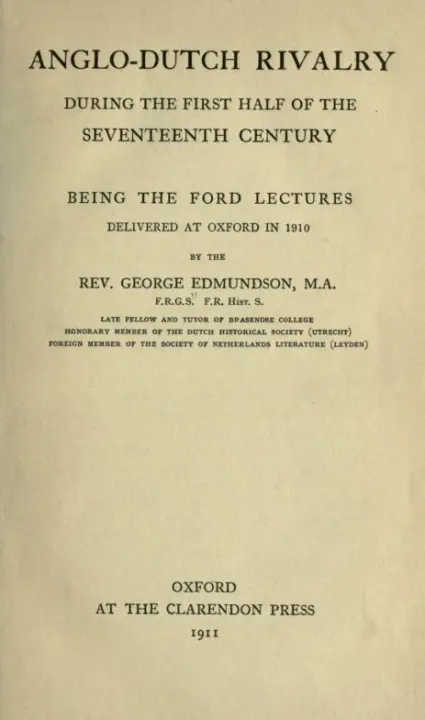
Anglo-Dutch Rivalry During the First Half of the Seventeenth Century being the Ford lectures delivered at Oxford in 1910
George Edmundson
THE CLASSIC COLLECTION · 1922
"History of Holland" by George Edmundson is a historical account likely written in the early 20th century. The book explores the significant events and transformations in the maritime province of Holland, particularly during its War of Independence and the subsequent historical developments of the Dutch state and people. It appears to provide a comprehensive overview of the socio-political landscape of Holland, reflecting on its feudal history and the enduring resilience of its people against various foreign dominations. At the start of "History of Holland," Edmundson outlines the context for the historical narrative, detailing the unique geographic characteristics of the region and their influence on the character of the Dutch people. He introduces key historical figures, including the Counts of Holland and the prominent role that the province played during the Burgundian period and beyond. The narrative establishes a foundation for understanding the complexities of Holland's governance, the emergence of factional conflicts like those between the Hooks and the Cods, and the impactful dynastic competitions that shaped its historical trajectory. The beginning not only sets the stage for a detailed exploration of Holland's history but also highlights the social and economic dynamics that contributed to its eventual independence and national identity.
Introduction adapted from the source catalogue; source summaries may be automatically generated.
Free to read · English · 179,579 words · No account needed
MAKE TIME FOR A GOOD BOOK
On by default. Untick to stop anonymous reading totals. Each page counts after 10 seconds in view. How this works.
Anonymous counting is on unless you have switched it off.
More serious in its results was the infringement of Art. CCXXVII of the Fundamental Law guaranteeing liberty of the press. The return of Napoleon from Elba, and the imminent danger to which the, as yet, unorganised kingdom of the Netherlands was exposed, led to the issue of an arrêté of the severest character. By it all persons publishing news of any kind, or giving information injurious to the State, or writing or distributing political pamphlets, were to be brought before a special tribunal of nine judges holding office at the king's pleasure; and, if condemned, were liable to be sentenced to exposure in the pillory, deprivation of civic rights, branding, imprisonment, and fines varying from 100 to 10,000 francs. This harsh measure was possibly justifiable in an extreme emergency upon the plea that it was necessary for the safety of the State. When the danger was over, and the Fundamental Law was passed, there was no excuse for its further maintenance on the Statute-book. Yet before this court Abbé de Foere was summoned for having defended in the Spectateur Beige the jugement doctrinal of Bishop de Broglie, and he was sentenced to two years' imprisonment. In the following year, 1818, the government obtained the approval of the States-General (with slight modification) for the continuance of this war-time censorship of the press. The penalties remained, but the court consisted of a judge and four assessors, all government nominees. Under this law a Brussels advocate, Van der Straeten, was fined 3000 fl. for a brochure attacking the ministers; and several other advocates were disbarred for protesting that this sentence was in conflict with the Fundamental Law. Prosecutions henceforth followed prosecutions, and the press was gagged.
As a result of these press persecutions, the two Belgian political parties, the clericals and the liberals, poles apart as they were in their principles, drew closer together. All differences of religious and political creed were fused in a common sense of national grievances under what was regarded as a foreign tyranny. This brought about in 1828 the formation of the Union, an association for the co-operation of Belgians of all parties in defence of liberty of worship, liberty of instruction and liberty of the press. The ultra-clericals, who looked to the Vatican for their guidance, and the advanced liberals who professed the principles of the French Revolution were thus by the force of events led on step by step to convert an informal into a formal alliance. The Abbe de Foere in the Spectateur and MM. D'Ellougue and Donker in the Observateur had been for some years advocating united action; and it was their success in winning over to their side the support and powerful pen of Louis de Potter, a young advocate and journalist of Franco-radical sympathies, that the Union, as a party, was actually effected. From this time the onslaughts in the press became more and more violent and embittered, and stirred up a spirit of unrest throughout the country. Petitions began to pour in against the mouture and abbatage taxes and other unpopular measures, especially from the Walloon provinces. These were followed by a National Petition, signed by representatives of every class of the community asking for redress of grievances, but it met with no response from the unyielding king. He had in the early summer of this year, 1828, made a tour in Belgium and had in several towns, especially in Antwerp and Ghent, met with a warm reception, which led him to underestimate the extent and seriousness of the existing discontent. At Liège, a centre of Walloon liberalism, he was annoyed by a number of petitions being presented to him; and, in a moment of irritation, he described the conduct of those who there protested against "pretended grievances" as infamous, "une conduite in-fâme." The words gave deep offence; and the incident called forth a parody of the League of the Beggars in 1566, an Order of Infamy being started with a medal bearing the motto fidèles jusqu' à l'infamie. The movement spread rapidly, but it remains a curious fact that the animosity of the Belgians, as yet, was directed against the Dutch ministers (especially Van Maanen the Minister of Justice) and the Dutch people, whose overbearing attitude was bitterly resented, rather than against the king or the House of Orange. William's good deeds for the benefit of the country were appreciated; his arbitrary measures in contravention to the Fundamental Law were attributed chiefly to his bad advisers.
Your reading position is saved on this browser. Take it to another device with a library code. Reading pages adapt to text, rather than matching a printed edition.
BEHIND THE BOOK
This eBook is for the use of anyone anywhere in the United States and most other parts of the world at no cost and with almost no restrictions whatsoever. You may copy it, give it away or re-use it under the terms of the Project Gutenberg License included with this eBook or online at www.gutenberg.org. If you are not located in the United States, you will have to check the laws of the country where you are located before using this eBook. Read the source licence.
The original source file, including credits and licence, is retained by this library. Request an original-format copy at no charge. Please include the book title and Project Gutenberg identifier #14971.
KEEP YOUR CURIOSITY GOING
Cécile Tormay

Moritz Busch
John L. Ransom
Frances Wright
Cécile Tormay

Mabel Potter Daggett