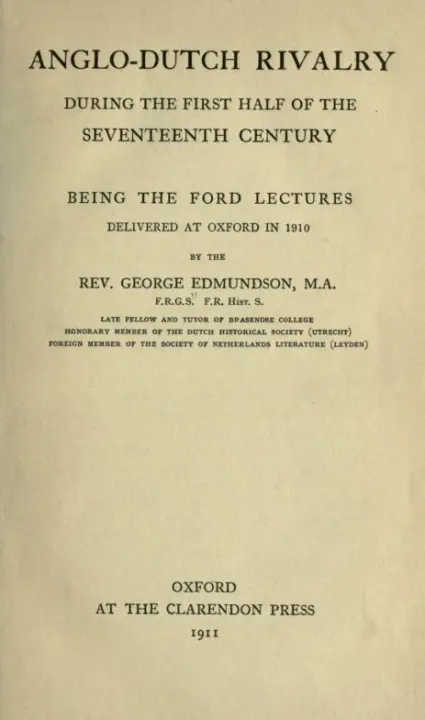
Anglo-Dutch Rivalry During the First Half of the Seventeenth Century being the Ford lectures delivered at Oxford in 1910
George Edmundson
THE CLASSIC COLLECTION · 1922
"History of Holland" by George Edmundson is a historical account likely written in the early 20th century. The book explores the significant events and transformations in the maritime province of Holland, particularly during its War of Independence and the subsequent historical developments of the Dutch state and people. It appears to provide a comprehensive overview of the socio-political landscape of Holland, reflecting on its feudal history and the enduring resilience of its people against various foreign dominations. At the start of "History of Holland," Edmundson outlines the context for the historical narrative, detailing the unique geographic characteristics of the region and their influence on the character of the Dutch people. He introduces key historical figures, including the Counts of Holland and the prominent role that the province played during the Burgundian period and beyond. The narrative establishes a foundation for understanding the complexities of Holland's governance, the emergence of factional conflicts like those between the Hooks and the Cods, and the impactful dynastic competitions that shaped its historical trajectory. The beginning not only sets the stage for a detailed exploration of Holland's history but also highlights the social and economic dynamics that contributed to its eventual independence and national identity.
Introduction adapted from the source catalogue; source summaries may be automatically generated.
Free to read · English · 179,579 words · No account needed
MAKE TIME FOR A GOOD BOOK
On by default. Untick to stop anonymous reading totals. Each page counts after 10 seconds in view. How this works.
Anonymous counting is on unless you have switched it off.
The dislike of the Catholic hierarchy in Belgium to Dutch rule had been intensified by the manner in which the king had dealt with the vote of the notables. Their leader was Maurice de Broglie, Bishop of Ghent, a Frenchman by birth. His efforts by speech and by pen to stir up active enmity in Belgium to the union aroused William's anger, and he resolved to prosecute him. It was an act of courage rather than of statesmanship, but the king could not brook opposition. Broglie refused to appear before the court and fled to France. In his absence he was condemned to banishment and the payment of costs. The powerful clerical party regarded him as a martyr and continued to criticise the policy of the Protestant king with watchful and hostile suspicion. Nor were the Belgian liberal party more friendly. They did not indeed support the clerical claim to practical predominance in the State, but they were patriotic Belgians who had no love for Holland and resented the thought that they were being treated as a dependency of their northern neighbours. They were at one with the clericals in claiming that the Belgian representation in the Second Chamber of the States-General should be proportional to their population. But this grievance might have been tolerated had the king shown any inclination to treat his Belgian subjects on a footing of equality with the Dutch. He was, as will be seen, keenly interested in the welfare and progress of the south, but in spirit and in his conduct of affairs he proved himself to be an out-and-out Hollander. The provision of the Fundamental Law that the seat of government and the meetings of the States-General should be alternately from year to year at the Hague and at Brussels was never carried out. All the ministries were permanently located at the Hague; and of the seven ministers who held office in 1816 only one, the Duke d'Ursel, was a Belgian, and he held the post of Minister of Public Works and Waterways. Fourteen years later (at the time of the revolt) six out of seven were still northerners. The military establishments were all in Holland, and nearly all the diplomatic and civil posts were given to Dutchmen. Nor was this merely due to the fact that, when the union took place, Holland already possessed an organised government and a supply of experienced officials, while Belgium lacked both. On the contrary, the policy of the king remained fixed and unwavering. In 1830 out of 39 diplomatists 30 were Dutch. All the chief military posts were filled by Dutchmen. Nor was it different in the civil service. In the home department there were 117 Dutch, 11 Belgians; in the war department 102 Dutch, 3 Belgians; in finance 59 Dutch, 5 Belgians. Such a state of things was bound to cause resentment. Parties in the Belgic provinces were in the early days of the Union divided very much as they have been in recent years. The Catholic or Clerical party had its stronghold in the two Flanders and Antwerp, i.e. in the Flemish-speaking districts. In Walloon Belgium the Liberals had a considerable majority. The opposition to the Fundamental Law came overwhelmingly from Flemish Belgium; the support from Liège, Namur, Luxemburg and other Walloon districts. But the sense of injustice brought both parties together, so that in the representative Chamber the Belgian members were soon found voting solidly together, as a permanent opposition, while the Dutch voted en bloc for the government. As the representation of north and south was equal, 55 members each, the result would have been a deadlock, but there were always two or three Belgians who held government offices; and these were compelled, on pain of instant dismissal, to vote for a government measure or at least to abstain. Thus the king could always rely on a small but constant majority, and by its aid he did not hesitate to force through financial and legislative proposals in the teeth of Belgian opposition. It is only fair, however, to the arbitrary king to point out how earnestly he endeavoured to promote the material and industrial welfare of the whole land, and to encourage to the best of his power literary, scientific and educational progress. In Holland the carrying-trade, which had so long been the chief source of the country's wealth, had been utterly ruined by Napoleon's Continental System. On the other hand, Belgian industries, which had been flourishing through the strict embargo placed upon the import of British goods, were now threatened with British competition. The steps taken by the energy and initiative of the king were, considering the state of the national finances, remarkable in the variety of their aims and the results that they achieved. The old Amsterdam Bank was transformed into a Bank of the Netherlands. A number of canals were planned and constructed. Chief among these was the North Holland Canal, connecting Amsterdam with the Helder. The approaches to Rotterdam were improved, so that this port became the meeting-point of sea-traffic from England and river-traffic by the Rhine from Germany. But both these ports were quickly overshadowed by the rapid recovery of Antwerp, now that the Scheldt was free and open to commerce. Other important canals, begun and wholly or in part constructed, during this period were the Zuid-Willemsvaart, the Zederik, the Appeldoorn and the Voorne canals. Water communication was not so necessary in the south as in the north, but care was there also bestowed upon the canals, especially upon the canal of Terneuzen connecting Ghent with the western Scheldt, and many highways were constructed. To restore the prosperity of the Dutch carrying-trade, especially that with their East Indies, in 1824 a Company--de Nederlandsche Handekmaatschappij--was founded; and at the same time a commercial treaty was concluded with Great Britain, by which both nations were to enjoy free trade with each other's East Indian possessions. The Handekmaatschappij had a capital of 37 million florins; to this the king contributed four millions and guaranteed to the shareholders for 20 years a dividend of 4 1/2 per cent. The Company at first worked at a loss, and in 1831 William had to pay four million florins out of his privy purse to meet his guarantee. This was partly due to the set-back of a revolt in Java which lasted some years.
Your reading position is saved on this browser. Take it to another device with a library code. Reading pages adapt to text, rather than matching a printed edition.
BEHIND THE BOOK
This eBook is for the use of anyone anywhere in the United States and most other parts of the world at no cost and with almost no restrictions whatsoever. You may copy it, give it away or re-use it under the terms of the Project Gutenberg License included with this eBook or online at www.gutenberg.org. If you are not located in the United States, you will have to check the laws of the country where you are located before using this eBook. Read the source licence.
The original source file, including credits and licence, is retained by this library. Request an original-format copy at no charge. Please include the book title and Project Gutenberg identifier #14971.
KEEP YOUR CURIOSITY GOING
Cécile Tormay

Moritz Busch
John L. Ransom
Frances Wright
Cécile Tormay

Mabel Potter Daggett