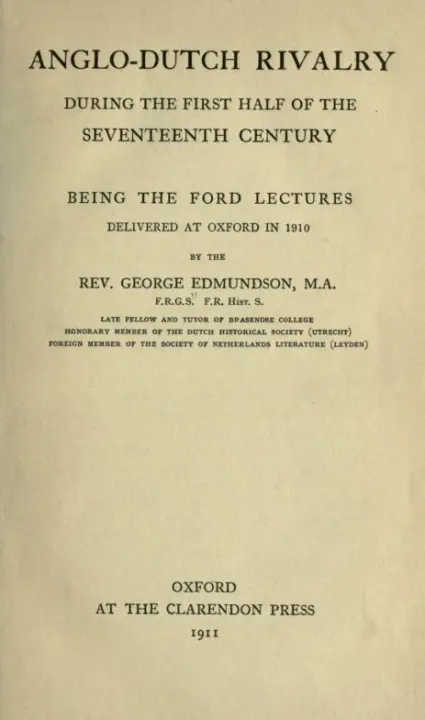
Anglo-Dutch Rivalry During the First Half of the Seventeenth Century being the Ford lectures delivered at Oxford in 1910
George Edmundson
THE CLASSIC COLLECTION · 1922
"History of Holland" by George Edmundson is a historical account likely written in the early 20th century. The book explores the significant events and transformations in the maritime province of Holland, particularly during its War of Independence and the subsequent historical developments of the Dutch state and people. It appears to provide a comprehensive overview of the socio-political landscape of Holland, reflecting on its feudal history and the enduring resilience of its people against various foreign dominations. At the start of "History of Holland," Edmundson outlines the context for the historical narrative, detailing the unique geographic characteristics of the region and their influence on the character of the Dutch people. He introduces key historical figures, including the Counts of Holland and the prominent role that the province played during the Burgundian period and beyond. The narrative establishes a foundation for understanding the complexities of Holland's governance, the emergence of factional conflicts like those between the Hooks and the Cods, and the impactful dynastic competitions that shaped its historical trajectory. The beginning not only sets the stage for a detailed exploration of Holland's history but also highlights the social and economic dynamics that contributed to its eventual independence and national identity.
Introduction adapted from the source catalogue; source summaries may be automatically generated.
Free to read · English · 179,579 words · No account needed
MAKE TIME FOR A GOOD BOOK
On by default. Untick to stop anonymous reading totals. Each page counts after 10 seconds in view. How this works.
Anonymous counting is on unless you have switched it off.
The envoys reached the Hague on May 8, and found the States-General in a more yielding mood than might have been expected from their previous attitude. Rewbell and Siéyès knew how to play upon the fears of the Provisional Government by representing to them that, if the terms they offered were rejected, their choice lay between French annexation or an Orange restoration. Four members were appointed by the States-General with full powers to negotiate. The conferences began on May 11; and in five days an agreement was reached. The Batavian Republic, recognised as a free and independent State, entered into an offensive and defensive alliance with the French Republic. But the Dutch had to cede Maestricht, Venloo and Dutch Flanders and to pay an indemnity of 100,000,000 florins. Flushing was to receive a French garrison, and its harbour was to be used in common by the two powers; 25,000 French troops were to be quartered in the Republic and were to be fed, clothed and paid. The Dutch were compelled to permit the free circulation of the worthless assignats in their country.
One of the first results of this treaty was a breach with Great Britain. The Dutch coast was blockaded; British fleets stopped all sea-borne commerce; and the Dutch colonies in the East and West Indies were one after the other captured. The action of the Prince of Orange made this an easy task. William placed in the hands of the British commanders letters addressed to the governors of the Dutch colonies ordering them "to admit the troops sent out on behalf of his Britannic Majesty and to offer no resistance to the British warships, but to regard them as vessels of a friendly Power." The Cape of Good Hope surrendered to Admiral Rodney; and in quick succession followed Malacca, Ceylon and the Moluccas. A squadron of nine ships under Rear-Admiral Lucas, sent out to recover the Cape and the other East Indian possessions, was compelled to surrender to the English in Saldanha Bay on August 17, 1796, almost without resistance, owing to the Orange sympathies of the crews. The West Indian Colonies fared no better. Demerara, Essequibo and Berbice capitulated in the spring of 1796; Surinam remained in Dutch hands until 1799; Java until 1801. The occupation by the English of this island, the most important of all the Dutch overseas possessions, made the tale of their colonial losses complete. The offensive and defensive alliance with France had thus brought upon the Republic, as a trading and colonial power, a ruin which the efforts of the provisional government under French pressure to re-organise and strengthen their naval and military forces had been unable to prevent. The erstwhile exiles, Daendels and Dumonceau, who had attained the rank of generals in the French service, were on their return entrusted with the task of raising an army of 36,000 men, disciplined and equipped on the French system. The navy was dealt with by a special Committee, of which Pieter Paulus was the energetic president. Unfortunately for the Committee, a large proportion of the officers and crews were strongly Orangist. Most of the officers resigned, and it was necessary to purge the crews. Their places had to be supplied by less experienced and trustworthy material; but Vice-Admiral Jan de Winter did his utmost to create a fleet in fit condition to join the French and Spanish fleets in convoying an expeditionary force to make a descent upon the coast of Ireland. In July, 1797, eighty ships were concentrated at the Texel with troops on board, ready to join the Franco-Spanish squadrons, which were to sail from Brest. But the junction was never effected. Week after week the Dutch admiral was prevented from leaving the Texel by contrary winds. The idea of an invasion of Ireland was given up, but so great was the disappointment in Holland and such the pressure exerted on De Winter by the Commission of Foreign Affairs, that he was obliged against his will to put to sea on October 7, and attack the English fleet under the command of Admiral Duncan, who was blockading the Dutch coast. The number of vessels on the two sides was not unequal, but neither officers nor crews under De Winter could compare in seamanship and experience with their opponents. The fleets met off Camperdown and the Dutch fought with their traditional bravery, but the defeat was complete. Out of sixteen ships of the line nine were taken, including the flag-ship of De Winter himself.
Your reading position is saved on this browser. Take it to another device with a library code. Reading pages adapt to text, rather than matching a printed edition.
BEHIND THE BOOK
This eBook is for the use of anyone anywhere in the United States and most other parts of the world at no cost and with almost no restrictions whatsoever. You may copy it, give it away or re-use it under the terms of the Project Gutenberg License included with this eBook or online at www.gutenberg.org. If you are not located in the United States, you will have to check the laws of the country where you are located before using this eBook. Read the source licence.
The original source file, including credits and licence, is retained by this library. Request an original-format copy at no charge. Please include the book title and Project Gutenberg identifier #14971.
KEEP YOUR CURIOSITY GOING
Cécile Tormay

Moritz Busch
John L. Ransom
Frances Wright
Cécile Tormay

Mabel Potter Daggett