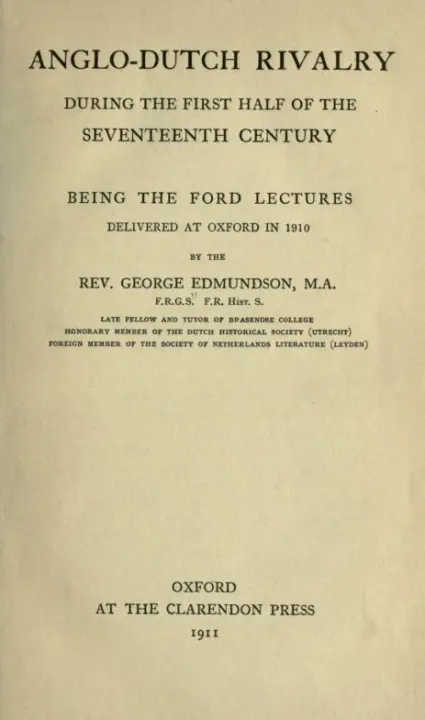
Anglo-Dutch Rivalry During the First Half of the Seventeenth Century being the Ford lectures delivered at Oxford in 1910
George Edmundson
THE CLASSIC COLLECTION · 1922
"History of Holland" by George Edmundson is a historical account likely written in the early 20th century. The book explores the significant events and transformations in the maritime province of Holland, particularly during its War of Independence and the subsequent historical developments of the Dutch state and people. It appears to provide a comprehensive overview of the socio-political landscape of Holland, reflecting on its feudal history and the enduring resilience of its people against various foreign dominations. At the start of "History of Holland," Edmundson outlines the context for the historical narrative, detailing the unique geographic characteristics of the region and their influence on the character of the Dutch people. He introduces key historical figures, including the Counts of Holland and the prominent role that the province played during the Burgundian period and beyond. The narrative establishes a foundation for understanding the complexities of Holland's governance, the emergence of factional conflicts like those between the Hooks and the Cods, and the impactful dynastic competitions that shaped its historical trajectory. The beginning not only sets the stage for a detailed exploration of Holland's history but also highlights the social and economic dynamics that contributed to its eventual independence and national identity.
Introduction adapted from the source catalogue; source summaries may be automatically generated.
Free to read · English · 179,579 words · No account needed
MAKE TIME FOR A GOOD BOOK
On by default. Untick to stop anonymous reading totals. Each page counts after 10 seconds in view. How this works.
Anonymous counting is on unless you have switched it off.
In the time of Charles the trade and industries of the Netherlands were in a highly prosperous state. The Burgundian provinces under the wise administrations of Margaret and Mary, and protected by the strong arm of the emperor from foreign attack, were at this period by far the richest state in Europe and the financial mainstay of the Habsburg power. Bruges, however, had now ceased to be the central market and exchange of Europe, owing to the silting up of the river Zwijn. It was no longer a port, and its place had been taken by Antwerp. At the close of the reign of Charles, Antwerp, with its magnificent harbour on the Scheldt, had become the "counting-house" of the nations, the greatest port and the wealthiest and most luxurious city in the world. Agents of the principal bankers and merchants of every country had their offices within its walls. It has been estimated that, inclusive of the many foreigners who made the town their temporary abode, the population of Antwerp in 1560 was about 150,000. Five hundred vessels sailed in and out of her harbour daily, and five times that number were to be seen thronging her wharves at the same time.
To the north of the Scheldt the condition of things was not less satisfactory than in the south, particularly in Holland. The commercial prosperity of Holland was in most respects different in kind from that of Flanders and Brabant, and during the period with which we are dealing had been making rapid advances, but on independent lines. A manufactory of the coarser kinds of cloth, established at Leyden, had indeed for a time met with a considerable measure of success, but had fallen into decline in the time of Mary of Hungary. The nature of his country led the Hollander to be either a sailor or a dairy-farmer, not an artisan or operative. Akin though he was in race to the Fleming and the Brabanter, his instincts led him by the force of circumstances to turn his energies in other directions. Subsequent history has but emphasised the fact--which from the fourteenth century onwards is clearly evident--that the people who inhabited the low-lying sea-girt lands of dyke, canal and polder in Holland and Zeeland were distinct in character and temper from the citizens of Bruges, Ghent, Ypres, Brussels or Mechlin, who were essentially landsmen and artisans. Ever since the discovery of the art of curing herrings (ascribed to William Beukelsz), the herring fishery had acquired a great importance to the Hollanders and Zeelanders, and formed the chief livelihood of a large part of the entire population of those provinces; and many thousands, who did not themselves sail in the fishing fleets, found employment in the ship and boat-building wharves and in the making of sails, cordage, nets and other tackle. It was in this hazardous occupation that the hardy race of skilled and seasoned seamen, who were destined to play so decisive a part in the coming wars of independence, had their early training. The herring harvest, through the careful and scientific methods that were employed in curing the fish and packing them in barrels, became a durable and much sought for article of commerce. A small portion of the catch served as a supply of food for home consumption, the great bulk in its thousands of barrels was a marketable commodity, and the distribution of the cured herring to distant ports became a lucrative business. It had two important consequences, the formation of a Dutch Mercantile Marine, and the growth of Amsterdam, which from small beginnings had in the middle of the sixteenth century become a town with 40,000 inhabitants and a port second only in importance in the Netherlands to Antwerp. From its harbour at the confluence of the estuary of the Y with the Zuyder Zee ships owned and manned by Hollanders sailed along the coasts of France and Spain to bring home the salt for curing purposes and with it wines and other southern products, while year by year a still larger and increasing number entered the Baltic. In those eastern waters they competed with the German Hanseatic cities, with whom they had many acrimonious disputes, and with such success that the Hollanders gradually monopolised the traffic in grain, hemp and other "Eastland" commodities and became practically the freight-carriers of the Baltic. And be it remembered that they were able to achieve this because many of the North-Netherland towns were themselves members of the Hanse League, and possessed therefore the same rights and privileges commercially as their rivals, Hamburg, Lübeck or Danzig. The great industrial cities of Flanders and Brabant, on the other hand, not being members of the League nor having any mercantile marine of their own, were content to transact business with the foreign agents of the Hanse towns, who had their counting-houses at Antwerp. It will thus be seen that in the middle of the sixteenth century the trade of the northern provinces, though as yet not to be compared in volume to that of the Flemings and Walloons, had before it an opening field for enterprise and energy rich in possibilities and promise for the future.
Your reading position is saved on this browser. Take it to another device with a library code. Reading pages adapt to text, rather than matching a printed edition.
BEHIND THE BOOK
This eBook is for the use of anyone anywhere in the United States and most other parts of the world at no cost and with almost no restrictions whatsoever. You may copy it, give it away or re-use it under the terms of the Project Gutenberg License included with this eBook or online at www.gutenberg.org. If you are not located in the United States, you will have to check the laws of the country where you are located before using this eBook. Read the source licence.
The original source file, including credits and licence, is retained by this library. Request an original-format copy at no charge. Please include the book title and Project Gutenberg identifier #14971.
KEEP YOUR CURIOSITY GOING
Cécile Tormay

Moritz Busch
John L. Ransom
Frances Wright
Cécile Tormay

Mabel Potter Daggett