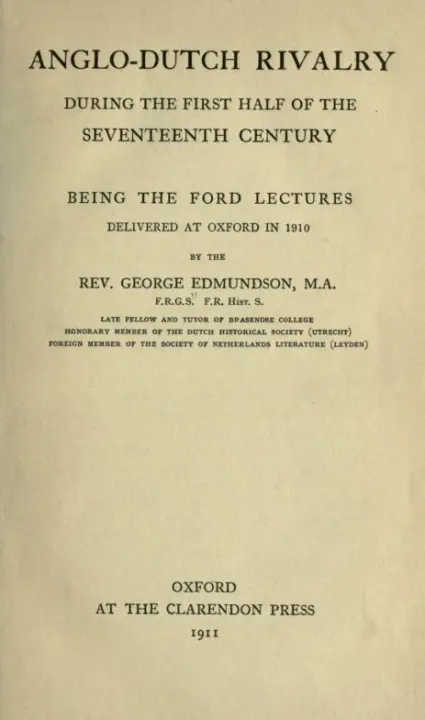
Anglo-Dutch Rivalry During the First Half of the Seventeenth Century being the Ford lectures delivered at Oxford in 1910
George Edmundson
THE CLASSIC COLLECTION · 1922
"History of Holland" by George Edmundson is a historical account likely written in the early 20th century. The book explores the significant events and transformations in the maritime province of Holland, particularly during its War of Independence and the subsequent historical developments of the Dutch state and people. It appears to provide a comprehensive overview of the socio-political landscape of Holland, reflecting on its feudal history and the enduring resilience of its people against various foreign dominations. At the start of "History of Holland," Edmundson outlines the context for the historical narrative, detailing the unique geographic characteristics of the region and their influence on the character of the Dutch people. He introduces key historical figures, including the Counts of Holland and the prominent role that the province played during the Burgundian period and beyond. The narrative establishes a foundation for understanding the complexities of Holland's governance, the emergence of factional conflicts like those between the Hooks and the Cods, and the impactful dynastic competitions that shaped its historical trajectory. The beginning not only sets the stage for a detailed exploration of Holland's history but also highlights the social and economic dynamics that contributed to its eventual independence and national identity.
Introduction adapted from the source catalogue; source summaries may be automatically generated.
Free to read · English · 179,579 words · No account needed
MAKE TIME FOR A GOOD BOOK
On by default. Untick to stop anonymous reading totals. Each page counts after 10 seconds in view. How this works.
Anonymous counting is on unless you have switched it off.
French naval co-operation against England was also promised; and war was actually declared by Louis XIV in the early spring of 1666. The real cause of this strong action was due to other motives than enmity to England. The death of Philip IV of Spain in September, 1665, had brought nearer the prospect of there being no heir-male to the vast Spanish monarchy. The French Queen, Maria Theresa, was the eldest child of Philip; and, though on her marriage she had renounced her claim to the Spanish throne, it was well known that Louis intended to insist upon her rights, particularly in regard to the Spanish Netherlands. He was afraid that the States, always suspicious of his ambitious projects, might be tempted to come to terms with England on the basis of a defensive alliance against French aggression in Flanders and Brabant, for both powers were averse to seeing Antwerp in French hands. To avert this danger Louis determined to take part in the war on the side of the Dutch. The move however was diplomatic rather than serious, for the French admiral, de Beaufort, never sailed into the North Sea or effected a junction with the Dutch fleet. Nevertheless, as will be seen, his presence in the Atlantic exercised an important effect upon the naval campaign of 1666.
The English fleet was not ready until the beginning of June. The ravages of the plague and financial difficulties had caused delay; and the fleet only numbered about eighty sail, including a squadron which had been recalled from the Mediterranean. The "Generals-at-Sea," as they were called, were Monk and Rupert. They began by committing the great blunder of dividing their force. Rupert was detached with twenty ships to keep watch over de Beaufort, a diversion which had serious consequences for the English. The Dutch fleet, consisting of seventy-two men-of-war with twelve frigates, was the most powerful that the Admiralties had ever sent to sea, not in numbers but in the quality of the ships. De Witt himself had supervised the preparations and had seen that the equipment was complete in every respect. De Ruyter was in supreme command and led the van, Cornelis Evertsen the centre, Cornelis Tromp the rear. On June 11 the English fleet under Monk was sighted between the North Foreland and Dunkirk, and the famous Four Days' Battle was begun. The English had only fifty-four ships, but having the weather gauge Monk attacked Tromp's squadron with his whole force; nor was it till later in the day that De Ruyter and Evertsen were able to come to the relief of their colleague. Night put an end to an indecisive contest, in which both sides lost heavily. The next day Monk renewed the attack, at first with some success; but, De Ruyter having received a reinforcement of sixteen ships, the weight of numbers told and Monk was forced to retreat. On the third morning De Ruyter pursued his advantage, but the English admiral conducted his retirement in a most masterly manner, his rear squadron covering the main body and fighting stubbornly. Several ships, however, including the flag-ship of Vice-Admiral Ayscue, had to be abandoned and were either destroyed or captured by the Dutch. At the end of the day Monk had only twenty-eight ships left fit for service. Very opportunely he was now rejoined by Rupert's squadron and other reinforcements; and on the fourth morning the two fleets confronted one another in almost equal numbers, each having some sixty vessels. Once more therefore the desperate struggle was resumed and with initial advantage to the English. Rupert forced his way through the Dutch fleet, which was for awhile divided. But the English habit of firing at the hulls, though it did most damage, was not so effective as the Dutch system of aiming at the masts and rigging in crippling the freedom of tacking and manoeuvring; and Monk and Rupert were unable to prevent De Ruyter from re-uniting his whole force, and bearing down with it upon the enemy. The English were forced to retreat again, leaving several of their "lamed" vessels behind. They lost in all ten ships besides fireships, something like 3000 killed and wounded and 2500 prisoners. Vice-Admiral Berkeley was killed, Vice-Admiral Ayscue taken prisoner. Nor were the Dutch much better off. Four or five of their ships were sunk, a number severely damaged, and their casualty list was probably as large as that of their foes. Nevertheless the victory was undoubtedly theirs; and the fleet on its return was greeted with public rejoicings in Holland and Zeeland. The triumph was of short duration.
Your reading position is saved on this browser. Take it to another device with a library code. Reading pages adapt to text, rather than matching a printed edition.
BEHIND THE BOOK
This eBook is for the use of anyone anywhere in the United States and most other parts of the world at no cost and with almost no restrictions whatsoever. You may copy it, give it away or re-use it under the terms of the Project Gutenberg License included with this eBook or online at www.gutenberg.org. If you are not located in the United States, you will have to check the laws of the country where you are located before using this eBook. Read the source licence.
The original source file, including credits and licence, is retained by this library. Request an original-format copy at no charge. Please include the book title and Project Gutenberg identifier #14971.
KEEP YOUR CURIOSITY GOING
Cécile Tormay

Moritz Busch
John L. Ransom
Frances Wright
Cécile Tormay

Mabel Potter Daggett