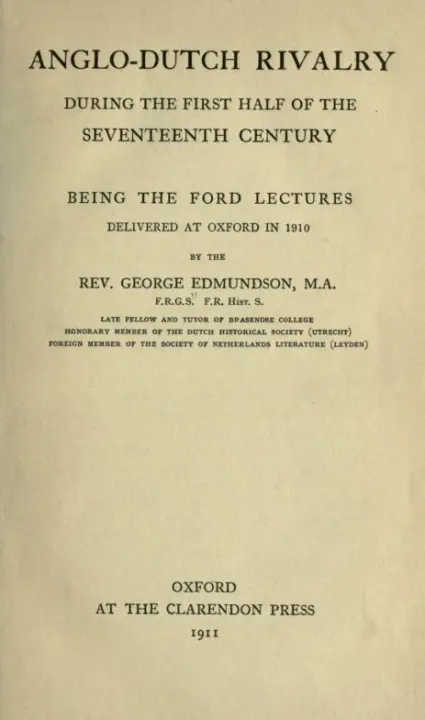
Anglo-Dutch Rivalry During the First Half of the Seventeenth Century being the Ford lectures delivered at Oxford in 1910
George Edmundson
THE CLASSIC COLLECTION · 1922
"History of Holland" by George Edmundson is a historical account likely written in the early 20th century. The book explores the significant events and transformations in the maritime province of Holland, particularly during its War of Independence and the subsequent historical developments of the Dutch state and people. It appears to provide a comprehensive overview of the socio-political landscape of Holland, reflecting on its feudal history and the enduring resilience of its people against various foreign dominations. At the start of "History of Holland," Edmundson outlines the context for the historical narrative, detailing the unique geographic characteristics of the region and their influence on the character of the Dutch people. He introduces key historical figures, including the Counts of Holland and the prominent role that the province played during the Burgundian period and beyond. The narrative establishes a foundation for understanding the complexities of Holland's governance, the emergence of factional conflicts like those between the Hooks and the Cods, and the impactful dynastic competitions that shaped its historical trajectory. The beginning not only sets the stage for a detailed exploration of Holland's history but also highlights the social and economic dynamics that contributed to its eventual independence and national identity.
Introduction adapted from the source catalogue; source summaries may be automatically generated.
Free to read · English · 179,579 words · No account needed
MAKE TIME FOR A GOOD BOOK
On by default. Untick to stop anonymous reading totals. Each page counts after 10 seconds in view. How this works.
Anonymous counting is on unless you have switched it off.
It remains to speak of the man who may truly be described as the central figure among his literary contemporaries. Pieter Cornelisz Hooft (1583-1647) was indisputably the first man of letters of his time. He sprang from one of the first families of the burgher-aristocracy of Amsterdam, in which city his father, Cornelis Pietersz Hooft, filled the office of burgomaster no less than thirteen times. He began even as a boy to write poetry, and his strong bent to literature was deepened by a prolonged tour of more than three years in France, Germany and Italy, almost two years of which were spent at Florence and Venice. After his return he studied jurisprudence at Leyden, but when he was only twenty-six years old he received an appointment which was to mould and fix the whole of his future career. In 1609 Prince Maurice, in recognition of his father's great services, nominated Hooft to the coveted post of Drost, or Governor, of Muiden and bailiff of Gooiland. This post involved magisterial and administrative duties of a by-no-means onerous kind; and the official residence of the Drost, the "High House of Muiden," an embattled feudal castle with pleasant gardens, lying at the point where at no great distance from Amsterdam the river Vecht sleepily empties itself into the Zuyder Zee, became henceforth for thirty years a veritable home of letters.
Hooft's literary life may be divided into two portions. In the decade after his settlement at Muiden, he was known as a dramatist and a writer of pretty love songs. His dramas--Geerard van Velzen, Warenar and Baeto--caught the popular taste and were frequently acted, but are not of high merit. His songs and sonnets are distinguished for their musical rhythm and airy lightness of touch, but they were mostly penned, as he himself tells us, for his own pleasure and that of his friends, not for general publication. There are, nevertheless, charming pieces in the collected edition of Hooft's poems, and he was certainly an adept in the technicalities of metrical craft. But Hooft himself was ambitious of being remembered by posterity as a national historian. He aimed at giving such a narrative of the struggle against Spain as would entitle him to the name of "the Tacitus of the Netherlands." He wished to produce no mere chronicle like those of Bor or Van Meteren, but a literary history in the Dutch tongue, whose style should be modelled on that of the great Roman writer, whose works Hooft is said to have read through fifty-two times. He first, to try his hand, wrote a life of Henry IV of France, which attained great success. Louis XIII was so pleased with it that he sent the author a gold chain and made him a Knight of St Michael. Thus encouraged, on August 19, 1628, Hooft began his Netherland Histories, and from this date until his death in 1647 he worked ceaselessly at the magnum opus, which, beginning with the abdication of Charles V, he intended to carry on until the conclusion of the Twelve Years' Truce. He did not live to bring the narrative further than the end of the Leicester régime. In a small tower in the orchard at Muiden he kept his papers; and here, undisturbed, he spent all his leisure hours for nineteen years engaged on the great task, on which he concentrated all his energies. He himself tells us of the enormous pains that he took to get full and accurate information, collecting records, consulting archives and submitting every portion as it was written to the criticism of living authorities, more especially to Constantine Huyghens and through him to the Prince of Orange himself. Above all Hooft strove, to use his own words, "never to conceal the truth, even were it to the injury of the fatherland"; and the carrying-out of this principle has given to the great prose-epic that he wrote a permanent value apart altogether from its merits as a remarkable literary achievement. And yet perhaps the most valuable legacy that Hooft has left to posterity is his collection of letters. Of these a recent writer[7] has declared "that, though it could not be asserted that they [Hooft's letters] threw into the shade the whole of the rest of Netherland literature, still the assertion would not be far beyond the mark." They deal with every variety of subject, grave and gay; and they give us an insight into the literary, social and domestic life of the Holland of his time, which is of more value than any history.
Your reading position is saved on this browser. Take it to another device with a library code. Reading pages adapt to text, rather than matching a printed edition.
BEHIND THE BOOK
This eBook is for the use of anyone anywhere in the United States and most other parts of the world at no cost and with almost no restrictions whatsoever. You may copy it, give it away or re-use it under the terms of the Project Gutenberg License included with this eBook or online at www.gutenberg.org. If you are not located in the United States, you will have to check the laws of the country where you are located before using this eBook. Read the source licence.
The original source file, including credits and licence, is retained by this library. Request an original-format copy at no charge. Please include the book title and Project Gutenberg identifier #14971.
KEEP YOUR CURIOSITY GOING
Cécile Tormay

Moritz Busch
John L. Ransom
Frances Wright
Cécile Tormay

Mabel Potter Daggett