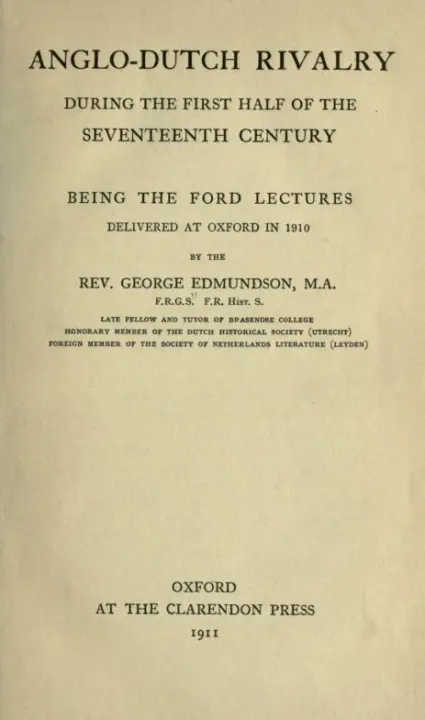
Anglo-Dutch Rivalry During the First Half of the Seventeenth Century being the Ford lectures delivered at Oxford in 1910
George Edmundson
THE CLASSIC COLLECTION · 1922
"History of Holland" by George Edmundson is a historical account likely written in the early 20th century. The book explores the significant events and transformations in the maritime province of Holland, particularly during its War of Independence and the subsequent historical developments of the Dutch state and people. It appears to provide a comprehensive overview of the socio-political landscape of Holland, reflecting on its feudal history and the enduring resilience of its people against various foreign dominations. At the start of "History of Holland," Edmundson outlines the context for the historical narrative, detailing the unique geographic characteristics of the region and their influence on the character of the Dutch people. He introduces key historical figures, including the Counts of Holland and the prominent role that the province played during the Burgundian period and beyond. The narrative establishes a foundation for understanding the complexities of Holland's governance, the emergence of factional conflicts like those between the Hooks and the Cods, and the impactful dynastic competitions that shaped its historical trajectory. The beginning not only sets the stage for a detailed exploration of Holland's history but also highlights the social and economic dynamics that contributed to its eventual independence and national identity.
Introduction adapted from the source catalogue; source summaries may be automatically generated.
Free to read · English · 179,579 words · No account needed
MAKE TIME FOR A GOOD BOOK
On by default. Untick to stop anonymous reading totals. Each page counts after 10 seconds in view. How this works.
Anonymous counting is on unless you have switched it off.
The Malay Archipelago was the chief scene of early activity, and more especially the Moluccas. Treaties were made with the native chiefs; and factories defended by forts were established at Tidor, Ternate, Amboina, Banda and other places. The victories of Cornelis Matelief established that supremacy of the Dutch arms in these eastern waters which they were to maintain for many years. With the conclusion of the truce the necessity of placing the general control of so many scattered forts and trading posts in the hands of one supreme official led, in 1609, to the appointment of a governor-general by the Seventeen with the assent of the States-General. The governor-general held office for five years, and he was assisted by a council, the first member of which, under the title of director-general, was in reality minister of commerce. Under him were at first seven (afterwards eight) local governors. These functionaries, though exercising considerable powers in their respective districts, were in all matters of high policy entirely subordinate to the governor-general. The first holders of the office were all men who had risen to that position by proving themselves to possess energy and enterprise, and being compelled by the distance from home to act promptly on their own initiative, were practically endowed with autocratic authority. In consequence of this the Dutch empire in the East became in their hands rapidly extended and consolidated, to the exclusion of all competitors. This meant not only that the Portuguese and Spaniards were ousted from their formerly dominant position in the Orient, but that a collision with the English was inevitable.
The first governor-general, Pieter Both, had made Java the centre of administration and had established factories and posts at Bantam, Jacatra and Djapara, not without arousing considerable hostility among the local rulers, jealous of the presence of the intruders. This hostility was fostered and encouraged by the English, whose vessels had also visited Java and had erected a trading-post close to that of the Dutch at Jacatra. Already the spice islands had been the scene of hostile encounters between the representatives of the two nations, and had led to many altercations. This was the state of things when Jan Pieterzoon Koen became governor-general in 1615. This determined man, whose experience in the East Indies was of long date, and who had already served as director-general, came into his new office with an intense prejudice against the English, and with a firm resolve to put an end to what he described as their treachery and intrigues. "Were they masters," he wrote home, "the Dutch would quickly be out of the Indies, but praise be to the Lord, who has provided otherwise. They are an unendurable nation." With this object he strongly fortified the factory near Jacatra, thereby arousing the hostility of the Pangeran, as the native ruler was styled. The English in their neighbouring post also began to erect defences and to encourage the Pangeran in his hostile attitude. Koen thereupon fell upon the English and destroyed and burnt their factory, and finding that there was a strong English fleet under Sir Thomas Dale in the neighbourhood, he sailed to the Moluccas in search of reinforcements, leaving Pieter van der Broeck in command at the factory. The Pangeran now feigned friendship, and having enticed Broeck to a conference, made him prisoner and attacked the Dutch stronghold. The garrison however held out until the governor-general returned with a strong force. With this he stormed and destroyed the town of Jacatra and on its site erected a new town, as the seat of the company's government, to which the name Batavia was given. From this time the Dutch had no rivalry to fear in Java. The conquest of the whole island was only a question of time, and the "pearl of the Malay Archipelago" has from 1620 to the present been the richest and most valuable of all the Dutch colonial possessions. Koen was planning to follow up his success by driving the English likewise from the Moluccas, when he heard that the home government had concluded a treaty which tied his hands.
Your reading position is saved on this browser. Take it to another device with a library code. Reading pages adapt to text, rather than matching a printed edition.
BEHIND THE BOOK
This eBook is for the use of anyone anywhere in the United States and most other parts of the world at no cost and with almost no restrictions whatsoever. You may copy it, give it away or re-use it under the terms of the Project Gutenberg License included with this eBook or online at www.gutenberg.org. If you are not located in the United States, you will have to check the laws of the country where you are located before using this eBook. Read the source licence.
The original source file, including credits and licence, is retained by this library. Request an original-format copy at no charge. Please include the book title and Project Gutenberg identifier #14971.
KEEP YOUR CURIOSITY GOING
Cécile Tormay

Moritz Busch
John L. Ransom
Frances Wright
Cécile Tormay

Mabel Potter Daggett