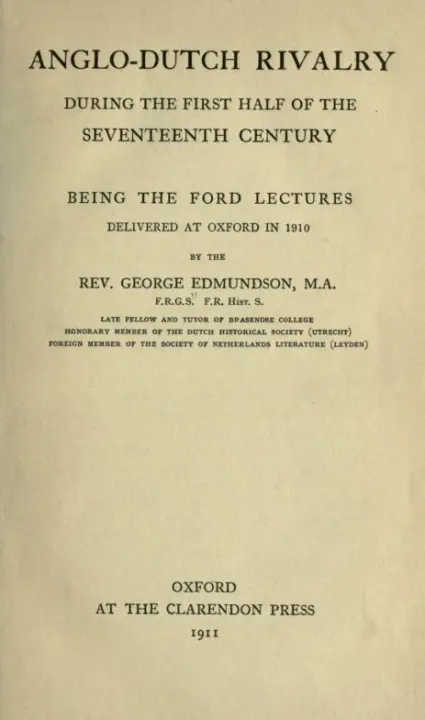
Anglo-Dutch Rivalry During the First Half of the Seventeenth Century being the Ford lectures delivered at Oxford in 1910
George Edmundson
THE CLASSIC COLLECTION · 1922
"History of Holland" by George Edmundson is a historical account likely written in the early 20th century. The book explores the significant events and transformations in the maritime province of Holland, particularly during its War of Independence and the subsequent historical developments of the Dutch state and people. It appears to provide a comprehensive overview of the socio-political landscape of Holland, reflecting on its feudal history and the enduring resilience of its people against various foreign dominations. At the start of "History of Holland," Edmundson outlines the context for the historical narrative, detailing the unique geographic characteristics of the region and their influence on the character of the Dutch people. He introduces key historical figures, including the Counts of Holland and the prominent role that the province played during the Burgundian period and beyond. The narrative establishes a foundation for understanding the complexities of Holland's governance, the emergence of factional conflicts like those between the Hooks and the Cods, and the impactful dynastic competitions that shaped its historical trajectory. The beginning not only sets the stage for a detailed exploration of Holland's history but also highlights the social and economic dynamics that contributed to its eventual independence and national identity.
Introduction adapted from the source catalogue; source summaries may be automatically generated.
Free to read · English · 179,579 words · No account needed
MAKE TIME FOR A GOOD BOOK
On by default. Untick to stop anonymous reading totals. Each page counts after 10 seconds in view. How this works.
Anonymous counting is on unless you have switched it off.
An expedition planned for the capture of Dunkirk at this time, spring 1631, proved too hazardous and was abandoned, but later in the year the Dutch sailors gave a signal proof of their superiority at sea. Encouraged by the failure of the attempted attack on Dunkirk the government at Brussels determined on a counter-stroke. A flotilla of 35 frigates, accompanied by a large number of smaller vessels to carry supplies and munitions and having on board a body of 6000 soldiers, set sail from Antwerp under the command of Count John of Nassau (a cousin of the stadholder) and in the presence of Isabel herself to effect the conquest of some of the Zeeland islands. As soon as the news reached Frederick Henry, detachments of troops were at once despatched to various points; and about a dozen vessels were rapidly equipped and ordered to follow the enemy and if possible bring him to action. A landing at Terscholen was foiled by Colonel Morgan, who, at the head of 2000 English troops, waded across a shallow estuary in time to prevent a descent. At last (September 12) the Dutch ships managed to come up with their adversaries in the Slaak near the island of Tholen. They at once attacked and though so inferior in numbers gained a complete victory. Count John of Nassau just contrived to escape, but his fleet was destroyed and 5000 prisoners were taken.
The year 1632 witnessed a renewal of military activity and was memorable for the famous siege and capture of Maestricht. This fortress held the same commanding position on the eastern frontier as Hertogenbosch on the southern; and, though its natural position was not so strong as the capital of North Brabant, Maestricht, lying as it did on both sides of the broad Meuse, and being strongly fortified and garrisoned, was very difficult to invest. The stadholder, at the head of a force of 17,000 infantry and 4000 horse, first made himself master of Venloo and Roeremonde and then advanced upon Maestricht. Unfortunately before Roeremonde, Ernest Casimir, the brave stadholder of Friesland and Groningen, was killed. He was succeeded in his offices by his son, Henry Casimir. Arriving (June 10) before Maestricht, Frederick Henry proceeded to erect strongly entrenched lines of circumvallation round the town connecting them above and below the town by bridges. Supplies reached him plentifully by the river. To the English and French regiments were once more assigned the place of honour in the attack. All went well until July 2, when Don Gonzales de Cordova led a superior Spanish force from Germany, consisting of 18,000 foot and 6000 horse, to raise the siege, and encamped close to the Dutch lines on the south side of the river. Finding however no vulnerable spot, he awaited the arrival at the beginning of August of an Imperialist army of 12,000 foot and 4000 horse, under the renowned Pappenheim. This impetuous leader determined upon an assault, and the Dutch entrenchments were attacked suddenly with great vigour at a moment when the prince was laid up with the gout. He rose, however, from his bed, personally visited all the points of danger, and after desperate fighting the assailants were at last driven off with heavy loss. The Spaniards and Imperialists, finding that the stadholder's lines could not be forced, instituted a blockade, so that the besiegers were themselves besieged. But Frederick Henry had laid up such ample stores of munitions and provisions that he paid no heed to the cutting of his communications, and pushed on his approaches with the utmost rapidity. All difficulties were overcome by the engineering skill of the scientific commander; and finally two tunnels sixty feet deep were driven under the broad dry moat before the town walls. The English regiments during these operations bore the brunt of the fighting and lost heavily, Colonels Harwood and the Earl of Oxford being killed and Colonel Morgan dangerously wounded. After exploding a mine, a forlorn hope of fifty English troops rushed out from one of the tunnels and made good their footing upon the ramparts. Others followed, and the garrison, fearing that further resistance might entail the sacking of the town, surrendered (August 23) with honours of war.
Your reading position is saved on this browser. Take it to another device with a library code. Reading pages adapt to text, rather than matching a printed edition.
BEHIND THE BOOK
This eBook is for the use of anyone anywhere in the United States and most other parts of the world at no cost and with almost no restrictions whatsoever. You may copy it, give it away or re-use it under the terms of the Project Gutenberg License included with this eBook or online at www.gutenberg.org. If you are not located in the United States, you will have to check the laws of the country where you are located before using this eBook. Read the source licence.
The original source file, including credits and licence, is retained by this library. Request an original-format copy at no charge. Please include the book title and Project Gutenberg identifier #14971.
KEEP YOUR CURIOSITY GOING
Cécile Tormay

Moritz Busch
John L. Ransom
Frances Wright
Cécile Tormay

Mabel Potter Daggett