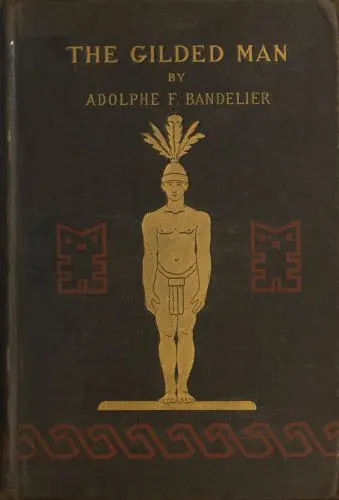
The Gilded Man (El Dorado) and other pictures of the Spanish occupancy of America
Adolph Francis Alphonse Bandelier
THE CLASSIC COLLECTION · 1881
"Historical Introduction to Studies Among the Sedentary Indians of New Mexico" by Ad. F. Bandelier is a scholarly historical account written in the late 19th century. The work delves into the early interactions and understandings of European explorers with the sedentary Native American tribes in New Mexico and Arizona. Bandelier focuses on various legends and historical narratives, examining their implications for interpreting the culture and societal structures of the indigenous peoples. The opening portion establishes the historical context by discussing the earliest knowledge of sedentary Indians as transmitted through Mexican narratives, particularly the tales of "Seven Cities" and the "Seven Caves.” Bandelier explores the influential roles these legends had in shaping European perceptions of the region, providing insights into the migration and cultural significance of the tribes. He references notable figures like Fray Marcos de Nizza and Coronado, situating their expeditions within the broader historical landscape while emphasizing the importance of understanding these narratives for studying indigenous ethnography and culture.
Introduction adapted from the source catalogue; source summaries may be automatically generated.
Free to read · English · 44,605 words · No account needed
MAKE TIME FOR A GOOD BOOK
On by default. Untick to stop anonymous reading totals. Each page counts after 10 seconds in view. How this works.
Anonymous counting is on unless you have switched it off.
[16] He was a native of Savoy, Italy, and was with Sebastian de Belalcazar during the latter's conquest of Quito. Juan de Velasco, Histoire du royaume de Quito, French translation by Ternaux-Compans, Introd. p. viii. He wrote the following books: Conquista de la Provincia del Quito: Ritos y Ceremonias de los Indios; Las dos Lineas de los Incas y de los Scyris en las Provincias del Peru y del Quito; Cartas Informativas de lo Obrado en las Provincias del Peru y del Cuzco. These manuscripts may still exist. According to Fray Augustin de Vetancurt (Menologio Franciscano, ed. of 1871, pp. 117, 118, 119), he was born at Nizza, and in 1531 came to America, being in Peru in 1532. Thence he went to Nicaragua and Mexico. He was provincial from 1540 to 1543, and died at Mexico, March 25, 1558.
[17] Fray Marcos Nizza, Descubrimiento de las Siete Ciudades, p. 329.
[18] Nizza, p. 332. Herrera, dec. vi. lib. vii. cap. vii. p. 156.
[19] In Documentos para la Historia de Mejico, 1856, 4 serie, vol. i. p. 327. The diary has not even a title. Mentioned by Father Jacob Sedelmair, S. J., Relacion que hizo ... Misionero de Tubatama, in Documentos para la Historia de Mejico, 3a serie, vol. ii. pp. 846, 848, 857, 859.
[20] On the map of Father Eusebio Francisco Kino, in Der neue Weltbott, by P. Joseph Stoecklein, vol. i. 2d edition, 1728, there appears St. Ludov. de Bacapa. The diary of Mange, p. 327, is explicit.
[21] Manuel Orozco y Berra, Geografia de las Lenguas y Carta Etnografica de Mexico, part iii. cap. xxiii. pp. 345-353, etc. Francisco Pimentel, Cuadro Descriptivo y Comparativo de las Lenguas Indigenas de Mexico, 1865, vol. ii. pp. 91, 92-116.
[22] The fact that he became the guide of Coronado, and led him to Cibola, indicates that Fray Marcos crossed the Gila, since otherwise the Spaniards would have traversed the Sierra Madre, and entered New Mexico from Chihuahua. It is true that the general direction of Coronado's march from Culiacan was from south to north, inclining to the east.
[23] The attest of D. Antonio de Mendoza, concerning Nizza's report, bears the date, Mexico, 2 Sept., 1539. Consequently, Fray Marcos had returned previously. See Relation du Voyage de Cibola, Ternaux-Compans, Appendix, p. 282.
[24] This word is said to be now found only in the dialect of the pueblo of Isleta, south of Santa Fe, under the form sibuloda, buffalo. Albert S. Gatschet, Zwoelf Sprachen aus dem Suedwesten Nord Amerika's, Weimar, 1876, p. 106.
[25] Herrera, Descripcion de las Indias, cap. ix. p. 17, says that Mexico has 4,000 vecinos. This was in 1610, about.
[26] Lewis H. Morgan, On the Ruins of a Stone Pueblo on the Animas River, in 12th Annual Report of the Peabody Museum of American Archaeology, etc., 1880, p. 550.
[27] The Spanish Conquest of New Mexico, Doylestown, Pa., 1869.
Your reading position is saved on this browser. Take it to another device with a library code. Reading pages adapt to text, rather than matching a printed edition.
Adolph Francis Alphonse Bandelier
Adolph Francis Alphonse Bandelier
Adolph Francis Alphonse Bandelier
Adolph Francis Alphonse Bandelier
BEHIND THE BOOK
This eBook is for the use of anyone anywhere in the United States and most other parts of the world at no cost and with almost no restrictions whatsoever. You may copy it, give it away or re-use it under the terms of the Project Gutenberg License included with this eBook or online at www.gutenberg.org. If you are not located in the United States, you will have to check the laws of the country where you are located before using this eBook. Read the source licence.
The original source file, including credits and licence, is retained by this library. Request an original-format copy at no charge. Please include the book title and Project Gutenberg identifier #23224.
KEEP YOUR CURIOSITY GOING
Cécile Tormay

Moritz Busch
John L. Ransom
Frances Wright
Cécile Tormay

Mabel Potter Daggett