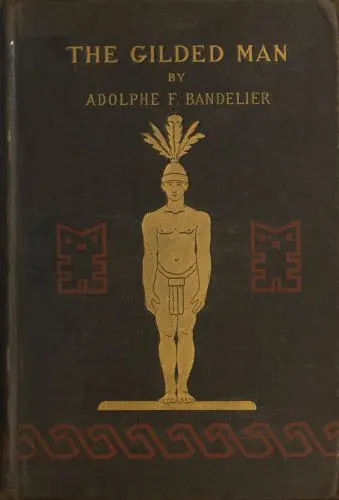
The Gilded Man (El Dorado) and other pictures of the Spanish occupancy of America
Adolph Francis Alphonse Bandelier
THE CLASSIC COLLECTION · 1881
"Historical Introduction to Studies Among the Sedentary Indians of New Mexico" by Ad. F. Bandelier is a scholarly historical account written in the late 19th century. The work delves into the early interactions and understandings of European explorers with the sedentary Native American tribes in New Mexico and Arizona. Bandelier focuses on various legends and historical narratives, examining their implications for interpreting the culture and societal structures of the indigenous peoples. The opening portion establishes the historical context by discussing the earliest knowledge of sedentary Indians as transmitted through Mexican narratives, particularly the tales of "Seven Cities" and the "Seven Caves.” Bandelier explores the influential roles these legends had in shaping European perceptions of the region, providing insights into the migration and cultural significance of the tribes. He references notable figures like Fray Marcos de Nizza and Coronado, situating their expeditions within the broader historical landscape while emphasizing the importance of understanding these narratives for studying indigenous ethnography and culture.
Introduction adapted from the source catalogue; source summaries may be automatically generated.
Free to read · English · 44,605 words · No account needed
MAKE TIME FOR A GOOD BOOK
On by default. Untick to stop anonymous reading totals. Each page counts after 10 seconds in view. How this works.
Anonymous counting is on unless you have switched it off.
The natives of Mexico appear to have had no knowledge, nay, not even the most dim recollection, of the fauna of South-western North America. While their so-called calendar, in the graphic tokens used to designate each one of the twenty days of their conventional "month," contains the forms of all the larger quadrupeds roaming over Mexico and Central America, the tapir excepted, we look in vain for the coyote, the bear, the mountain-sheep, and the buffalo.
[6] Popol Vuh, part iii. cap. iv. p. 216, cap. vi. pp. 226, 228, cap.
viii. p. 238, etc.
[7] Hernando Cortes, Carta Quarta, dated Temixtitan, 15 October, 1524, Vedia i. p. 102. Gonzalo Fernandez de Oviedo y Valdes, Historia General y Natural de las Indias, lib. xxxiii. cap. xxxvi. vol. iii. p. 447, lib. xxxiv. cap. viii. p. 576, Madrid, 1853. The information was derived from Gonzalo de Sandoval. See Antonio de Herrera, Historia General de los Hechos de los Castellanos en las Islas y Tierra Firme del Mar Oceano, dec. iii. lib. iii. cap. xvii. p. 106, edition of 1726.
[8] Relacion de las Ceremonias y Ritos, Poblacion y Gobierno de los Indios de la Provincia de Mechuacan, p. 113, from the Coleccion de Documentos para la Historia de la Espana. Tercera Relacion Anonima de la Jornada de Nuno de Guzman, Coleccion de Documentos, Icazbalceta, ii. pp. 443, 449, 451. Matias de la Mota Padilla, Historia de la Nueva-Galicia, published 1870, cap. iii. p. 27. Oviedo, lib. vi. cap. xxxiii. vol. i. pp. 222, 223.
[9] Quarta Relacion Anonima de la Jornada de Nuno de Guzman, Coleccion de Documentos, Icazbalceta, ii. p. 475. Oviedo, lib. vi. cap. xxxiii. vol. i. p. 223.
[10] In 1527, Herrera, dec. iv. lib. ii. cap. iv. pp. 26, 27.
[11] He was treasurer of Narvaez' expedition, and subsequently, upon his return, or rather in 1541, became adelantado of Paraguay.
[12] He wrote all from memory. The title of his work is Naufragios de Alvar Nunez Cabeza de Vaca, y Relacion de la Jornada que hizo a la Florida. It was first printed in 1555, at Valladolid. My references are to the reprint in Vedia's Historiadores Primitivos de Indias, vol. i.
[13] Cabeza de Vaca, Naufragios, etc., cap. xxxvii. p. 548, xxxiv. p. 545. According to Herrera, dec. vi. lib. i. cap. vii. p. 11 and cap. viii. p. 11, it might be either 1536 or 1534, "el ano pasado de 1534." Oviedo, lib. xxxv. cap. vi. p. 614, intimates as much as 1538. Fray Antonio Tello, Historia de la Nueva-Galicia, fragment preserved in Coleccion de Documentos, Icazbalceta, ii. cap. xii. p. 358, says "habian llegado ese ano de treinta y tres a aquellas tierras," 1533.
[14] Cabeza de Vaca, cap. xxxi. pp. 542, 543.
[15] Id., p. 543.
Your reading position is saved on this browser. Take it to another device with a library code. Reading pages adapt to text, rather than matching a printed edition.
Adolph Francis Alphonse Bandelier
Adolph Francis Alphonse Bandelier
Adolph Francis Alphonse Bandelier
Adolph Francis Alphonse Bandelier
BEHIND THE BOOK
This eBook is for the use of anyone anywhere in the United States and most other parts of the world at no cost and with almost no restrictions whatsoever. You may copy it, give it away or re-use it under the terms of the Project Gutenberg License included with this eBook or online at www.gutenberg.org. If you are not located in the United States, you will have to check the laws of the country where you are located before using this eBook. Read the source licence.
The original source file, including credits and licence, is retained by this library. Request an original-format copy at no charge. Please include the book title and Project Gutenberg identifier #23224.
KEEP YOUR CURIOSITY GOING
Cécile Tormay

Moritz Busch
John L. Ransom
Frances Wright
Cécile Tormay

Mabel Potter Daggett