THE CLASSIC COLLECTION✦Journal of a tour in Marocco and the Great AtlasCLASSIC FREE BOOKS
Journal of a tour in Marocco and the Great Atlas
Joseph Dalton Hooker & John Ball
THE CLASSIC COLLECTION · 1854
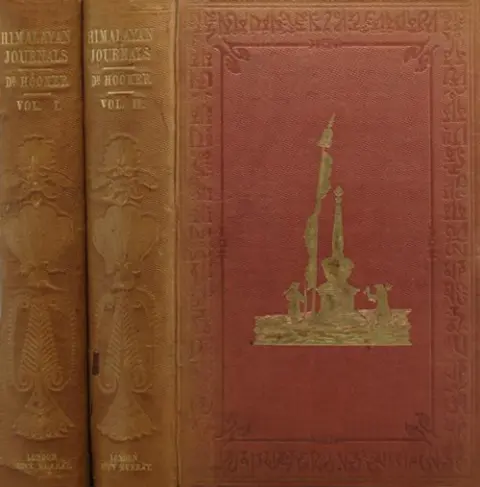
"Himalayan Journals — Volume 1" by Joseph Dalton Hooker is a scientific publication crafted in the mid-19th century. This detailed account highlights Hooker's explorations and observations of the natural history, botany, and geography of regions including Bengal, Sikkim, Nepal, and the eastern Himalayas. The work offers an in-depth perspective on the flora and fauna he encountered and provides insights into the scientific and cultural landscapes of the time. The opening of the book sets the stage for Hooker’s journey, detailing his motivations for exploration, connections with notable scientific figures such as Sir James Colvile and Dr. Falconer, and the logistical preparations for his expedition. Hooker describes his departure from England and arrival in Calcutta, where he prepares for a journey into the less-travelled regions of the Himalayas. With detailed observations of the landscape and vegetation around Sunderbunds and Calcutta Botanic Garden, the narrative reveals his keen scientific focus and the rich biodiversity he aims to study. Elements of his adventure include interactions with various geographical features, native flora, and the social conditions of the regions he traverses, establishing a foundation for the comprehensive natural history studies that follow in subsequent chapters.
Introduction adapted from the source catalogue; source summaries may be automatically generated.
Free to read · English · 123,841 words · No account needed
MAKE TIME FOR A GOOD BOOK
On by default. Untick to stop anonymous reading totals. Each page counts after 10 seconds in view. How this works.
Anonymous counting is on unless you have switched it off.
Leave Bhagulpore -- Kunker -- Colgong -- Himalaya, distant view of -- Cosi, mouth of -- Difficult navigation -- Sand storms -- Caragola-Ghat -- Purnea -- Ortolans -- Mahanuddee, transport of pebbles, etc. -- Betel-pepper, cultivation of -- Titalya -- Siligoree -- View of outer Himalaya -- Terai -- Mechis -- Punkabaree -- Foot of mountains -- Ascent to Dorjiling -- Cicadas -- Leeches -- Animals -- Kursiong, spring vegetation of -- Pacheem -- Arrive at Dorjiling -- Dorjiling, origin and settlement of -- Grant of land from Rajah -- Dr. Campbell appointed superintendent -- Dewan, late and present -- Aggressive conduct of the latter -- Increase of the station -- Trade -- Titalya fair -- Healtby climate for Europeans and children -- Invalids, diseases prejudicial to.
I took as it were, a new departure, on Saturday, April the 8th, my dawk being laid on that day from Caragola-Ghat, about thirty miles down the river, for the foot of the Himalaya range and Dorjiling.
Passing the pretty villa-like houses of the English residents, the river-banks re-assumed their wonted features the hills receded from the shore; and steep clay cliffs, twenty to fifty feet high, on one side, opposed long sandy shelves on the other. Kunker was still most abundant, especially in the lower bed of the banks, close to the (now very low) water. The strata containing it were much undulated, but not uniformly so; horizontal layers over or under-lying the disturbed ones. At Colgong, conical hills appear, and two remarkable sister-rocks start out of the river, the same in structure with those of Sultangunj. A boisterous current swirls round them, strong even at this season, and very dangerous in the rains, when the swollen river is from twenty-eight to forty feet deeper than now. We landed opposite the rocks, and proceeded to the residence of Mr. G. Barnes, prettily situated on one of the conical elevations characteristic of the geology of the district. The village we passed through had been recently destroyed by fire; and nothing but the clay outer walls and curious-looking partition walls remained, often white-washed and daubed with figures in red of the palm of the hand, elephant, peacock, and tiger,--a sort of rude fresco-painting. We did not arrive till past mid-day, and the boat, with my palkee and servant, not having been able to face the gale, I was detained till the middle of the following day. Mr. Barnes and his brother proved most agreeable companions,--very luckily for me, for it requires no ordinary philosophy to bear being storm-stayed on a voyage, with the prospect of paying a heavy demurrage for detaining the dawk, and the worse one of finding the bearers given to another traveller when you arrive at the rendezvous. The view from Mr. Barnes' house is very fine: it commands the river and its rocks; the Rajmahal hills to the east and south; broad acres of indigo and other crops below; long lines of palm-trees, and groves of mango, banana, tamarind, and other tropical trees, scattered close around and in the distance. In the rainy season, and immediately after, the snowy Himalaya are distinctly seen on the horizon, fully 170 miles off. Nearly opposite, the Cosi river enters the Ganges, bearing (considering its short course) an enormous volume of water, comprising the drainage of the whole Himalaya between the two giant peaks of Kinchinjunga in Sikkim, and Gossain-Than in Nepal. Even at this season, looking from Mr. Barnes' eyrie over the bed of the Ganges, the enormous expanses of sand, the numerous shifting islets, and the long spits of mud betray the proximity of some very restless and resistless power. During the rains, the scene must indeed be extraordinary, when the Cosi lays many miles of land under water, and pours so vast a quantity of detritus into the bed of the Ganges that long islets are heaped up and swept away in a few hours; and the latter river becomes all but unnavigable. Boats are caught in whirlpools, formed without a moment's warning, and sunk ere they have spun round thrice in the eddies; and no part of the inland navigation of India is so dreaded or dangerous, as the Ganges at its junction with the Cosi.
Your reading position is saved on this browser. Take it to another device with a library code. Reading pages adapt to text, rather than matching a printed edition.
Joseph Dalton Hooker & John Ball
Joseph Dalton Hooker
Joseph Dalton Hooker
BEHIND THE BOOK
This eBook is for the use of anyone anywhere in the United States and most other parts of the world at no cost and with almost no restrictions whatsoever. You may copy it, give it away or re-use it under the terms of the Project Gutenberg License included with this eBook or online at www.gutenberg.org. If you are not located in the United States, you will have to check the laws of the country where you are located before using this eBook. Read the source licence.
The original source file, including credits and licence, is retained by this library. Request an original-format copy at no charge. Please include the book title and Project Gutenberg identifier #6476.
KEEP YOUR CURIOSITY GOING
Wilfrid Scawen Blunt
Wilfrid Scawen Blunt

E. W. (Edgar Watson) Howe
Cécile Tormay

Moritz Busch
John L. Ransom