THE CLASSIC COLLECTION✦Journal of a tour in Marocco and the Great AtlasCLASSIC FREE BOOKS
Journal of a tour in Marocco and the Great Atlas
Joseph Dalton Hooker & John Ball
THE CLASSIC COLLECTION · 1854
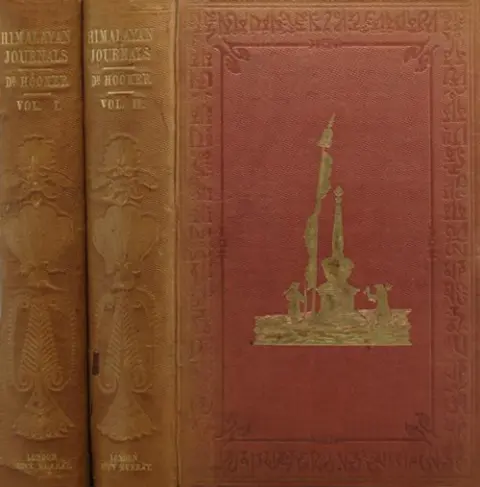
"Himalayan Journals — Volume 1" by Joseph Dalton Hooker is a scientific publication crafted in the mid-19th century. This detailed account highlights Hooker's explorations and observations of the natural history, botany, and geography of regions including Bengal, Sikkim, Nepal, and the eastern Himalayas. The work offers an in-depth perspective on the flora and fauna he encountered and provides insights into the scientific and cultural landscapes of the time. The opening of the book sets the stage for Hooker’s journey, detailing his motivations for exploration, connections with notable scientific figures such as Sir James Colvile and Dr. Falconer, and the logistical preparations for his expedition. Hooker describes his departure from England and arrival in Calcutta, where he prepares for a journey into the less-travelled regions of the Himalayas. With detailed observations of the landscape and vegetation around Sunderbunds and Calcutta Botanic Garden, the narrative reveals his keen scientific focus and the rich biodiversity he aims to study. Elements of his adventure include interactions with various geographical features, native flora, and the social conditions of the regions he traverses, establishing a foundation for the comprehensive natural history studies that follow in subsequent chapters.
Introduction adapted from the source catalogue; source summaries may be automatically generated.
Free to read · English · 123,841 words · No account needed
MAKE TIME FOR A GOOD BOOK
On by default. Untick to stop anonymous reading totals. Each page counts after 10 seconds in view. How this works.
Anonymous counting is on unless you have switched it off.
They assured us that the average rise at the mouth of the river, in the rains, was not more than five feet: the mean breadth of the stream is from seventy to ninety yards. From the point where it leaves the mountains, to its junction with the Megna, is at this season thirteen days' voyage, the return occupying from twenty to twenty-five days, with the boats unladen. The name "Teesta" signifies "quiet," this river being so in comparison with other Himalayan torrents further west, the Cosi, Konki, etc., which are devastators of all that bounds their course.
We passed but two crossing-places: at one the river is divided by an island, covered with the rude chaits and flags of the Boodhists. We also saw some Cooch fishermen, who throw the net much as we do: a fine "Mahaser" (a very large carp) was the best fish they had. Of cultivation there was very little, and the only habitations were a few grass-huts of the boatmen or buffalo herdsmen, a rare Cooch village of Catechu and Sal cutters, or the shelter of timber-floaters, who seem to pass the night in nests of long dry grass.
Our servants not having returned with the elephants from Rummai, we spent the following day at Rangamally shooting and botanizing. I collected about 100 species in a couple of hours, and observed perhaps twice that number: the more common I have repeatedly alluded to, and excepting some small terrestrial Orchids, I added nothing of particular interest to my collection.* [The following is a list of the principal genera, most of which are English:--Polygonum, Quercus, Sonchus, Gnaphalium, Cratagus, Lobelia, Lactuca, Hydrocotyle, Saponaria, Campanula, Bidens, Rubus, Oxalis, Artemisia, Fragaria, Clematis, Dioscorea, Potamogeton, Chara, Veronica, Viola, Smilax.]
On the 14th of March we proceeded west to Siligoree, along the skirts of the ragged Sal forest. Birds are certainly the most conspicuous branch of the natural history of this country, and we saw many species, interesting either from their habits, beauty, or extensive distribution. We noticed no less than sixteen kinds of swimming birds, several of which are migratory and English. The Shoveller, white-eyed and common wild ducks; Merganser, Brahminee, and Indian goose (Anser Indica); common and Gargany teal; two kinds of gull; one of Shearwater (Rhynchops ablacus); three of tern, and one of cormorant. Besides these there were three egrets, the large crane, stork, green heron, and the demoiselle; the English sand-martin, kingfisher, peregrine-falcon, sparrow-hawk, kestrel, and the European vulture: the wild peacock, and jungle-fowl. There were at least 100 peculiarly Indian birds in addition, of which the more remarkable were several kinds of mina, of starling, vulture, kingfisher, magpie, quail, and lapwing.
Your reading position is saved on this browser. Take it to another device with a library code. Reading pages adapt to text, rather than matching a printed edition.
Joseph Dalton Hooker & John Ball
Joseph Dalton Hooker
Joseph Dalton Hooker
BEHIND THE BOOK
This eBook is for the use of anyone anywhere in the United States and most other parts of the world at no cost and with almost no restrictions whatsoever. You may copy it, give it away or re-use it under the terms of the Project Gutenberg License included with this eBook or online at www.gutenberg.org. If you are not located in the United States, you will have to check the laws of the country where you are located before using this eBook. Read the source licence.
The original source file, including credits and licence, is retained by this library. Request an original-format copy at no charge. Please include the book title and Project Gutenberg identifier #6476.
KEEP YOUR CURIOSITY GOING
Wilfrid Scawen Blunt
Wilfrid Scawen Blunt

E. W. (Edgar Watson) Howe
Cécile Tormay

Moritz Busch
John L. Ransom