THE CLASSIC COLLECTION✦Journal of a tour in Marocco and the Great AtlasCLASSIC FREE BOOKS
Journal of a tour in Marocco and the Great Atlas
Joseph Dalton Hooker & John Ball
THE CLASSIC COLLECTION · 1854
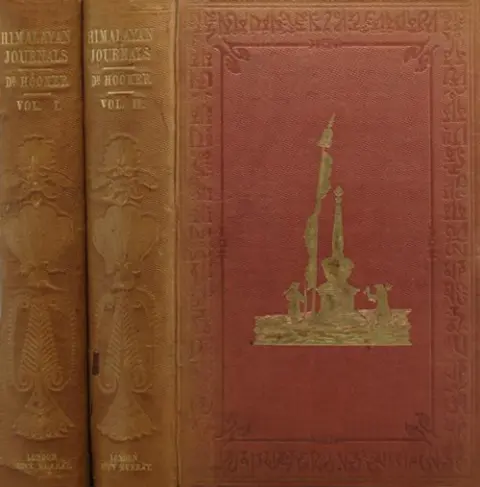
"Himalayan Journals — Volume 1" by Joseph Dalton Hooker is a scientific publication crafted in the mid-19th century. This detailed account highlights Hooker's explorations and observations of the natural history, botany, and geography of regions including Bengal, Sikkim, Nepal, and the eastern Himalayas. The work offers an in-depth perspective on the flora and fauna he encountered and provides insights into the scientific and cultural landscapes of the time. The opening of the book sets the stage for Hooker’s journey, detailing his motivations for exploration, connections with notable scientific figures such as Sir James Colvile and Dr. Falconer, and the logistical preparations for his expedition. Hooker describes his departure from England and arrival in Calcutta, where he prepares for a journey into the less-travelled regions of the Himalayas. With detailed observations of the landscape and vegetation around Sunderbunds and Calcutta Botanic Garden, the narrative reveals his keen scientific focus and the rich biodiversity he aims to study. Elements of his adventure include interactions with various geographical features, native flora, and the social conditions of the regions he traverses, establishing a foundation for the comprehensive natural history studies that follow in subsequent chapters.
Introduction adapted from the source catalogue; source summaries may be automatically generated.
Free to read · English · 123,841 words · No account needed
MAKE TIME FOR A GOOD BOOK
On by default. Untick to stop anonymous reading totals. Each page counts after 10 seconds in view. How this works.
Anonymous counting is on unless you have switched it off.
Dr. Campbell's tent was pitched in an orange-grove, occupying a flat on the west bank of the Teesta, close to a small enclosure of pine-apples, with a pomegranate tree in the middle. The valley is very narrow, and the vegetation wholly tropical, consisting of two species of oak, several palms, rattan-cane (screw-pine), Pandanus, tall grasses, and all the natives of dense hot jungles. The river is a grand feature, broad, rocky, deep, swift, and broken by enormous boulders of rock; its waters were of a pale opal green, probably from the materials of the soft micaceous rocks through which it flows.
A cane bridge crosses it,* [Whence the name of Bhomsong Samdong, the latter word meaning bridge.] but had been cut away (in feigned distrust of us), and the long canes were streaming from their attachments on either shore down the stream, and a triangular raft of bamboo was plying instead, drawn to and fro by means of a strong cane.
Soon after arriving I received a present from the Rajah, consisting of a brick of Tibet tea, eighty pounds of rancid yak butter, in large squares, done up in yak-hair cloth, three loads of rice, and one of Murwa for beer; rolls of bread,* [These rolls, or rather, sticks of bread, are made in Tibet, of fine wheaten flour, and keep for a long time: they are sweet and good, but very dirtily prepared.] fowls, eggs, dried plums, apricots, jujubes, currants, and Sultana raisins, the latter fruits purchased at Lhassa, but imported thither from western Tibet; also some trays of coarse milk-white crystallised salt, as dug in Tibet.
In the evening we were visited by the Dewan, the head and front of all our Sikkim difficulties, whose influence was paramount with the Rajah, owing to the age and infirmities of the latter, and his devotion to religion, which absorbed all his time and thoughts. The Dewan was a good-looking Tibetan, very robust, fair, muscular and well fleshed; he had a very broad Tartar face, quite free of hair; a small and beautifully formed mouth and chin, very broad cheekbones, and a low, contracted forehead: his manners were courteous and polite, but evidently affected, in assumption of better breeding than he could in reality lay claim to. The Rajah himself was a Tibetan of just respectable extraction, a native of the Sokpo province, north of Lhassa: his Dewan was related to one of his wives, and I believe a Lhassan by birth as well as extraction, having probably also Kashmir blood in him.* [The Tibetans court promiscuous intercourse between their families and the Kashmir merchants who traverse their country.] Though minister, he was neither financier nor politician, but a mere plunderer of Sikkim, introducing his relations, and those whom he calls so, into the best estates in the country, and trading in great and small wares, from a Tibet pony to a tobacco pipe, wholesale and retail. Neither he nor the Rajah are considered worthy of notice by the best Tibet families or priests, or by the Chinese commissioners settled in Lhassa and Jigatzi. The latter regard Sikkim as virtually English, and are contented with knowing that its ruler has no army, and with believing that its protectors, the English, could not march an army across the Himalaya if they would.
Your reading position is saved on this browser. Take it to another device with a library code. Reading pages adapt to text, rather than matching a printed edition.
Joseph Dalton Hooker & John Ball
Joseph Dalton Hooker
Joseph Dalton Hooker
BEHIND THE BOOK
This eBook is for the use of anyone anywhere in the United States and most other parts of the world at no cost and with almost no restrictions whatsoever. You may copy it, give it away or re-use it under the terms of the Project Gutenberg License included with this eBook or online at www.gutenberg.org. If you are not located in the United States, you will have to check the laws of the country where you are located before using this eBook. Read the source licence.
The original source file, including credits and licence, is retained by this library. Request an original-format copy at no charge. Please include the book title and Project Gutenberg identifier #6476.
KEEP YOUR CURIOSITY GOING
Wilfrid Scawen Blunt
Wilfrid Scawen Blunt

E. W. (Edgar Watson) Howe
Cécile Tormay

Moritz Busch
John L. Ransom