THE CLASSIC COLLECTION✦Journal of a tour in Marocco and the Great AtlasCLASSIC FREE BOOKS
Journal of a tour in Marocco and the Great Atlas
Joseph Dalton Hooker & John Ball
THE CLASSIC COLLECTION · 1854
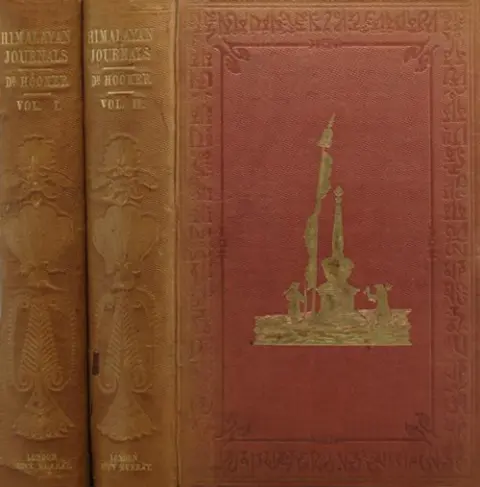
"Himalayan Journals — Volume 1" by Joseph Dalton Hooker is a scientific publication crafted in the mid-19th century. This detailed account highlights Hooker's explorations and observations of the natural history, botany, and geography of regions including Bengal, Sikkim, Nepal, and the eastern Himalayas. The work offers an in-depth perspective on the flora and fauna he encountered and provides insights into the scientific and cultural landscapes of the time. The opening of the book sets the stage for Hooker’s journey, detailing his motivations for exploration, connections with notable scientific figures such as Sir James Colvile and Dr. Falconer, and the logistical preparations for his expedition. Hooker describes his departure from England and arrival in Calcutta, where he prepares for a journey into the less-travelled regions of the Himalayas. With detailed observations of the landscape and vegetation around Sunderbunds and Calcutta Botanic Garden, the narrative reveals his keen scientific focus and the rich biodiversity he aims to study. Elements of his adventure include interactions with various geographical features, native flora, and the social conditions of the regions he traverses, establishing a foundation for the comprehensive natural history studies that follow in subsequent chapters.
Introduction adapted from the source catalogue; source summaries may be automatically generated.
Free to read · English · 123,841 words · No account needed
MAKE TIME FOR A GOOD BOOK
On by default. Untick to stop anonymous reading totals. Each page counts after 10 seconds in view. How this works.
Anonymous counting is on unless you have switched it off.
Many herds of fine yaks were grazing about Wallanchoon: there were a few ponies, sheep, goats, fowls, and pigs, but very little cultivation except turnips, radishes, and potatos. The yak is a very tame, domestic animal, often handsome, and a true bison in appearance; it is invaluable to these mountaineers from its strength and hardiness, accomplishing, at a slow pace, twenty miles a day, bearing either two bags of salt or rice, or four to six planks of pinewood slung in pairs along either flank. Their ears are generally pierced, and ornamented with a tuft of scarlet worsted; they have large and beautiful eyes, spreading horns, long silky black hair, and grand bushy tails: black is their prevailing colour, but red, dun, parti-coloured, and white are common. In winter, the flocks graze below 8000 feet, on account of the great quantity of snow above that height; in summer they find pasturage as high as 17,000 feet, consisting of grass and small tufted Carices, on which they browse with avidity.
The zobo, or cross between the yak and hill cow (much resembling the English cow), is but rarely seen in these mountains, though common in the North West Himalaya. The yak is used as a beast of burden; and much of the wealth of the people consists in its rich milk and curd, eaten either fresh or dried, or powdered into a kind of meal. The hair is spun into ropes, and woven into a covering for their tents, which is quite pervious to wind and rain;* [The latter is, however, of little consequence in the dry climate of Tibet.] from the same material are made the gauze shades for the eyes used in crossing snowy passes. The bushy tail forms the well-known "chowry" or fly-flapper of the plains of India; the bones and dung serve for fuel. The female drops one calf in April; and the young yaks are very full of gambols, tearing up and down the steep grassy and rocky slopes: their flesh is delicious, much richer and more juicy than common veal; that of the old yak is sliced and dried in the sun, forming jerked meat, which is eaten raw, the scanty proportion of fat preventing its becoming very rancid, so that I found it palatable food: it is called schat-tcheu (dried meat). I never observed the yak to be annoyed by any insects; indeed at the elevation it inhabits, there are no large diptera, bots, or gadflies to infest it. It loves steep places, delighting to scramble among rocks, and to sun its black hide perched on the glacial boulders which strew the Wallanchoon flat, and on which these beasts always sleep. Their average value is from two to three pounds, but the price varies with the season. In autumn, when her calf is killed for food, the mother will yield no milk, unless the herdsman gives it the calf's foot to lick, or lays a stuffed skin before it, to fondle, which it does with eagerness, expressing its satisfaction by short grunts, exactly like those of a pig, a sound which replaces the low uttered by ordinary cattle. The yak, though indifferent to ice and snow and to changes of temperature, cannot endure hunger so long as the sheep, nor pick its way so well upon stony ground. Neither can it bear damp heat, for which reason it will not live in summer below 7000 feet, where liver disease carries it off after a very few years.* [Nevertheless, the yak seems to have survived the voyage to England. I find in Turner's "Tibet" (p. 189), that a bull sent by that traveller to Mr. Hastings, reached England alive, and after suffering from languor, so far recovered its health and vigour as to become the father of many calves. Turner does not state by what mother these calves were born, an important omission, as he adds that all these died but one cow, which bore a calf by an Indian bull. A painting of the yak (copied into Turner's book) by Stubbs, the animal painter, may be seen in the Museum of the Royal College of Surgeons, London. The artist is probably a little indebted to description for the appearance of its hair in a native state, for it is represented much too even in length, and reaching to too uniform a depth from the flanks.] Lastly, the yak is ridden, especially by the fat Lamas, who find its shaggy coat warm, and its paces easy; under these circumstances it is always led. The wild yak or bison (D'hong) of central Asia, the superb progenitor of this animal, is the largest native animal of Tibet, in various parts of which country it is found; and the Tibetans say, in reference to its size, that the liver is a load for a tame yak. The Sikkim Dewan gave Dr. Campbell and myself an animated account of the chase of this animal, which is hunted by large dogs, and shot with a blunderbuss: it is untameable and horridly fierce, falling upon you with horns and chest, and if he rasps you with his tongue, it is so rough as to scrape the flesh from the bones. The horn is used as a drinking-cup in marriage feasts, and on other grand occasions. My readers are probably familiar with Messrs. Huc and Gabet's account of a herd of these animals being frozen fast in the head-waters of the Yangtsekiang river. There is a noble specimen in the British Museum not yet set up, and another is preparing for exhibition in the Crystal Palace at Sydenham.
Your reading position is saved on this browser. Take it to another device with a library code. Reading pages adapt to text, rather than matching a printed edition.
Joseph Dalton Hooker & John Ball
Joseph Dalton Hooker
Joseph Dalton Hooker
BEHIND THE BOOK
This eBook is for the use of anyone anywhere in the United States and most other parts of the world at no cost and with almost no restrictions whatsoever. You may copy it, give it away or re-use it under the terms of the Project Gutenberg License included with this eBook or online at www.gutenberg.org. If you are not located in the United States, you will have to check the laws of the country where you are located before using this eBook. Read the source licence.
The original source file, including credits and licence, is retained by this library. Request an original-format copy at no charge. Please include the book title and Project Gutenberg identifier #6476.
KEEP YOUR CURIOSITY GOING
Wilfrid Scawen Blunt
Wilfrid Scawen Blunt

E. W. (Edgar Watson) Howe
Cécile Tormay

Moritz Busch
John L. Ransom