THE CLASSIC COLLECTION✦Journal of a tour in Marocco and the Great AtlasCLASSIC FREE BOOKS
Journal of a tour in Marocco and the Great Atlas
Joseph Dalton Hooker & John Ball
THE CLASSIC COLLECTION · 1854
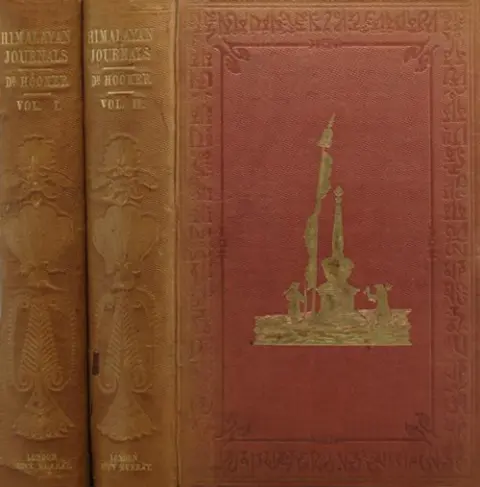
"Himalayan Journals — Volume 1" by Joseph Dalton Hooker is a scientific publication crafted in the mid-19th century. This detailed account highlights Hooker's explorations and observations of the natural history, botany, and geography of regions including Bengal, Sikkim, Nepal, and the eastern Himalayas. The work offers an in-depth perspective on the flora and fauna he encountered and provides insights into the scientific and cultural landscapes of the time. The opening of the book sets the stage for Hooker’s journey, detailing his motivations for exploration, connections with notable scientific figures such as Sir James Colvile and Dr. Falconer, and the logistical preparations for his expedition. Hooker describes his departure from England and arrival in Calcutta, where he prepares for a journey into the less-travelled regions of the Himalayas. With detailed observations of the landscape and vegetation around Sunderbunds and Calcutta Botanic Garden, the narrative reveals his keen scientific focus and the rich biodiversity he aims to study. Elements of his adventure include interactions with various geographical features, native flora, and the social conditions of the regions he traverses, establishing a foundation for the comprehensive natural history studies that follow in subsequent chapters.
Introduction adapted from the source catalogue; source summaries may be automatically generated.
Free to read · English · 123,841 words · No account needed
MAKE TIME FOR A GOOD BOOK
On by default. Untick to stop anonymous reading totals. Each page counts after 10 seconds in view. How this works.
Anonymous counting is on unless you have switched it off.
On the 3rd November I encamped on the flank of Tonglo (called Nanki in Nepal), at 9,300 feet, about 700 feet below the western summit, which is rocky, and connected by a long flat ridge with that which I had visited in the previous May. The Bhotan coolies behaved worse than ever; their conduct being in all respects typical of the turbulent, mulish race to which they belong. They had been plundering my provisions as they went along, and neither their Sirdar nor the Ghorka soldiers had the smallest authority over them. I had hired some Ghorka coolies to assist and eventually to replace them, and had made up my mind to send back the worst from the more populous banks of the Tambur, when I was relieved by their making off of their own accord. The dilemma was however awkward, as it was impossible to procure men on the top of a mountain 10,000 feet high, or to proceed towards Phulloot. No course remained but to send to Dorjiling for others, or to return to the Myong valley, and take a more circuitous route over the west end of Sakkiazung, which led through villages from which I could procure coolies day by day. I preferred the latter plan, and sent one of the soldiers to the nearest village for assistance to bring the loads down, halting a day for that purpose.
From the summit of Tonglo I enjoyed the view I had so long desired of the Snowy Himalaya, from north-east to north-west; Sikkim being on the right, Nepal on the left, and the plains of India to the southward; and I procured a set of compass bearings, of the greatest use in mapping the country. In the early morning the transparency of the atmosphere renders this view one of astonishing grandeur. Kinchinjunga bore nearly due north, a dazzling mass of snowy peaks, intersected by blue glaciers, which gleamed in the slanting rays of the rising sun, like aquamarines set in frosted silver. From this the sweep of snowed mountains to the eastward was almost continuous as far as Chola (bearing east-north-east), following a curve of 150 miles, and enclosing the whole of the northern part of Sikkim, which appeared a billowy mass of forest-clad mountains. On the north-east horizon rose the Donkia mountain (23,176 feet), and Chumulari (23,929). Though both were much more distant than the snowy ranges, being respectively eighty and ninety miles off, they raised their gigantic heads above, seeming what they really were, by far the loftiest peaks next to Kinchinjunga; and the perspective of snow is so deceptive, that though 40 to 60 miles beyond, they appeared as though almost in the same line with the ridges they overtopped. Of these mountains, Chumulari presents many attractions to the geographer, from its long disputed position, its sacred character, and the interest attached to it since Turner's mission to Tibet in 1783. It was seen and recognised by Dr. Campbell, and measured by Colonel Waugh, from Sinchul, and also from Tonglo, and was a conspicuous object in my subsequent journey to Tibet. Beyond Junnoo, one of the western peaks of Kinchinjunga, there was no continuous snowy chain; the Himalaya seemed suddenly to decline into black and rugged peaks, till in the far north-west it rose again in a white mountain mass of stupendous elevation at 80 miles distance, called, by my Nepal people, "Tsungau."* [This is probably the easternmost and loftiest peak seen from Katmandoo, distant 78 miles, and estimated elevation 20,117 feet by Col. Crawford's observations. See "Hamilton's Nepal," p. 346, and plate 1.] From the bearings I took of it from several positions, it is in about lat. 27 degrees 49 minutes and long. 86 degrees 24 minutes, and is probably on the west flank of the Arun valley and river, which latter, in its course from Tibet to the plains of India, receives the waters from the west flank of Kinchinjunga, and from the east flank of the mountain in question. It is perhaps one which has been seen and measured from the Tirhoot district by some of Colonel Waugh's party, and which has been reported to be upwards of 28,000 feet in elevation; and it is the only mountain of the first class in magnitude between Gosainthan (north-east of Katmandoo) and Kinchinjunga.
Your reading position is saved on this browser. Take it to another device with a library code. Reading pages adapt to text, rather than matching a printed edition.
Joseph Dalton Hooker & John Ball
Joseph Dalton Hooker
Joseph Dalton Hooker
BEHIND THE BOOK
This eBook is for the use of anyone anywhere in the United States and most other parts of the world at no cost and with almost no restrictions whatsoever. You may copy it, give it away or re-use it under the terms of the Project Gutenberg License included with this eBook or online at www.gutenberg.org. If you are not located in the United States, you will have to check the laws of the country where you are located before using this eBook. Read the source licence.
The original source file, including credits and licence, is retained by this library. Request an original-format copy at no charge. Please include the book title and Project Gutenberg identifier #6476.
KEEP YOUR CURIOSITY GOING
Wilfrid Scawen Blunt
Wilfrid Scawen Blunt

E. W. (Edgar Watson) Howe
Cécile Tormay

Moritz Busch
John L. Ransom