THE CLASSIC COLLECTION✦A dead man’s diaryCLASSIC FREE BOOKS
A dead man’s diary
Coulson Kernahan
THE CLASSIC COLLECTION · 1902
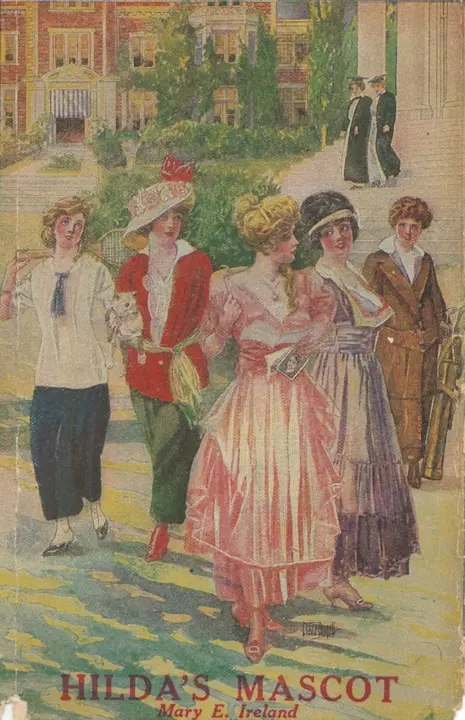
"Hilda's Mascot: A Tale of 'Maryland, My Maryland'" by Mary E. Ireland is a children's fiction narrative written in the early 20th century. The story follows Hilda, a young girl who navigates the challenges of life with her aunt, Mrs. Ashley, and her interactions with the world around her, all while grappling with themes of family, loss, and resilience. Central to the narrative are characters like Mrs. Ashley, who embodies care and compassion, highlighting the importance of familial bonds. The opening of the story introduces a somber and emotional journey as a man takes two children, Jerusha and Horace Flint, to an orphanage, revealing their untimely separation from their mother. The narrative immediately sets a tone of loss and uncertainty as the children face their new reality in the orphanage. Meanwhile, it hints at a deeper connection to Hilda’s life later on by exploring her relationships and the complexities of her upbringing and environment. The emotional gravity of the beginning lays the groundwork for exploring themes such as love, abandonment, and the search for belonging, making it a poignant read for young audiences.
Introduction adapted from the source catalogue; source summaries may be automatically generated.
Free to read · English · 57,107 words · No account needed
MAKE TIME FOR A GOOD BOOK
On by default. Untick to stop anonymous reading totals. Each page counts after 10 seconds in view. How this works.
Anonymous counting is on unless you have switched it off.
He was above medium height, and although past thirty, was youthful, almost boyish in appearance, with his fair complexion, blonde hair and slight moustache; a handsome man save for the pallor and attenuation of his clear-cut features and the look of hopeless grief in his fine eyes.
His left hand, white and shapely, held that of the little boy who was chatting merrily, and in his right was a package--of which, though bulky, he appeared as oblivious as though his hand were empty.
Beside him walked the girl, whose watchful interest in the package betokened ownership, though intrusted for a time to another's care, but for the safety of which she was responsible.
She had the clear olive complexion, black hair and the brilliant black eyes of the boy, but unlike him, was thin and almost as pallid as the man. But there was no lassitude in her movements; instead they were full of energy, and her meagre face, while intelligent and attractive, lacked repose and the promise of patient endurance of life's trials and disappointments.
"We never were on this street before," she commented, after walking several squares in silence. "Where are we going; tell me?"
There was no response, and she continued, "Does mamma know that you are taking Horace and me away from her? Why don't you talk?"
A sigh, almost a groan, escaped the lips of the man, and he whispered some words which the children did not understand.
An angry flush arose to the girl's face, and her eyes sparkled with the
tears that filled them.
"I won't go one step further unless you tell me where we are going," she said, halting and stamping her foot impatiently.
The man seemed to rouse from his abstraction with effort, and in a voice scarcely audible to the eager listener, replied, "We are going where you will see many children, where you will have enough to eat, a comfortable bed and good clothes; you will have a much better home than the one you are leaving."
"But I have good clothes now and pretty ones," and she looked with an air of satisfaction upon the package. "Will mamma come?"
The man trembled with suppressed emotion, which was noticed by the boy, who looked up into his face and waited for the answer.
"Your mother will be given a home where she will suffer no more sorrow nor distress of body or mind," he answered, and again relapsed into silence until they reached the asylum, were admitted and stood in the presence of the matron.
"Have you brought these children for admission?" she asked.
The man nodded; he could not summon voice to speak.
"Where is your permit?"
Your reading position is saved on this browser. Take it to another device with a library code. Reading pages adapt to text, rather than matching a printed edition.
BEHIND THE BOOK
This eBook is for the use of anyone anywhere in the United States and most other parts of the world at no cost and with almost no restrictions whatsoever. You may copy it, give it away or re-use it under the terms of the Project Gutenberg License included with this eBook or online at www.gutenberg.org. If you are not located in the United States, you will have to check the laws of the country where you are located before using this eBook. Read the source licence.
The original source file, including credits and licence, is retained by this library. Request an original-format copy at no charge. Please include the book title and Project Gutenberg identifier #40620.
KEEP YOUR CURIOSITY GOING
Coulson Kernahan

Maurice Baring
Frances Wright
Cécile Tormay

Frederic Jesup Stimson

W. H. P. (William Henry Pope) Jarvis