By-Ways of War: The Story of the Filibusters
James Jeffrey Roche
THE CLASSIC COLLECTION · 1898
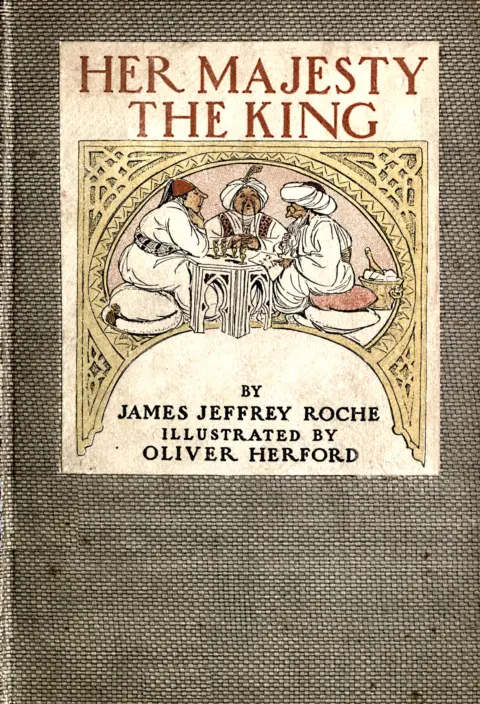
"Her Majesty the King: A Romance of the Harem" by James Jeffrey Roche is a novel written in the late 19th century. This work appears to explore themes of love, governance, and societal expectations within a Middle Eastern palace setting, primarily focusing on the characters of Pasha Muley Mustapha and his wife, Kayenna. As the story unfolds, we observe their tumultuous relationship and the ensuing comedic and dramatic events resulting from their attempts to adjust to their roles and responsibilities. At the start of the narrative, we meet Pasha Muley Mustapha, a man finding himself at odds with his wife, Kayenna, over the upbringing of their child. He expresses his desire to allow their son the freedom to experience life outside the confines of the harem, while Kayenna vehemently opposes this idea, deciding instead to tightly control their child’s environment. This clash ignites a series of misunderstandings and accidental deceptions, particularly surrounding the birth of their child, whom the outside world believes to be a boy, when in fact the truth is far more complicated. The opening sets the stage for a humorous yet critical examination of love, authority, and the absurdities within family and court politics, promising a mix of wit and narrative intrigue as the tale progresses.
Introduction adapted from the source catalogue; source summaries may be automatically generated.
Free to read · English · 19,417 words · No account needed
MAKE TIME FOR A GOOD BOOK
On by default. Untick to stop anonymous reading totals. Each page counts after 10 seconds in view. How this works.
Anonymous counting is on unless you have switched it off.
The Pasha Muley Mustapha was unhappy. He was a peaceloving, easy-tempered man, as Pashas go, and, when allowed to have his own way, was never inclined to ask for more. But now, after seven years of wedded life, he found his wishes thwarted, not for the first time, by the caprice of a woman, and that woman his only wife, Kayenna, well surnamed the Eloquent. The misunderstanding had arisen, innocently enough, in this way:—
“I think, my dear,” said Muley Mustapha, as he sat smoking his nargileh one day at the beginning of this history, while his wife reclined on a divan,—“I think, my dear, that my parents (may their memory be blessed!) made a great mistake in their treatment of me in my youth. I was brought up too strictly. They gave me no opportunity of seeing life in all its phases. Consequently, I find myself, in middle age, almost a stranger among my own subjects. I mean to adopt an entirely different system with little Muley.”
“In what way?” asked his wife, rising on her elbow, and casting a suspicious look at her lord.
“Well, in this way,” replied Muley Mustapha, deliberately,—“in this way. I intend to let him go out into the world, mingle with the youth of his own age, share in their sports, and, as the Giaours say, ‘sow his wild oats.’”
“Muley Mustapha,” said his wife, sitting bolt upright, “you shall do nothing of the sort. ‘Sow his wild oats,’ indeed! He shall never leave my sight, not for a single moment, until he is a grown man and I have provided him with a wife to take my place as guardian of his morals. It ill becomes the trusted vassal of my noble father, the Sultan of Kopaul, to talk thus of corrupting the child who is to be one day ruler of that mighty empire. You forget that fact, Muley Mustapha.”
“On the contrary,” retorted the Pasha, a little tartly, “I am not likely to forget it, so long as the daughter of the Sultan of Kopaul condescends to remain the wife of the Pasha of Ubikwi.”
For Muley Mustapha had married above his station, and the circumstance had not been permitted to escape his memory. He never complained of his lot; but, when his faithful Vizier once hinted that the Koran allowed each true believer the blessing of four wives, he answered with a sigh, “I find one enough for this world: the rest I will take in houris.”
Some subtle reflection of that sentiment must have made itself visible on the face of the Pasha at this moment; for his worthy spouse, with apparent irrelevance, suddenly exclaimed,—
Your reading position is saved on this browser. Take it to another device with a library code. Reading pages adapt to text, rather than matching a printed edition.
James Jeffrey Roche
BEHIND THE BOOK
This eBook is for the use of anyone anywhere in the United States and most other parts of the world at no cost and with almost no restrictions whatsoever. You may copy it, give it away or re-use it under the terms of the Project Gutenberg License included with this eBook or online at www.gutenberg.org. If you are not located in the United States, you will have to check the laws of the country where you are located before using this eBook. Read the source licence.
The original source file, including credits and licence, is retained by this library. Request an original-format copy at no charge. Please include the book title and Project Gutenberg identifier #75179.
KEEP YOUR CURIOSITY GOING
Coulson Kernahan

Maurice Baring
Frances Wright
Cécile Tormay

Frederic Jesup Stimson

W. H. P. (William Henry Pope) Jarvis