THE CLASSIC COLLECTION✦The gray wolf’s daughterCLASSIC FREE BOOKS
The gray wolf’s daughter
Gertrude Warden
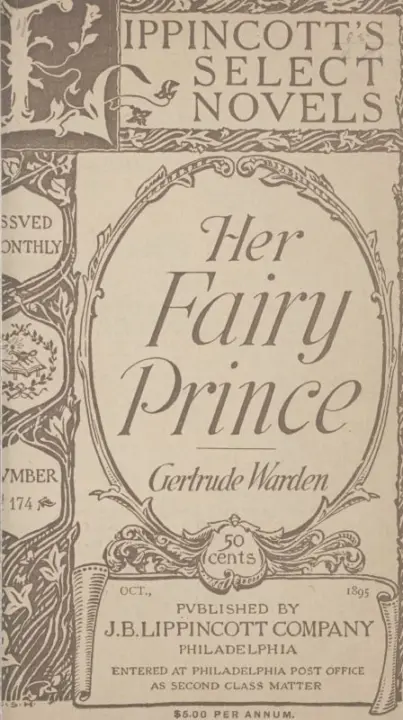
THE CLASSIC COLLECTION · 1895
"Her Fairy Prince" by Gertrude Warden is a novel written in the late 19th century. The story opens with two Englishmen, Captain Garth and Wallace Armstrong, reuniting in Boulogne after several years apart. As they converse, it becomes clear that Armstrong is in dire straits financially and is disillusioned with life. He presents himself as a man marked by past indiscretions but is still hopeful for redemption, primarily through a marriage that could restore his fortune and regain the favor of his wealthy uncle. The opening of the novel introduces readers to the complex relationship between Garth, a gambler and opportunist, and Armstrong, a young man who feels lost and embittered. Through their dialogue, we learn of Armstrong's struggles and a desperate drive to secure a better future, including a potential marriage to Garth's daughter, Laline. Laline is portrayed as innocent and unaware of the sordid realities surrounding her impending marriage, which is implied to be a calculated move to escape her father's gambling lifestyle and a means for Armstrong to secure his uncle's wealth. As the plot unfolds, the dynamics of deception, economic desperation, and emotional manipulation set the scene for Laline's journey, which promises to explore themes of innocence, sacrifice, and the pursuit of a better life.
Introduction adapted from the source catalogue; source summaries may be automatically generated.
Free to read · English · 92,870 words · No account needed
MAKE TIME FOR A GOOD BOOK
On by default. Untick to stop anonymous reading totals. Each page counts after 10 seconds in view. How this works.
Anonymous counting is on unless you have switched it off.
She raised her hands to her eyes, in which tears were shining, and pressed them close. Wallace Armstrong watched her, surprised and amused by what he considered her folly and weak-mindedness. In reality Laline was neither foolish nor specially weak-minded, only abnormally sensitive to influences to which a coarser nature would have been impervious. Looking into Wallace Armstrong's bold bright eyes, in the depths of which a scornful smile was lurking, the young girl seemed to read there, better than any fortune-teller could inform her, a will, selfish, resolute, and cruel, a nature attracted by and yet strongly antagonistic to her own, a personality she might grow to fear and even, it might be, to hate, but which she would never be able to regard with indifference.
Not in so many words did these convictions come upon her, but the sense of them grew as she gazed, her soft, near-sighted eyes, that had something of the wistfulness of a dumb animal, straining to realize what she saw.
At last Wallace broke the silence with a laugh.
"If we sit so still, staring at each other, people will think that I am mesmerising you," he said. "And, by-the-way, I believe I could."
"Please don't try!" she exclaimed, starting from her seat and pushing her hair from her forehead with a quick nervous gesture peculiar to her. "I must be getting back home now to see after papa's dinner."
"I will walk up with you," he said; "but you haven't yet told me whether you would like to go back to England, leaving your father comfortably settled here, provided for for life, and with all his bills paid."
"Why do you ask me such questions," she said, "when you know what you
suggest is impossible?"
Then an inspiration seized Armstrong. In his pocket was another advance from his uncle to provide his niece Laline with medicines, new clothes, and other necessaries. Wallace directed his steps to the Rue Royale.
"Come and look in this jeweller's shop-window," he said, "and tell me whether you are fond of trinkets."
"Very fond," she answered, "and I often look in here."
"Don't you want to have some of the pretty things?"
"I should, I dare say, if I had any money. But I have never had any jewelry except my dear mother's gold watch and chain. I hope I shall never part with that; but I don't wear it, because it is a great deal out of repair, and I can't afford to have it put right."
"Come inside and look at the things," he said. "Oh, it's all right," he added, seeing that she hesitated; "I have to buy something for myself!"
Your reading position is saved on this browser. Take it to another device with a library code. Reading pages adapt to text, rather than matching a printed edition.
BEHIND THE BOOK
This eBook is for the use of anyone anywhere in the United States and most other parts of the world at no cost and with almost no restrictions whatsoever. You may copy it, give it away or re-use it under the terms of the Project Gutenberg License included with this eBook or online at www.gutenberg.org. If you are not located in the United States, you will have to check the laws of the country where you are located before using this eBook. Read the source licence.
The original source file, including credits and licence, is retained by this library. Request an original-format copy at no charge. Please include the book title and Project Gutenberg identifier #70582.
KEEP YOUR CURIOSITY GOING
Coulson Kernahan

Maurice Baring
Frances Wright
Cécile Tormay

Frederic Jesup Stimson

W. H. P. (William Henry Pope) Jarvis