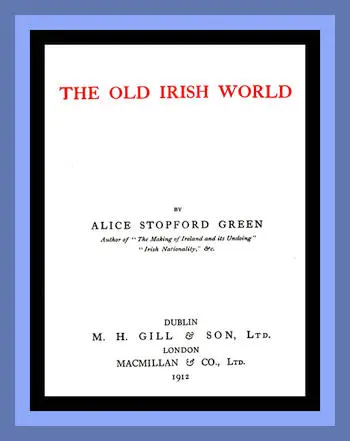
The Old Irish World
Alice Stopford Green
THE CLASSIC COLLECTION · 1888
"Henry the Second" by Alice Stopford Green is a historical account written during the late 19th century. The book delves into the life and reign of Henry II of England, exploring his impact on the development of English law, governance, and the broader implications of his rule across Britain and France. It highlights how his reforms laid the groundwork for modern governance and unified diverse regions under his rule. The opening of the book sets the stage for a detailed examination of Henry II's influence, character, and the political landscape of 12th-century England. It introduces Henry Plantagenet as a formidable foreign king who spoke little English, yet shaped a unified identity among the conquered and conqueror races over his 35-year reign. The narrative describes the legacy of Henry's reforms, including the establishment of common law and the relationship between the Church and the State. As the chapter progresses, it outlines the political turmoil surrounding Henry's rise, including his early life, struggles for power, and the historical context of England at the time, ultimately establishing the foundation for understanding his role as a transformative figure in history.
Introduction adapted from the source catalogue; source summaries may be automatically generated.
Free to read · English · 64,228 words · No account needed
MAKE TIME FOR A GOOD BOOK
On by default. Untick to stop anonymous reading totals. Each page counts after 10 seconds in view. How this works.
Anonymous counting is on unless you have switched it off.
There was, in fact, in all Christendom no such system of government or of justice as that which Henry's reforms built up. The king became the fountain of law in a way till then unknown. The later jealousy of the royal power which grew up with the advance of industrial activity, with the growth of public opinion and of its means of expressing itself, with the development of national experience and national self-dependence, had no place in Henry's days, and had indeed no reason for existence. The strife for the abolition of privileges which in the nineteenth century was waged by the people was in the twelfth century waged by the Crown. In that time, if in no other, the assertion of the supreme authority of the king meant the assertion of the supreme authority of a common law; and there was, in fact, no country in Europe where the whole body of the baronage and of the clergy was so early and so completely brought into bondage to the law of the land. Since all courts were royal courts, since all law was royal law, since no justice was known but his, and its conduct lay wholly in the hands of his trained servants, there was no reason for the king to look with jealousy on the authority exercised by the law over any of his officers or servants. It may possibly be due to this fact that in England alone, of all countries in the world, the police, the civil servants, the soldiers, are tried in the same courts and by the same code as any private citizen; and that in England and lands settled by English peoples alone the Common law still remains the ultimate and only appeal for every subject of the realm.
But the power which was taken from certain privileged classes and put in the hands of the king was in effect by Henry's Assize given back to the people at large. Foreigner as he was, Henry preserved to Englishmen an inheritance which had been handed down from an immemorial past, and which had elsewhere vanished away or was slipping fast into forgetfulness. According to the Roman system, which in the next century spread over Europe, all law and government proceeded directly from the king, and the subject had no right save that of implicit obedience; the system of representation and the idea of the jury had no place in it. Teutonic tradition, on the other hand, looked upon the nation as a commonwealth, and placed the ultimate authority in the will of the whole people; the law was the people's law--it was to be declared and carried out in the people's courts. At a very critical moment, when everything was shifting, uncertain, transitional, Henry's legislation established this tradition for England. By his Assize Englishmen were still to be tried in their ancient courts. Justice was to be administered by the ancient machinery of shire-moot and hundred-moot, by the legal men of hundred and township, by the lord and his steward. The shire-moot became the king's court in so far as its president was a king's judge and its procedure regulated by the king's decree; but it still remained the court of the people, to which the freemen gathered as their fathers had done to the folk-moot, and where judgment could only be pronounced by the verdict of the freeholders who sat in the court. The king's action indeed was determined by a curious medley of chance circumstances and rooted prejudices. The canon law was fast spreading over his foreign states, and wherever the canon law came in the civil law followed in its train. But in England local liberties were strong, the feudal system had never been completely established, insular prejudice against the foreigner and foreign ways was alert, the Church generally still held to national tradition, the king was at deadly feud with the Primate, and was quite resolved to have no customs favoured by him brought into the land; his own absolute power made it no humiliation to accept the maxim of English lawyers that "the king is under God and the law." So it happened that while all the other civilized nations quietly passed under the rule of the Roman code England alone stood outside it. From the twelfth century to the present day the groundwork of our law has been English, in spite of the ceaseless filtering in of the conceptions and rules of the civil law of Rome. "Throughout the world at this moment there is no body of ten thousand Englishmen governed by a system of law which was not fashioned by themselves."
Your reading position is saved on this browser. Take it to another device with a library code. Reading pages adapt to text, rather than matching a printed edition.
Alice Stopford Green
Alice Stopford Green
BEHIND THE BOOK
This eBook is for the use of anyone anywhere in the United States and most other parts of the world at no cost and with almost no restrictions whatsoever. You may copy it, give it away or re-use it under the terms of the Project Gutenberg License included with this eBook or online at www.gutenberg.org. If you are not located in the United States, you will have to check the laws of the country where you are located before using this eBook. Read the source licence.
The original source file, including credits and licence, is retained by this library. Request an original-format copy at no charge. Please include the book title and Project Gutenberg identifier #10494.
KEEP YOUR CURIOSITY GOING
Cécile Tormay

Moritz Busch
John L. Ransom
Frances Wright
Cécile Tormay

Mabel Potter Daggett