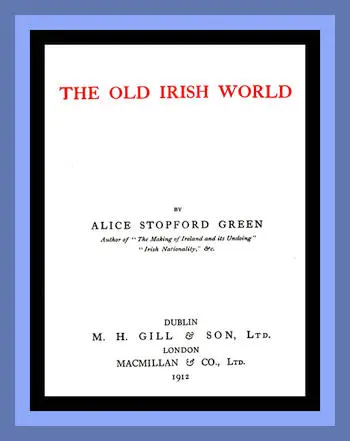
The Old Irish World
Alice Stopford Green
THE CLASSIC COLLECTION · 1888
"Henry the Second" by Alice Stopford Green is a historical account written during the late 19th century. The book delves into the life and reign of Henry II of England, exploring his impact on the development of English law, governance, and the broader implications of his rule across Britain and France. It highlights how his reforms laid the groundwork for modern governance and unified diverse regions under his rule. The opening of the book sets the stage for a detailed examination of Henry II's influence, character, and the political landscape of 12th-century England. It introduces Henry Plantagenet as a formidable foreign king who spoke little English, yet shaped a unified identity among the conquered and conqueror races over his 35-year reign. The narrative describes the legacy of Henry's reforms, including the establishment of common law and the relationship between the Church and the State. As the chapter progresses, it outlines the political turmoil surrounding Henry's rise, including his early life, struggles for power, and the historical context of England at the time, ultimately establishing the foundation for understanding his role as a transformative figure in history.
Introduction adapted from the source catalogue; source summaries may be automatically generated.
Free to read · English · 64,228 words · No account needed
MAKE TIME FOR A GOOD BOOK
On by default. Untick to stop anonymous reading totals. Each page counts after 10 seconds in view. How this works.
Anonymous counting is on unless you have switched it off.
Amid all the intellectual activity which surrounded the English students abroad it is, curious to note what they carried home with them across the Channel, and what they left simply untouched. The zeal for learning quickly showed itself in the growth of the Universities. As early as 1133 Robert Pulleyn was teaching Latin at Oxford. In 1149 Archbishop Theobald brought to it Master Vacarius, a famous Lombard lawyer, who lectured on the Civil law until he was expelled by Stephen, half fearful of the new teaching and half influenced by the pressure of the older and more conservative of the English bishops. There was much of the foreign movement, however, which found no place in England. Difference of tongue shut out Norman and Englishman from the influence of the new Provençal poetry, and for a century to come England owed nothing to the finished art of the South. The strip of sea which kept aloof all European tumults shut out also the speculations in politics and government which were making their way abroad. Even the religious movement which overran one half of France under the Albigenses, or that which counted its followers and martyrs by multitudes in Flanders never crossed the Channel, in spite of the constant intercourse between the peoples; and missionaries from Germany during the reign of Henry only succeeded in converting one poor woman in England who immediately recanted. It was in other directions that the energies of the people found their exercise. If Englishmen were heedless of foreign philosophers, they were quick to notice that the fruit of the vine had failed, and forthwith the unheard-of novelty of taverns where beer and mead were sold sprang up in France, probably by the help of those English traders whose beer was the marvel of Frenchmen.
It was these new conditions of the national life which constituted the real problem of government--a problem far more slow and difficult to work out than the mere suppression of a turbulent baronage. In the rapid movement towards material prosperity, the energies of the people were in all directions breaking away from the channels and limits in which they had been so long confined. Rules which had been sufficient for the guidance of a simple society began to break down under the new fullness and complexity of the national life, and the simple decisions by which questions of property and public order had been solved in earlier times were no longer possible. Moreover, a new confusion and uncertainty had been brought into the law in the last hundred years by the effort to fuse together Norman and English custom. Norman landlord or Norman sheriff naturally knew little of English law or custom, and his tendency was always to enforce the feudal rules which he practised on his Norman estates. In course of time it came about that all questions of land-tenure and of the relations of classes were regulated by a kind of double system. The Englishman as well as the Norman became the "man" of his lord as in Norman law, and was bound by the duties which this involved. On the other hand, the Norman as well as the Englishman held his land subject to the customary burdens and rights recognized by English law. Both races were thus made equal before the law, and no legal distinction was recognized between conqueror and conquered. There was, however, every element of confusion and perplexity in the theory and administration of the law itself, in the variety of systems which were contending for the mastery, and in the inefficiency of the courts in which they were applied. English law had grown up out of Teutonic custom, into which Roman tradition had been slowly filtering through the Dark Ages Feudal law still bore traces of its double origin in the system of the Teutonic "comitatus" and of the Roman "beneficium." Forest law, which governed the vast extent of the king's domains, was bound neither by Norman forms nor by English traditions, but was framed absolutely at the king's will. Canon law had been developed out of customs and precedents which had served to regulate the first Christian communities, and which had been largely formed out of the civil law of Rome. There was a multitude of local customs which varied in every hundred and in every manor, and which were preserved by the jealousy that prevailed between one village and another, the strong sense of local life and jurisdiction, and the strict adherence to immemorial traditions.
Your reading position is saved on this browser. Take it to another device with a library code. Reading pages adapt to text, rather than matching a printed edition.
Alice Stopford Green
Alice Stopford Green
BEHIND THE BOOK
This eBook is for the use of anyone anywhere in the United States and most other parts of the world at no cost and with almost no restrictions whatsoever. You may copy it, give it away or re-use it under the terms of the Project Gutenberg License included with this eBook or online at www.gutenberg.org. If you are not located in the United States, you will have to check the laws of the country where you are located before using this eBook. Read the source licence.
The original source file, including credits and licence, is retained by this library. Request an original-format copy at no charge. Please include the book title and Project Gutenberg identifier #10494.
KEEP YOUR CURIOSITY GOING
Cécile Tormay

Moritz Busch
John L. Ransom
Frances Wright
Cécile Tormay

Mabel Potter Daggett