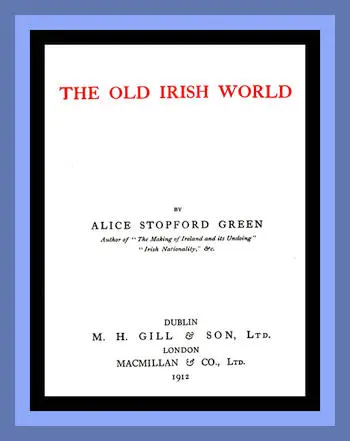
The Old Irish World
Alice Stopford Green
THE CLASSIC COLLECTION · 1888
"Henry the Second" by Alice Stopford Green is a historical account written during the late 19th century. The book delves into the life and reign of Henry II of England, exploring his impact on the development of English law, governance, and the broader implications of his rule across Britain and France. It highlights how his reforms laid the groundwork for modern governance and unified diverse regions under his rule. The opening of the book sets the stage for a detailed examination of Henry II's influence, character, and the political landscape of 12th-century England. It introduces Henry Plantagenet as a formidable foreign king who spoke little English, yet shaped a unified identity among the conquered and conqueror races over his 35-year reign. The narrative describes the legacy of Henry's reforms, including the establishment of common law and the relationship between the Church and the State. As the chapter progresses, it outlines the political turmoil surrounding Henry's rise, including his early life, struggles for power, and the historical context of England at the time, ultimately establishing the foundation for understanding his role as a transformative figure in history.
Introduction adapted from the source catalogue; source summaries may be automatically generated.
Free to read · English · 64,228 words · No account needed
MAKE TIME FOR A GOOD BOOK
On by default. Untick to stop anonymous reading totals. Each page counts after 10 seconds in view. How this works.
Anonymous counting is on unless you have switched it off.
King of England, Duke of Normandy, Count of Anjou, Maine, and Touraine, Count of Poitou, Duke of Aquitaine, suzerain lord of Britanny, Henry found himself at twenty-one ruler of dominions such as no king before him had ever dreamed of uniting. He was master of both sides of the English Channel, and by his alliance with his uncle, the Count of Flanders, he had command of the French coast from the Scheldt to the Pyrenees, while his claims on Toulouse would carry him to the shores of the Mediterranean. His subjects told with pride how "his empire reached from the Arctic Ocean to the Pyrenees;" there was no monarch save the Emperor himself who ruled over such vast domains. But even the Emperor did not gather under his sway a grouping of peoples so strangely divided in race, in tongue, in aims, in history. No common tie of custom or of sympathy united the unwieldy bundle of states bound together in a common subjection; the men of Aquitaine hated Anjou with as intense a bitterness as they hated France; Angevin and Norman had been parted for generations by traditional feuds; the Breton was at war with both; to all England was "another world"--strange in speech, in law, and in custom. And to all the subjects of his heterogeneous empire Henry himself was a mere foreigner. To Gascon or to Breton he was a man of hated race and alien speech, just as much as he was to Scot or Welshman; he seemed a stranger alike to Angevin and Norman, and to Englishmen he came as a ruler with foreign tastes and foreign aims as well as a foreign tongue.
We see in descriptions of the time the strange rough figure of the new king, "Henry Curtmantel," as he was nicknamed from the short Angevin cape which hung on his shoulders, and marked him out oddly as a foreigner amid the English and Norman knights, with their long fur-lined cloaks hanging to the ground. The square stout form, the bull-neck and broad shoulders, the powerful arms and coarse rough hands, the legs bowed from incessant riding, showed a frame fashioned to an extraordinary strength. His head was large and round; his hair red, close-cut for fear of baldness; his fiery face much freckled; his voice harsh and cracked. Those about him saw something "lion-like" in his face; his gray eyes, clear and soft in his peaceful moments, shone like fire when he was moved, and few men were brave enough to confront him when his face was lighted up by rising wrath, and when his eyes rolled and became bloodshot in a paroxysm of passion. His overpowering energy found an outlet in violent physical exertion. "With an immoderate love of hunting he led unquiet days," following the chase over waste and wood and mountain; and when he came home at night he was never seen to sit down save for supper, but wore out his court with walking or standing till after nightfall, even when his own feet and legs were covered with sores from incessant exertion. Bitter were the complaints of his courtiers that there was never any moment of rest for himself or his servants; in war time indeed, they grumbled, excessive toil was natural, but time of peace was ill-consumed in continual vigils and labours and in incessant travel--one day following another in merciless and intolerable journeyings. Henry had inherited the qualities of the Angevin race--its tenacity, its courage, its endurance, the sagacity that was without impatience, and the craft that was never at fault. With the ruddy face and unwieldy frame of the Normans other gifts had come to him; he had their sense of strong government and their wisdom; he was laborious, patient, industrious, politic. He never forgot a face he had once seen, nor anything that he heard which he deemed worthy of remembering; where he once loved he never turned to hate, and where he once hated he was never brought to love. Sparing in diet, wasting little care on his dress--perhaps the plainest in his court,--frugal, "so much as was lawful to a prince," he was lavish in matters of State or in public affairs. A great soldier and general, he was yet an earnest striver after peace, hating to refer to the doubtful decision of battle that which might be settled by any other means, and stirred always by a great pity, strange in such an age and in such a man, for lives poured out in war. "He was more tender to dead soldiers than to the living," says a chronicler querulously; "and found far more sorrow in the loss of those who were slain than comfort in the love of those who remained." His pitiful temper was early shown in his determination to put down the barbarous treatment of shipwrecked sailors. He abolished the traditions of the civil war by forbidding plunder, and by a resolute fidelity to his plighted word. In political craft he was matchless; in great perils none was gentler than he, but when the danger was past none was harsher; and common talk hinted that he was a willing breaker of his word, deeming that in the pressure of difficulty it was easier to repent of word than deed, and to render vain a saying than a fact. "His mother's teaching, as we have heard, was this: That he should delay all the business of all men; that whatever fell into his hands he should retain along while and enjoy the fruit of it, and keep suspended in hope those who aspired to it; confirming her sentences with this cruel parable, 'Glut a hawk with his quarry and he will hunt no more; show it him and then draw it back and you will ever keep him tractable and obedient.' She taught him also that he should be frequently in his chamber, rarely in public; that he should give nothing to any one upon any testimony but what he had seen and known; and many other evil things of the same kind. We, indeed," adds this good hater of Matilda, "confidently attributed to her teaching everything in which he displeased us."
Your reading position is saved on this browser. Take it to another device with a library code. Reading pages adapt to text, rather than matching a printed edition.
Alice Stopford Green
Alice Stopford Green
BEHIND THE BOOK
This eBook is for the use of anyone anywhere in the United States and most other parts of the world at no cost and with almost no restrictions whatsoever. You may copy it, give it away or re-use it under the terms of the Project Gutenberg License included with this eBook or online at www.gutenberg.org. If you are not located in the United States, you will have to check the laws of the country where you are located before using this eBook. Read the source licence.
The original source file, including credits and licence, is retained by this library. Request an original-format copy at no charge. Please include the book title and Project Gutenberg identifier #10494.
KEEP YOUR CURIOSITY GOING
Cécile Tormay

Moritz Busch
John L. Ransom
Frances Wright
Cécile Tormay

Mabel Potter Daggett