Fortune
J. C. (John Collis) Snaith
THE CLASSIC COLLECTION · 1906
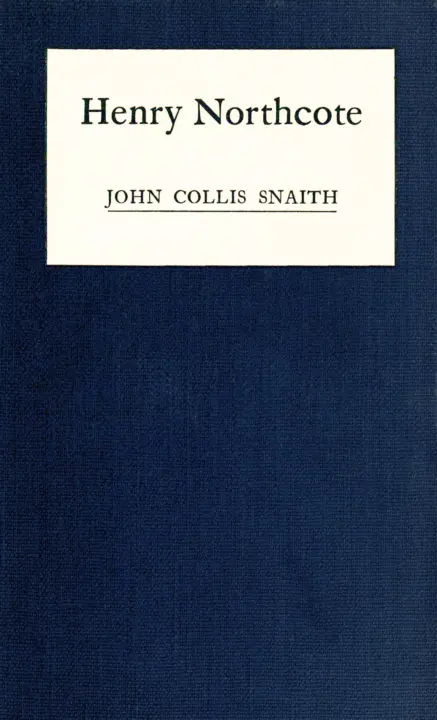
"Henry Northcote" by J. C. Snaith is a novel written in the early 20th century. The story centers on the titular character, Henry Northcote, a struggling barrister who finds himself at the brink of poverty and despair. Set against the backdrop of an unforgiving winter in London, the narrative delves into Northcote's internal struggles as he grapples with ambition, societal expectations, and a fleeting encounter that could change the course of his life. At the start of the book, Northcote is introduced in his drafty chambers during a harsh December evening, contemplating his dire circumstances and the precariousness of his situation. He has been at the bar for six years without achieving significant success and is now facing potential homelessness. Just as he is lost in his thoughts, a mysterious visitor named Mr. Iggs appears, who offers cryptic insights about Northcote's potential and destiny. Their conversation ignites a spark of ambition within Northcote, prompting him to reflect on his life choices, aspirations, and the possibility of a more distinguished future, despite the overwhelming odds stacked against him.
Introduction adapted from the source catalogue; source summaries may be automatically generated.
Free to read · English · 98,494 words · No account needed
MAKE TIME FOR A GOOD BOOK
On by default. Untick to stop anonymous reading totals. Each page counts after 10 seconds in view. How this works.
Anonymous counting is on unless you have switched it off.
“Waiter!” called the solicitor at this point. “More coffee, if you please. Let it be hot and strong.” Turning to Northcote, he added: “Our minds have grown so subtle with that claret we’ve got to find out where we are.”
“Narcotics are not usually the friends of truth,” said his companion.
“My worthy Samuel Taylor,” laughed the solicitor, “I hope you will not forget I want to get to Norbiton to-night.”
“There is one other point,” said the young man imperturbably, “on which I wish to render myself clear.”
Mr. Whitcomb permitted himself a shrug of unmistakable expostulation.
“What, another!” he muttered under his breath. “This fellow is the
devil!”
“I do not propose to take the line of insanity.”
Northcote spoke with a quietness which seemed to deepen the reverberation of Mr. Whitcomb’s subsequent exclamation.
“Then you hang her!”
“On the contrary,” said Northcote, “I promise an acquittal.”
For a moment the solicitor was robbed of speech by this extraordinary
announcement.
“Upon my word,” he exclaimed, with a more manifest impatience than any he had yet shown, “you can hardly have read your brief. There is nothing to extenuate the crime; and the evidence of it is overwhelming.”
“Circumstantial, apparently.”
“You must know that in a capital charge the prosecution relies almost invariably upon circumstantial evidence.”
“So much the worse for it in this particular instance.”
“I am at a loss to understand.” The solicitor spoke in accents of alarm. “There is not a man living who could overthrow the present evidence.”
The young man smiled darkly. The symptoms of his inebriation had yielded to the clarifying influence of a liqueur and two cups of strong black coffee. His calmness was now forming a memorable contrast to the marked excitement of the older man.
“My dear Mr. Whitcomb,” he said, “I suggest, as you wish to get to Norbiton, that we adjourn this discussion until Friday evening, by which time Emma Harrison, alias Cox, alias Marshall, will be restored to society.”
“Such an undertaking is entirely reckless,” said the solicitor bluntly. “Quite the last thing that Tobin himself would attempt would be to upset the theory of the prosecution. The chain of evidence could not be more complete. Even he, in the opinion of many the most brilliant common law man we have at the present moment at the bar, would be content to urge extenuating circumstances, and call witnesses in their support.”
“Since you have seen fit to entrust the conduct of this case to me,” said Northcote, “I shall beg to be conceded as free a hand as would have been conceded to Michael Tobin.”
Your reading position is saved on this browser. Take it to another device with a library code. Reading pages adapt to text, rather than matching a printed edition.
J. C. (John Collis) Snaith
J. C. (John Collis) Snaith
J. C. (John Collis) Snaith
J. C. (John Collis) Snaith
BEHIND THE BOOK
This eBook is for the use of anyone anywhere in the United States and most other parts of the world at no cost and with almost no restrictions whatsoever. You may copy it, give it away or re-use it under the terms of the Project Gutenberg License included with this eBook or online at www.gutenberg.org. If you are not located in the United States, you will have to check the laws of the country where you are located before using this eBook. Read the source licence.
The original source file, including credits and licence, is retained by this library. Request an original-format copy at no charge. Please include the book title and Project Gutenberg identifier #73110.
KEEP YOUR CURIOSITY GOING
Coulson Kernahan

Maurice Baring
Frances Wright
Cécile Tormay

Frederic Jesup Stimson

W. H. P. (William Henry Pope) Jarvis