THE CLASSIC COLLECTION✦Andersonville diaryCLASSIC FREE BOOKS
Andersonville diary
John L. Ransom
THE CLASSIC COLLECTION · 1882
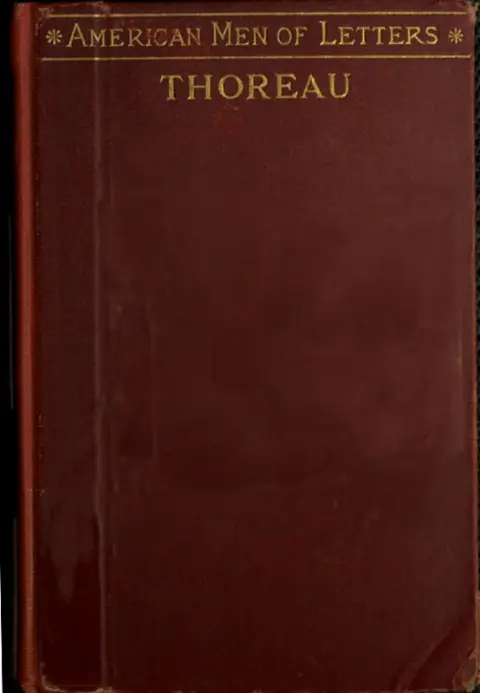
"Henry D. Thoreau" by F. B. Sanborn is a biography written in the late 19th century. This work delves into the life and character of the iconic American writer and philosopher Henry D. Thoreau, highlighting his philosophical perspectives, personal relationships, and contributions to literature and ecology. Through the lens of Sanborn's insights and connections to Thoreau, readers gain a deeper appreciation for Thoreau's unique blend of naturalism and transcendental thought. The opening of the biography sets the stage for an exploration of Thoreau's lineage, connecting his ancestry to both New England and the island of Jersey. F. B. Sanborn chronicles the early years of Thoreau's family, particularly focusing on his parents, John Thoreau and Cynthia Dunbar, their roots, and how these factors influenced the upbringing of their son. The detailed familial history serves to paint Thoreau as a product of a diverse and intellectually rich background, preparing readers for a nuanced understanding of his later writings and philosophical musings.
Introduction adapted from the source catalogue; source summaries may be automatically generated.
Free to read · English · 68,041 words · No account needed
MAKE TIME FOR A GOOD BOOK
On by default. Untick to stop anonymous reading totals. Each page counts after 10 seconds in view. How this works.
Anonymous counting is on unless you have switched it off.
Between Hawthorne and Thoreau, Ellery Channing was perhaps the interpreter, for they had not very much in common, though friendly and mutually respectful. The boat in which Thoreau made his voyage of 1839, on the Concord and Merrimac, came afterwards into Hawthorne's possession, and was the frequent vehicle for Channing and Hawthorne as they made those excursions which Hawthorne has commemorated. Channing also has commemorated those years when Hawthorne spent the happiest hours of his life in the Old Manse, to which he had removed soon after his marriage in 1842:--
"There in the old gray house, whose end we see
Half peeping through the golden willow's veil,
Whose graceful twigs make foliage through the year,
My Hawthorne dwelt, a scholar of rare worth,
The gentlest man that kindly nature drew;
New England's Chaucer, Hawthorne fitly lives.
His tall, compacted figure, ably strung
To urge the Indian chase or guide the way,
Softly reclining 'neath the aged elm,
Like some still rock looked out upon the scene,
As much a part of nature as itself."
In July, 1860, writing to his sister Sophia, among the New Hampshire
mountains, Thoreau said:--
"Mr. Hawthorne has come home. I went to meet him the other evening (at Mr. Emerson's), and found that he had not altered, except that he was looking pretty brown after his voyage. He is as simple and childlike as ever."
This was upon the return of Hawthorne from his long residence abroad, in England, Portugal, and Italy. Thoreau died two years before Hawthorne, and they are buried within a few feet of each other in the Concord cemetery, their funerals having proceeded from the same parish church near by.
Of Thoreau's relations with Emerson, this is not the place to speak in full; it was, however, the most important, if not the most intimate, of all his friendships, and that out of which the others mainly grew. Their close acquaintance began in 1837. In the latter part of April, 1841, Thoreau became an inmate of Mr. Emerson's house, and remained there till, in the spring of 1843, he went for a few months to be the tutor of Mr. William Emerson's sons at Staten Island. In 1840, while teaching school in Concord, Thoreau seems to have been fully admitted into that circle of which Emerson, Alcott, and Margaret Fuller were the leaders. In May, 1840, this circle met, as it then did frequently, at the house of Mr. Emerson, to converse on "the inspiration of the Prophet and Bard, the nature of Poetry, and the causes of the sterility of Poetic Inspiration in our age and country." Mr. Alcott, in his diary, has preserved a record of this meeting, and some others of the same kind. It seems that on this occasion--Thoreau being not quite twenty-three years old, Mr. Alcott forty-one, Mr. Emerson thirty-seven, and Miss Fuller thirty--all these were present, and also Jones Very, the Salem poet, Dr. F. H. Hedge, Dr. C. A. Bartol, Dr. Caleb Stetson, and Robert Bartlett of Plymouth. Bartlett and Very were graduates of Harvard a year before Thoreau, and afterwards tutors there; indeed, all the company except Alcott were Cambridge scholars,--for Margaret Fuller, without entering college, had breathed in the learned air of Cambridge, and gone beyond the students who were her companions. I find no earlier record of Thoreau's participation in these meetings; but afterward he was often present. In May, 1839, Mr. Alcott had held one of his conversations at the house of Thoreau's mother, but no mention is made of Henry taking part in it. At a conversation in Concord in 1846, one April evening, Thoreau came in from his Walden hermitage, and protested with some vehemence against Mr. Alcott's declaration that Jesus "stood in a more tender and intimate nearness to the heart of mankind than any character in life or literature." Thoreau thought he "asserted this claim for the fair Hebrew in exaggeration"; yet he could say in the "Week," "It is necessary not to be Christian to appreciate the beauty and significance of the life of Christ."
Your reading position is saved on this browser. Take it to another device with a library code. Reading pages adapt to text, rather than matching a printed edition.
BEHIND THE BOOK
This eBook is for the use of anyone anywhere in the United States and most other parts of the world at no cost and with almost no restrictions whatsoever. You may copy it, give it away or re-use it under the terms of the Project Gutenberg License included with this eBook or online at www.gutenberg.org. If you are not located in the United States, you will have to check the laws of the country where you are located before using this eBook. Read the source licence.
The original source file, including credits and licence, is retained by this library. Request an original-format copy at no charge. Please include the book title and Project Gutenberg identifier #51426.
KEEP YOUR CURIOSITY GOING
John L. Ransom

Herman W. Mudgett

Harriet Monroe
Daniel Dulany Addison
Charles Lanman

Harold Rosher