THE CLASSIC COLLECTION✦Andersonville diaryCLASSIC FREE BOOKS
Andersonville diary
John L. Ransom
THE CLASSIC COLLECTION · 1882
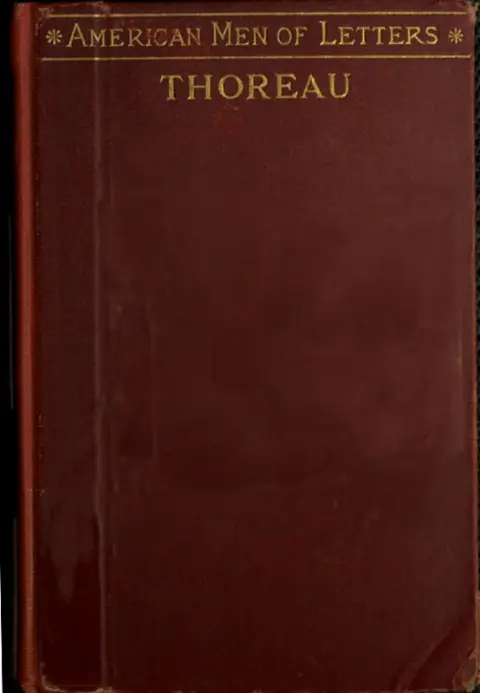
"Henry D. Thoreau" by F. B. Sanborn is a biography written in the late 19th century. This work delves into the life and character of the iconic American writer and philosopher Henry D. Thoreau, highlighting his philosophical perspectives, personal relationships, and contributions to literature and ecology. Through the lens of Sanborn's insights and connections to Thoreau, readers gain a deeper appreciation for Thoreau's unique blend of naturalism and transcendental thought. The opening of the biography sets the stage for an exploration of Thoreau's lineage, connecting his ancestry to both New England and the island of Jersey. F. B. Sanborn chronicles the early years of Thoreau's family, particularly focusing on his parents, John Thoreau and Cynthia Dunbar, their roots, and how these factors influenced the upbringing of their son. The detailed familial history serves to paint Thoreau as a product of a diverse and intellectually rich background, preparing readers for a nuanced understanding of his later writings and philosophical musings.
Introduction adapted from the source catalogue; source summaries may be automatically generated.
Free to read · English · 68,041 words · No account needed
MAKE TIME FOR A GOOD BOOK
On by default. Untick to stop anonymous reading totals. Each page counts after 10 seconds in view. How this works.
Anonymous counting is on unless you have switched it off.
It was not the famous lawyers, the godly ministers, the wealthy citizens, nor even the learned ladies of Concord, who interested Henry Thoreau specially,--but the sturdy farmers, each on his hereditary acres, battling with the elements and enjoying that open-air life which to Thoreau was the only existence worth having. As his best biographer, Ellery Channing, says: "He came to see the inside of every farmer's house and head, his pot of beans, and mug of hard cider. Never in too much hurry for a dish of gossip, he could sit out the oldest frequenter of the bar-room, and was alive from top to toe with curiosity."
Concord, in our day, and still more in Thoreau's childhood, was dotted with frequent old farm-houses, of the ample and picturesque kind that bespeaks antiquity and hospitality. In one such he was born, though not one of the oldest or the best. He was present at the downfall of several of these ancient homesteads, in whose date and in the fortunes of their owners for successive generations, he took a deep interest; and still more in their abandoned orchards and door-yards, where the wild apple tree and the vivacious lilac still flourished.
To show what sort of men these Concord farmers were in the days when their historical shot was fired, let me give some anecdotes and particulars concerning two of the original family stocks,--the Hosmers, who first settled in Concord in 1635, with Bulkeley and Willard, the founders of the town; and the Barretts, whose first ancestor, Humphrey Barrett, came over in 1639. James Hosmer, a clothier from Hawkhurst in Kent, with his wife Ann (related to Major Simon Willard, that stout Kentishman, Indian trader and Indian fighter, who bought of the Squaw Sachem the township of Concord, six miles square), two infant daughters, and two maid-servants, came from London to Boston in the ship "Elizabeth," and the next year built a house on Concord Street, and a mill on the town brook. From him descended James Hosmer, who was killed at Sudbury in 1658, in an Indian fight, Stephen, his great-grandson, a famous surveyor, and Joseph, his great-great-grandson, one of the promoters of the Revolution, who had a share in its first fight at Concord Bridge. Joseph Hosmer was the son of a Concord farmer, who, in 1743, seceded from the parish church, because Rev. Daniel Bliss, the pastor, had said in a sermon (as his opponents averred), "that it was as great a sin for a man to get an estate by honest labor, if he had not a single aim at the glory of God, as to get it by gaming at cards or dice." What this great-grandfather of Emerson did say, a century before the Transcendental epoch, was this, as he declared: "If husbandmen plow and sow that they may be rich, and live in the pleasures of this world, and appear grand before men, they are as far from true religion in their plowing, sowing, etc., as men are that game for the same purpose." Thomas Hosmer, being a prosperous husbandman, perhaps with a turn for display, took offense, and became a worshipper at what was called the "Black Horse Church,"--a seceding conventicle which met at the tavern with the sign of the Black Horse, near where the Concord Library now stands. Joseph Hosmer, his boy, was known at the village school as "the little black colt,"--a lad of adventurous spirit, with dark eyes and light hair, whose mother, Prudence Hosmer, would repeat old English poetry until all her listeners but her son were weary. When he was thirty-nine years old, married and settled, a farmer and cabinet-maker, there was a convention in the parish church to consider the Boston Port Bill, the doings of General Gage in Boston, and the advice of Samuel Adams and John Hancock to resist oppression. Daniel Bliss, the leading lawyer and leading Tory in Concord, eldest son of Parson Bliss, and son-in-law of Colonel Murray, of Rutland, Vt., the chief Tory of that region, made a speech in this convention against the patriotic party. He was a graceful and fluent speaker, a handsome man, witty, sarcastic, and popular, but with much scorn for the plain people. He painted in effective colors the power of the mother country and the feebleness of the colonies; he was elegantly dressed, friendly in his manner, but discouraging to the popular heart, and when he sat down, a deep gloom seemed to settle on the assembly. His brother-in-law, Parson Emerson, an ardent patriot, if present, was silent. From a corner of the meeting-house there rose at last a man with sparkling eyes, plainly dressed in butternut brown, who began to speak in reply to the handsome young Tory, at first slowly and with hesitation, but soon taking fire at his own thoughts, he spoke fluently, in a strain of natural eloquence, which gained him the ear and applause of the assembly. A delegate from Worcester, who sat near Mr. Bliss, noticed that the Tory was discomposed, biting his lip, frowning, and pounding with the heel of his silver-buckled shoe. "Who is the speaker?" he asked of Bliss. "Hosmer, a Concord mechanic," was the scornful reply. "Then how does he come by his English?" "Oh, he has an old mother at home, who sits in her chimney-corner and reads and repeats poetry all day long;" adding in a moment, "He is the most dangerous rebel in Concord, for he has all the young men at his back, and where he leads the way they will surely follow."
Your reading position is saved on this browser. Take it to another device with a library code. Reading pages adapt to text, rather than matching a printed edition.
BEHIND THE BOOK
This eBook is for the use of anyone anywhere in the United States and most other parts of the world at no cost and with almost no restrictions whatsoever. You may copy it, give it away or re-use it under the terms of the Project Gutenberg License included with this eBook or online at www.gutenberg.org. If you are not located in the United States, you will have to check the laws of the country where you are located before using this eBook. Read the source licence.
The original source file, including credits and licence, is retained by this library. Request an original-format copy at no charge. Please include the book title and Project Gutenberg identifier #51426.
KEEP YOUR CURIOSITY GOING
John L. Ransom

Herman W. Mudgett

Harriet Monroe
Daniel Dulany Addison
Charles Lanman

Harold Rosher