THE CLASSIC COLLECTION✦Andersonville diaryCLASSIC FREE BOOKS
Andersonville diary
John L. Ransom
THE CLASSIC COLLECTION · 1882
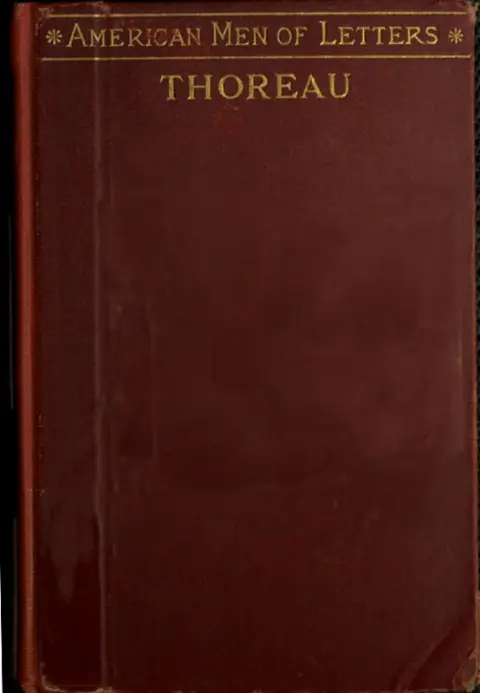
"Henry D. Thoreau" by F. B. Sanborn is a biography written in the late 19th century. This work delves into the life and character of the iconic American writer and philosopher Henry D. Thoreau, highlighting his philosophical perspectives, personal relationships, and contributions to literature and ecology. Through the lens of Sanborn's insights and connections to Thoreau, readers gain a deeper appreciation for Thoreau's unique blend of naturalism and transcendental thought. The opening of the biography sets the stage for an exploration of Thoreau's lineage, connecting his ancestry to both New England and the island of Jersey. F. B. Sanborn chronicles the early years of Thoreau's family, particularly focusing on his parents, John Thoreau and Cynthia Dunbar, their roots, and how these factors influenced the upbringing of their son. The detailed familial history serves to paint Thoreau as a product of a diverse and intellectually rich background, preparing readers for a nuanced understanding of his later writings and philosophical musings.
Introduction adapted from the source catalogue; source summaries may be automatically generated.
Free to read · English · 68,041 words · No account needed
MAKE TIME FOR A GOOD BOOK
On by default. Untick to stop anonymous reading totals. Each page counts after 10 seconds in view. How this works.
Anonymous counting is on unless you have switched it off.
"And now, as I have written all I can glean of Father's family, I will turn to the maternal side, of which it appears, in religious belief, they were of the Quaker persuasion. But I was sorry to see, by good old great-great-grandfather Tillet's will, that slavery was tolerated in those days in the good State of Massachusetts, and handed down from generation to generation. My great-grandmother (Tillet) married David Orrok; her daughter, Sarah Orrok, married Mr. Burns, a Scotch gentleman. At what time he came to this country, or married, I cannot ascertain, but have often been told, to gain the consent to it of grandmother's Quaker parents, he was obliged to doff his rich apparel of gems and ruffles, and conform to the more simple garb of his Quaker bride. On a visit to his home in Scotland he died, in what year is not mentioned. Before my father's decease, a letter was received from the executor of grandfather's estate, dated Stirling, informing him there was property left to Jane Burns, his daughter in America, 'well worth coming after.' But Father was too much out of health to attend to the getting it; and the letter, subsequently put into a lawyer's hands by Brother, then the only heir, was lost.
"It has been said I inherit more of the traits of my foreign ancestry than any of my family,--which pleases me. Probably the vivacity of the French and the superstition of the Scotch may somewhat characterize me,--which it is to be hop'd the experience of an octogenarian may suitably modify. But this is nothing, here nor there. And now that I have written all that is necessary, and perhaps more, I will close, with kind wishes for health and happiness. Yours respectfully,
It would be hard to compress more family history into a short letter, and yet leave it so sprightly in style as this. Of the four children of Maria Thoreau's brother John and Cynthia Dunbar,--John, Helen, Henry, and Sophia,--the two eldest, John and Helen, were said to be "clear Thoreau," and the others, Henry and Sophia, "clear Dunbar;" though in fact the Thoreau traits were marked in Henry also. Let us see, then, who and what were the family of Henry Thoreau's mother, Cynthia Dunbar, who was born in Keene, N. H., in 1787. She was the daughter of Rev. Asa Dunbar, who was born at Bridgewater, Mass., in 1745; graduated at Harvard College in 1767 (a classmate of Sir Thomas Bernard and Increase Sumner); preached for a while at Bedford, near Concord, in 1769, when he was "a young candidate, newly begun to preach;" settled in Salem in 1772; resigned his pastorate in 1779; and removed to Keene just at the close of the Revolution, where he became a lawyer, and died, a little upwards of forty-two, in 1787. He married before 1775, Miss Mary Jones, the daughter of Col. Elisha Jones, of Weston, a man of wealth and influence in his town, who died in 1776. Mrs. Mary (Jones) Dunbar long outlived the husband of her youth; in middle life she married a Concord farmer, Jonas Minott, whom she also outlived; and it was in his house that her famous grandson was born in July, 1817. Mrs. Minott was left a widow for the second time in 1813, when she was sixty-five years old, and in 1815 she sent a petition to the Grand Lodge of Masons in Massachusetts, which was drawn up and indorsed by her pastor, Dr. Ripley, of Concord, and which contains a short sketch of Henry Thoreau's maternal grandfather, from whom he is said to have inherited many qualities. Mrs. Minott's petition sets forth "that her first husband, Asa Dunbar, Esq., late of Keene, N. H., was a native of Massachusetts; that he was for a number of years settled in the gospel ministry at Salem; that afterwards he was a counselor-at-law; that he was Master of a Lodge of Free and Accepted Masons at Keene, where he died; that in the cause of Masonry he was interested and active; that through some defection or misfortune of that Lodge she has suffered loss, both on account of what was due to him and to her, at whose house they held their meetings; that in the settlement of the estate of her late husband, Jonas Minott, Esq., late of Concord, she has been peculiarly unfortunate, and become very much straitened in the means of living comfortably; that being thus reduced, and feeling the weight of cares, of years, and of widowhood to be very heavy, after having seen better days, she is induced, by the advice of friends, as well as her own exigencies, to apply for aid to the benevolence and charity of the Masonic fraternity." At the house of this decayed gentlewoman, about two years after the date of this petition, Henry Thoreau was born. She lived to see him running about, a sprightly boy, and he remembered her with affection. One of his earliest recollections of Concord was of driving in a chaise with his grandmother along the shore of Walden Pond, perhaps on the way to visit her relatives in Weston, and thinking, as he said afterward, that he should like to live there.
Your reading position is saved on this browser. Take it to another device with a library code. Reading pages adapt to text, rather than matching a printed edition.
BEHIND THE BOOK
This eBook is for the use of anyone anywhere in the United States and most other parts of the world at no cost and with almost no restrictions whatsoever. You may copy it, give it away or re-use it under the terms of the Project Gutenberg License included with this eBook or online at www.gutenberg.org. If you are not located in the United States, you will have to check the laws of the country where you are located before using this eBook. Read the source licence.
The original source file, including credits and licence, is retained by this library. Request an original-format copy at no charge. Please include the book title and Project Gutenberg identifier #51426.
KEEP YOUR CURIOSITY GOING
John L. Ransom

Herman W. Mudgett

Harriet Monroe
Daniel Dulany Addison
Charles Lanman

Harold Rosher