THE CLASSIC COLLECTION✦Andersonville diaryCLASSIC FREE BOOKS
Andersonville diary
John L. Ransom
THE CLASSIC COLLECTION · 1882
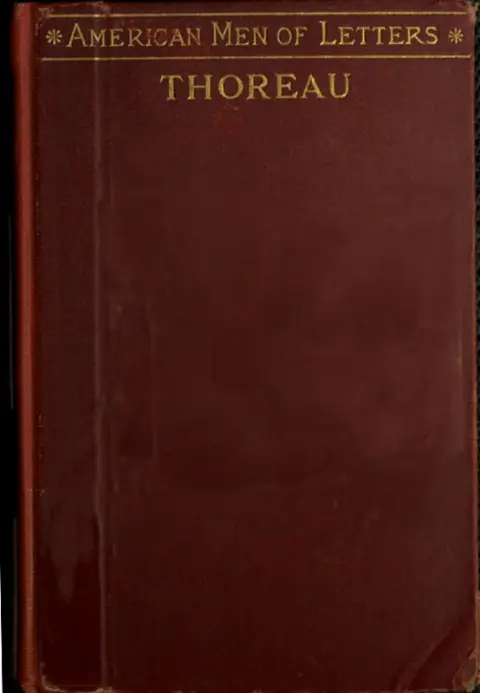
"Henry D. Thoreau" by F. B. Sanborn is a biography written in the late 19th century. This work delves into the life and character of the iconic American writer and philosopher Henry D. Thoreau, highlighting his philosophical perspectives, personal relationships, and contributions to literature and ecology. Through the lens of Sanborn's insights and connections to Thoreau, readers gain a deeper appreciation for Thoreau's unique blend of naturalism and transcendental thought. The opening of the biography sets the stage for an exploration of Thoreau's lineage, connecting his ancestry to both New England and the island of Jersey. F. B. Sanborn chronicles the early years of Thoreau's family, particularly focusing on his parents, John Thoreau and Cynthia Dunbar, their roots, and how these factors influenced the upbringing of their son. The detailed familial history serves to paint Thoreau as a product of a diverse and intellectually rich background, preparing readers for a nuanced understanding of his later writings and philosophical musings.
Introduction adapted from the source catalogue; source summaries may be automatically generated.
Free to read · English · 68,041 words · No account needed
MAKE TIME FOR A GOOD BOOK
On by default. Untick to stop anonymous reading totals. Each page counts after 10 seconds in view. How this works.
Anonymous counting is on unless you have switched it off.
From these river-grapes, by seedling cultivation, a Concord gardener, in Thoreau's manhood, bred and developed the Concord grape, which is now more extensively grown throughout the United States than any other vine, and once adorned, in vineyards large and small, the hillsides over which Thoreau rambled. The uplands are sandy in many places, gravelly and rocky in others, and nearly half the township is now covered, as it has always been, with woods of oak, pine, chestnut, and maple. It is a town of husbandmen, chiefly, with a few mechanics, merchants, and professional men in its villages; a quiet region, favorable to thought, to rambling, and to leisure, as well as to that ceaseless industry by which New England lives and thrives. Its population in 1909 approaches 5,000, but at Thoreau's birth it did not exceed 2,000. There are few great estates in it, and little poverty; the mode of life has generally been plain and simple, and was so in Thoreau's time even more than now. When he was born, and for some years afterward, there was but one church, and the limits of the parish and the township were the same. At that time it was one of the two shire towns of the great county of Middlesex,--Cambridge, thirteen miles away, being the other. It was therefore a seat of justice and a local centre of trade,--attracting lawyers and merchants to its public square much more than of late years.
Trade in Concord then was very different from what it has been since the railroad began to work its revolutions. In the old days, long lines of teams from the upper country, New Hampshire and Vermont, loaded with the farm products of the interior, stopped nightly at the taverns, especially in the winter, bound for the Boston market, whence they returned with a cargo for their own country. If a thaw came on, or there was bad sleighing in Boston, the drivers, anxious to lighten their loads, would sell and buy in the Concord public square, to the great profit of the numerous traders, whose little shops stood around or near it. Then, too, the hitching-posts in front of the shops had full rows of wagons and chaises from the neighboring towns fastened there all day long; while the owners looked over goods, priced, chaffered, and beat down by the hour together the calicoes, sheetings, shirtings, kerseymeres, and other articles of domestic need,--bringing in, also, the product of their own farms and looms to sell or exchange. Each "store" kept an assortment of "West India goods," dry goods, hardware, medicines, furniture, boots and shoes, paints, lumber, lime, and the miscellaneous articles of which the village or the farms might have need; not to mention a special trade in New England rum and old Jamaica, hogsheads of which were brought up every week from Boston by teams, and sold or given away by the glass, with an ungrudging hand. A little earlier than the period now mentioned, when Colonel Whiting (father of the late eminent lawyer, Abraham Lincoln's right-hand adviser in the law of emancipation, William Whiting, of Boston) was a lad in Concord village, "there were five stores and three taverns in the middle of the town, where intoxicating liquors were sold by the glass to any and every body; and it was the custom, when a person bought even so little as fifty cents' worth of goods, to offer him a glass of liquor, and it was generally accepted." Such was the town when John Thoreau, the Jerseyman, came there to die in 1800, and such it remained during the mercantile days of John Thoreau, his son, who was brought up in a house on the public square, and learned the business of buying and selling in the store of Deacon White, close by. Pencil-making, the art by which he earned his modest livelihood during Henry Thoreau's youth, was introduced into Concord about 1812 by William Munroe, whose son has in later years richly endowed the small free library from which Thoreau drew books, and to which he gave some of his own. In this handicraft, which was at times quite profitable, the younger Thoreaus assisted their father from time to time, and Henry acquired great skill in it; even to the extent, says Mr. Emerson, of making as good a pencil as the best English ones. "His friends congratulated him that he had now opened his way to fortune. But he replied that he should never make another pencil. 'Why should I? I would not do again what I have done once.'" Thoreau may have said this, but he afterward changed his mind, for he went on many years, at intervals, working at his father's business, which in time grew to be mainly the preparation of fine-ground plumbago for electrotyping. This he supplied to various publishers, and among others to the Harpers, for several years. But what he did in this way was incidental, and as an aid to his father, his mother, or his sister Sophia, who herself carried on the business for some time after the death of Henry in 1862. It was the family employment, and must be pursued by somebody.
Your reading position is saved on this browser. Take it to another device with a library code. Reading pages adapt to text, rather than matching a printed edition.
BEHIND THE BOOK
This eBook is for the use of anyone anywhere in the United States and most other parts of the world at no cost and with almost no restrictions whatsoever. You may copy it, give it away or re-use it under the terms of the Project Gutenberg License included with this eBook or online at www.gutenberg.org. If you are not located in the United States, you will have to check the laws of the country where you are located before using this eBook. Read the source licence.
The original source file, including credits and licence, is retained by this library. Request an original-format copy at no charge. Please include the book title and Project Gutenberg identifier #51426.
KEEP YOUR CURIOSITY GOING
John L. Ransom

Herman W. Mudgett

Harriet Monroe
Daniel Dulany Addison
Charles Lanman

Harold Rosher