
The lost dirigible
Ralph Henry Barbour
THE CLASSIC COLLECTION · 1907
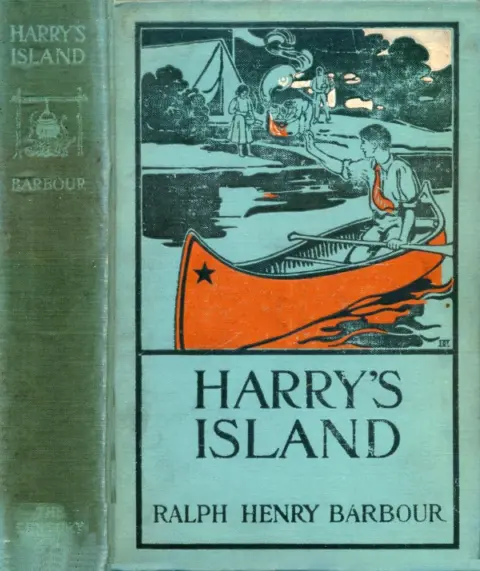
"Harry's Island" by Ralph Henry Barbour is a novel written in the early 20th century. This charming story revolves around a group of boys, specifically focusing on three main characters: Chub, Roy, and Dick, who are on the brink of graduation from Ferry Hill School. As summer approaches, the friends fantasize about camping on Fox Island, planning exploits full of youthful exuberance, adventures, and budding friendships. At the start of the novel, the three boys lounge on Hood's Hill, admiring the scenery and discussing their coming separation after graduation, highlighting a sense of nostalgia mixed with excitement. The narrative introduces Harry, an adventurous girl who is as spirited and determined as the boys, further enriching the dynamics between them. As the boys plan their potential camping trip, they express a mix of hopefulness and uncertainty about the future, setting the stage for the adventures that lie ahead. The opening portion vividly captures the carefree essence of boyhood and the anticipation of new experiences, making it an engaging read for audiences who appreciate tales of friendship and youthful adventures.
Introduction adapted from the source catalogue; source summaries may be automatically generated.
Free to read · English · 63,750 words · No account needed
MAKE TIME FOR A GOOD BOOK
On by default. Untick to stop anonymous reading totals. Each page counts after 10 seconds in view. How this works.
Anonymous counting is on unless you have switched it off.
“It’s even worse than we feared!” said Chub to Dick sotto voce.
“Oh, cut it out,” exclaimed Roy, testily. “Talk sense.”
“Well, it sounds rather--er--interesting, don’t you think, Dick?”
“Oh, it’s great,” Dick answered. “What’s it mean?”
“It doesn’t mean anything, you silly chump!” Roy answered warmly. “It’s just a name; T-o, for Tom; r-o, for Roy; d-i, for Dick.”
“Sort of a shorthand effect,” said Chub, thoughtfully. “But why not put it the other way, and call it Rotodi? I think Rotodi is much more musical to the ear.”
“Lend me your pencil,” said Dick. “I’ve got a better one.”
“Let him have it, Roy,” Chub said. “In the end you’ll all come back to my suggestion; you can’t beat Camp Thomas H. Eaton if you spoil all the bark on the tree. Hand him a new piece of bark Roy; humor him; let him have his way.”
“Say, can’t you stop talking for a minute?” demanded Dick.
Chub grinned and accepted the suggestion. In a minute Dick said
triumphantly:
“I’ve got it! Camp Sopœa!”
“So--what?” asked Chub.
“How do you get that?” inquired Roy.
“First two letters of our last names,” answered Dick, proudly.
“Sounds like Camp Sapolio,” Chub objected, “and if you’re going in for that sort of thing I think Camp Pearline would be much prettier.”
“Oh, well, you try it, then,” said Dick, tossing the pencil to Chub.
“I knew you’d have to come to me in the end,” said Chub. “Now let me
see.”
“No funny business,” warned Roy. Chub shook his head. At that moment the silence, which had been disturbed only by the puffing of a distant steamer, was suddenly rudely shattered by a discordant sound that was like something between the finished efforts of a fish peddler and the wail of a bereaved cow.
“Tell Dick to stop snoring,” said Chub without looking up from his task.
“What the dickens is that?” marvelled Roy, as the sound again reached them, apparently from some distance down the river.
“Blamed if I know!” said Dick.
“It’s a cow,” said Chub. “She’s in great pain.”
“A cow!” jeered Dick.
“Certainly. Cows eat too much nice green grass at this time of year and have the tummy ache. I know. We used to own one.”
“What, a tummy ache?” asked Roy. But Chub was busy again and made no answer. Presently he looked up with a smile of satisfaction.
“I’ve beat you at your own game, Roy,” he said. “The name is Camp Torohadik, with the accent, you will kindly observe, on the penultimate syllable.”
Your reading position is saved on this browser. Take it to another device with a library code. Reading pages adapt to text, rather than matching a printed edition.
Ralph Henry Barbour
Ralph Henry Barbour

Ralph Henry Barbour

Ralph Henry Barbour
BEHIND THE BOOK
This eBook is for the use of anyone anywhere in the United States and most other parts of the world at no cost and with almost no restrictions whatsoever. You may copy it, give it away or re-use it under the terms of the Project Gutenberg License included with this eBook or online at www.gutenberg.org. If you are not located in the United States, you will have to check the laws of the country where you are located before using this eBook. Read the source licence.
The original source file, including credits and licence, is retained by this library. Request an original-format copy at no charge. Please include the book title and Project Gutenberg identifier #54909.
KEEP YOUR CURIOSITY GOING
Coulson Kernahan

Maurice Baring
Frances Wright
Cécile Tormay

Frederic Jesup Stimson

W. H. P. (William Henry Pope) Jarvis