
The lost dirigible
Ralph Henry Barbour
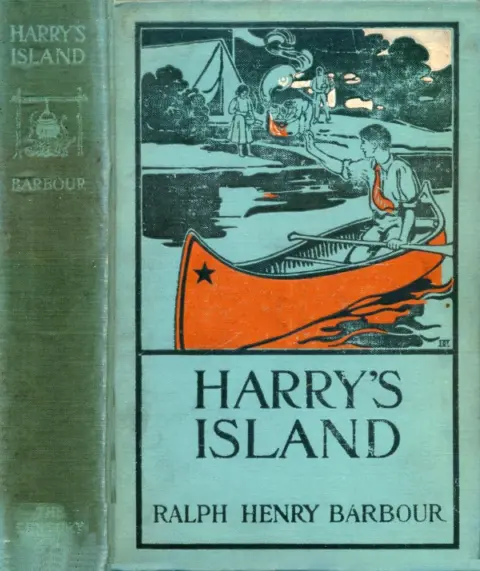
THE CLASSIC COLLECTION · 1907
"Harry's Island" by Ralph Henry Barbour is a novel written in the early 20th century. This charming story revolves around a group of boys, specifically focusing on three main characters: Chub, Roy, and Dick, who are on the brink of graduation from Ferry Hill School. As summer approaches, the friends fantasize about camping on Fox Island, planning exploits full of youthful exuberance, adventures, and budding friendships. At the start of the novel, the three boys lounge on Hood's Hill, admiring the scenery and discussing their coming separation after graduation, highlighting a sense of nostalgia mixed with excitement. The narrative introduces Harry, an adventurous girl who is as spirited and determined as the boys, further enriching the dynamics between them. As the boys plan their potential camping trip, they express a mix of hopefulness and uncertainty about the future, setting the stage for the adventures that lie ahead. The opening portion vividly captures the carefree essence of boyhood and the anticipation of new experiences, making it an engaging read for audiences who appreciate tales of friendship and youthful adventures.
Introduction adapted from the source catalogue; source summaries may be automatically generated.
Free to read · English · 63,750 words · No account needed
MAKE TIME FOR A GOOD BOOK
On by default. Untick to stop anonymous reading totals. Each page counts after 10 seconds in view. How this works.
Anonymous counting is on unless you have switched it off.
“Now what?” asked Dick, surveying the scene with satisfaction and wiping the perspiration from his face. Chub looked speculatively at the flagpole which stands at the end of School Point.
“We ought to have a flag,” he said. “Why didn’t we bring along the
school flag?”
“Because this isn’t the school camp,” answered Roy. “It’s a private affair. We must have a flag of our own.”
“With the name of the camp on it,” said Dick. “By the way, what is the name of the camp?”
“Well, I’ve been thinking of that,” answered Chub, gravely, seating himself on a root which had apparently shaped itself for the purpose, “and I’ve got it all settled. It’s a nice camp, and it ought to have a nice name, a name that stands for--er--respectability and renown. So I suggest that we call it Camp Thomas H. Eaton.”
“What I’ve always admired in you,” said Dick, sarcastically, “is your
modesty, Chub.”
“Yes, it is one of my many excellent qualities,” Chub replied sweetly.
“Who’s got a piece of paper?” Roy demanded. No one had, so he pulled a strip of bark from a birch-tree. “I’ve got an idea,” he said. “You fellows wait a minute.” He seated himself cross-legged and began to write on the bark, scowling intently. Chub viewed him apprehensively.
“Do you think it’s over-study?” he asked Dick in a hoarse whisper, “or merely the sun?”
“Crazed by the heat,” responded Dick, sadly.
“Isn’t it a sad case?” continued Chub. “Such a promising youth as he was! He was always promising--and never doing it. And so young, too!”
“Say, dry up a minute, you fellows,” Roy begged.
“He may get over it, though,” observed Dick, thoughtfully. But Chub
shook his head.
“I’m afraid not,” he said. “Just look at his eyes; see that baleful glare, Dick? That’s what tells the story, the baleful glare; when you develop the baleful glare you are quite incurable. And see his lips work. He’s muttering to himself. That’s a frightfully bad sign, Dick. Pretty soon he will gibber, and when--”
“Dry up, Chub,” commanded Roy. “Now listen. Let’s get a name the way the soap and biscuit people do.”
“A romantic idea,” murmured Chub, politely.
“I mean by using the initials or first two letters.”
“What first two letters?” asked Dick.
“Of our names, of course. You can’t make anything out of the initials, because they’re all consonants, but--”
“We could make believe it was a Russian name,” said Chub helpfully.
“By using the first two letters,” continued Roy, “you get Torodi. How’s
that?”
Your reading position is saved on this browser. Take it to another device with a library code. Reading pages adapt to text, rather than matching a printed edition.
Ralph Henry Barbour
Ralph Henry Barbour

Ralph Henry Barbour

Ralph Henry Barbour
BEHIND THE BOOK
This eBook is for the use of anyone anywhere in the United States and most other parts of the world at no cost and with almost no restrictions whatsoever. You may copy it, give it away or re-use it under the terms of the Project Gutenberg License included with this eBook or online at www.gutenberg.org. If you are not located in the United States, you will have to check the laws of the country where you are located before using this eBook. Read the source licence.
The original source file, including credits and licence, is retained by this library. Request an original-format copy at no charge. Please include the book title and Project Gutenberg identifier #54909.
KEEP YOUR CURIOSITY GOING
Coulson Kernahan

Maurice Baring
Frances Wright
Cécile Tormay

Frederic Jesup Stimson

W. H. P. (William Henry Pope) Jarvis