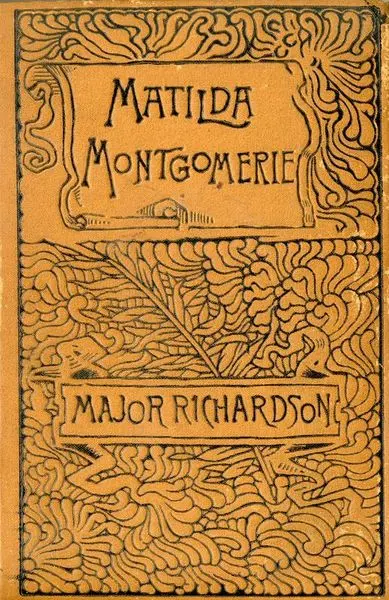
Matilda Montgomerie; Or, The Prophecy Fulfilled
Major (John) Richardson
THE CLASSIC COLLECTION · 1856
"Hardscrabble; or, The Fall of Chicago: A Tale of Indian Warfare" by John Richardson is a historical novel written in the early 19th century. The story unfolds during the tensions surrounding the War of 1812, specifically focusing on the precarious life on the frontier where settlers interact with Native American tribes. The narrative introduces several characters, including Mr. Heywood, a landowner; Ephraim Giles, his servant; and the boy Wilton, hinting at the challenges they face from the encroaching threats of war and conflict. At the start of the novel, readers are placed in a rustic farmhouse near Chicago, where the characters engage in daily life. The narrative highlights their interactions, revealing dynamics of social class amidst the backdrop of impending danger. Mr. Heywood's unease grows as he learns about a group of Native Americans spotted nearby, leading to escalating tensions in the area. Meanwhile, the characters' concerns about their safety intensify as they recognize that their lives may depend on how they navigate this precarious relationship with the Native tribes. The opening sets a rich tone of suspense and establishes the profound themes of survival and the complexities of frontier life during a time of turmoil.
Introduction adapted from the source catalogue; source summaries may be automatically generated.
Free to read · English · 57,561 words · No account needed
MAKE TIME FOR A GOOD BOOK
On by default. Untick to stop anonymous reading totals. Each page counts after 10 seconds in view. How this works.
Anonymous counting is on unless you have switched it off.
“Am I braved in my own command, and by my own men? Mr. Elmsley, who are these Indians, and how came they in?”
“They are a part of the encampment without, sir. There was no order given against their admission this morning, besides it is Winnebeg, and you have said that the gates of the Fort was to be open to him at all hours.”
“Ah! Winnebeg, my friend, how do you do. I did not know it was you or your people. You know you are always welcome.”
“How do, gubbernor,” answered the chief, coming round from the rear of the line, and taking the proffered hand--“'Spose not very angry now--him good warrior--him good soger,” and he pointed to the young subaltern.
“Ensign Ronayne is, no doubt, very sensible to your good opinion,” remarked the captain, with evident pique; “but, Winnebeg, as I am sure you never allow a white man to interfere with you, when you find fault with your young chiefs, you must let me do the same.”
“What find him fault for?” asked the chief, with some surprise; “brave
like a devil!”
“Captain Headley,” interposed the ensign, with some impatience, “am I to surrender my sword, or resume my duty?”
But the captain either could not, or would not give a direct answer. “Can you give me a good reason, Mr. Ronayne, why I should not receive your sword? Do you deny that you have been guilty of neglect of duty?”
“In what?” was the brief demand.
“In being absent from the Fort, without leave, sir.”
“Indeed! To substantiate that, you must bring proofs, Captain Headley. Who,” and he looked around him, as if challenging his accuser, “pretends to have seen me beyond these defences?”
The commandant was for some moments at a loss, for he had not anticipated this difficulty. At length he resumed. “Was it not to be absent without leave, that, when the guard was all ready to be marched off, you were not to be found?”
“Had the guard been marched off, or the parade even formed, I should of course, have come justly under your censure, Captain Headley; but it was not so--you ordered the parade and guard-mounting for a later hour. I am here at that hour.”
“Hem!” returned the commandant, who was in some degree obliged to admit the justice of the remark; “you defend yourself more in the spirit of a lawyer, than of a soldier, Mr. Ronayne, but all this difficulty is soon set at rest. I require but your simple denial that you have been absent from the Fort, within the last twenty-four hours. That given, I shall be satisfied.”
Your reading position is saved on this browser. Take it to another device with a library code. Reading pages adapt to text, rather than matching a printed edition.
Major (John) Richardson
Major (John) Richardson
Major (John) Richardson
Major (John) Richardson
BEHIND THE BOOK
This eBook is for the use of anyone anywhere in the United States and most other parts of the world at no cost and with almost no restrictions whatsoever. You may copy it, give it away or re-use it under the terms of the Project Gutenberg License included with this eBook or online at www.gutenberg.org. If you are not located in the United States, you will have to check the laws of the country where you are located before using this eBook. Read the source licence.
The original source file, including credits and licence, is retained by this library. Request an original-format copy at no charge. Please include the book title and Project Gutenberg identifier #5169.
KEEP YOUR CURIOSITY GOING
Cécile Tormay

Moritz Busch
Coulson Kernahan
John L. Ransom

Maurice Baring
Frances Wright