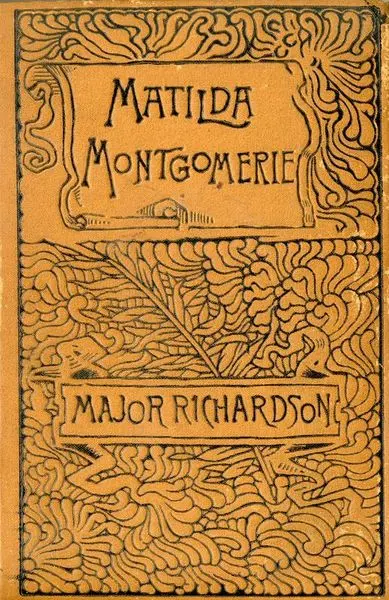
Matilda Montgomerie; Or, The Prophecy Fulfilled
Major (John) Richardson
THE CLASSIC COLLECTION · 1856
"Hardscrabble; or, The Fall of Chicago: A Tale of Indian Warfare" by John Richardson is a historical novel written in the early 19th century. The story unfolds during the tensions surrounding the War of 1812, specifically focusing on the precarious life on the frontier where settlers interact with Native American tribes. The narrative introduces several characters, including Mr. Heywood, a landowner; Ephraim Giles, his servant; and the boy Wilton, hinting at the challenges they face from the encroaching threats of war and conflict. At the start of the novel, readers are placed in a rustic farmhouse near Chicago, where the characters engage in daily life. The narrative highlights their interactions, revealing dynamics of social class amidst the backdrop of impending danger. Mr. Heywood's unease grows as he learns about a group of Native Americans spotted nearby, leading to escalating tensions in the area. Meanwhile, the characters' concerns about their safety intensify as they recognize that their lives may depend on how they navigate this precarious relationship with the Native tribes. The opening sets a rich tone of suspense and establishes the profound themes of survival and the complexities of frontier life during a time of turmoil.
Introduction adapted from the source catalogue; source summaries may be automatically generated.
Free to read · English · 57,561 words · No account needed
MAKE TIME FOR A GOOD BOOK
On by default. Untick to stop anonymous reading totals. Each page counts after 10 seconds in view. How this works.
Anonymous counting is on unless you have switched it off.
“I knew he had not been out of the Fort. Courage, Maria! was audible to the men who were nearest to the speaker, from Elmsley's doorway.
“I know what you would urge, Mr. Ronayne,” remarked the captain; “you would offer this in plea for your late appearance. I make all due allowance in the matter; but, let me tell you, sir, that an officer who thoroughly understands his duty, and consults the interests of the service, would make light of these matters, in cases of strong emergency.”
“Poor Ronayne!” sighed Maria, to her friend. “This is terrible to his proud spirit. In presence of the whole of the men, too!”
“I told you, my dear, there would be a row, but never fear--Elmsley be there. See, he is looking significantly at us, as if to call our attention to what is passing.”
The lieutenant had been no less astonished than the captain, at the unexpected appearance of Ronayne--even more so, indeed--because he had observed, without, however, remarking on it, the cool and unhastened pace at which he moved along the square, from the direction of the mess-room. “Now it is coming,” he thought, and half-murmured to himself, as he saw the crimson gathering on his brow, during the last harsh address of his superior.
“Captain Headley,” said the young man, drawing himself up to his full height, and somewhat elevating his voice, for he had remarked there were other and dearer eyes upon him, than those immediately around. “I WILL NOT be spoken to in this manner, before the men. If you think I have been guilty of a breach of duty or of discipline, I am prepared to meet your charges before the proper tribunal, but you shall not take the liberty of thus addressing me in public parade. My sword, sir,” and he unbuckled it, and offered the handle, “is at, your disposal, but I deny your further right.”
“No, no, no!” shouted several men from the ranks
“No, no, no!” repeated almost every man of the fishing-party, in even more energetic tones, while the commanding officer was glancing his eye keenly and rapidly along the little line, to detect those who had set the example of insubordination.
“Ugh! wah! good soger!” came from one of a small party of Indians in the rear, as the disconcerted captain turned, frowningly, from the men in front to those who had followed him from the orderly room, and now stood grouped on the inner flank.
“What is the meaning of all this?” he cried, in a loud and angry voice.
Your reading position is saved on this browser. Take it to another device with a library code. Reading pages adapt to text, rather than matching a printed edition.
Major (John) Richardson
Major (John) Richardson
Major (John) Richardson
Major (John) Richardson
BEHIND THE BOOK
This eBook is for the use of anyone anywhere in the United States and most other parts of the world at no cost and with almost no restrictions whatsoever. You may copy it, give it away or re-use it under the terms of the Project Gutenberg License included with this eBook or online at www.gutenberg.org. If you are not located in the United States, you will have to check the laws of the country where you are located before using this eBook. Read the source licence.
The original source file, including credits and licence, is retained by this library. Request an original-format copy at no charge. Please include the book title and Project Gutenberg identifier #5169.
KEEP YOUR CURIOSITY GOING
Cécile Tormay

Moritz Busch
Coulson Kernahan
John L. Ransom

Maurice Baring
Frances Wright