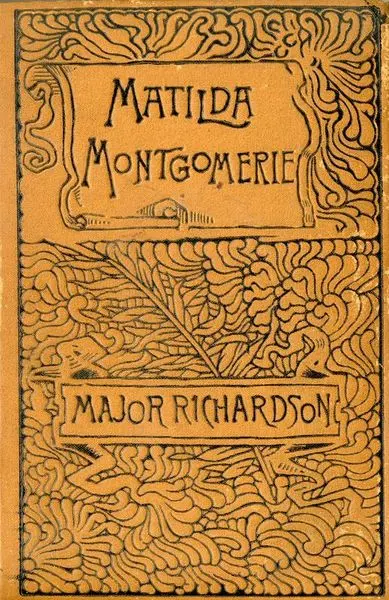
Matilda Montgomerie; Or, The Prophecy Fulfilled
Major (John) Richardson
THE CLASSIC COLLECTION · 1856
"Hardscrabble; or, The Fall of Chicago: A Tale of Indian Warfare" by John Richardson is a historical novel written in the early 19th century. The story unfolds during the tensions surrounding the War of 1812, specifically focusing on the precarious life on the frontier where settlers interact with Native American tribes. The narrative introduces several characters, including Mr. Heywood, a landowner; Ephraim Giles, his servant; and the boy Wilton, hinting at the challenges they face from the encroaching threats of war and conflict. At the start of the novel, readers are placed in a rustic farmhouse near Chicago, where the characters engage in daily life. The narrative highlights their interactions, revealing dynamics of social class amidst the backdrop of impending danger. Mr. Heywood's unease grows as he learns about a group of Native Americans spotted nearby, leading to escalating tensions in the area. Meanwhile, the characters' concerns about their safety intensify as they recognize that their lives may depend on how they navigate this precarious relationship with the Native tribes. The opening sets a rich tone of suspense and establishes the profound themes of survival and the complexities of frontier life during a time of turmoil.
Introduction adapted from the source catalogue; source summaries may be automatically generated.
Free to read · English · 57,561 words · No account needed
MAKE TIME FOR A GOOD BOOK
On by default. Untick to stop anonymous reading totals. Each page counts after 10 seconds in view. How this works.
Anonymous counting is on unless you have switched it off.
“Well, I reckon,” he said, picking up his knife, and resuming his whittling, but in a less absorbed manner, “I meant no harm, but merely that Loup Garou can nose an Injin better than ere a one of us.”
“Nose an Indian better than any one of us! Well, perhaps he can--he sees them every day, but what has that to do with his whining and growling just now?”
“Well, I'll tell you, Boss, what I mean, more plain-like. You know that patch of wood borderin' on the prairie, where you set me to cut, t'other day?”
“I do. What of that?”
“Well, then, this mornin' I was cuttin' down as big an oak as ever grew in Michigan, when, as it went thunderin' through the branches, with noise enough to scare every buffalo within a day's hunt, up started, not twenty yards from it's tip, ten or a dozen or so of Injins, all gruntin' like pigs, and looking as fierce as so many red devils. They didn't look quite pleasant, I calcilate.”
“Indeed,” remarked Mr. Heywood, musingly; “a party of Pottawattamies I presume, from the Fort. We all know there is a large encampment of them in the neighborhood, but they are our friends.”
“May-be so,” continued Ephraim Giles, “but these varmint didn't look over friendly, and then I guess the Pottawattamies don't dress in war paint, 'cept when they dance for liquor.”
“And are you quite sure these Indians were in their war paint?” asked his master, with an ill-concealed look of anxiety.
“No mistake about it,” replied Giles, still whittling, “and I could almost swear, short as the squint was I got of 'em, that they were part of those who fought us on the Wabash, two years ago.”
“How so, den, you are here, Gile. If dey wicked Injin, how you keep your funny little cap, an' your scalp under de cap?”
This question was asked by the Canadian, who had hitherto, while puffing his pipe, listened indifferently to the conversation, but whose attention had now become arrested, from the moment that his fellow-laborer had spoken of the savages, so strangely disturbed by him.
“Well, I don't exactly know about that, myself,” returned the soldier, slightly raising his cap and scratching his crown, as if in recollection of some narrowly escaped danger. “I reckon, tho', when I see them slope up like a covey of red-legged pattridges, my heart was in my mouth, for I looked for nothin' else but that same operation: but I wur just as well pleased, when, after talkin' their gibberish, and makin' all sorts of signs among themselves, they made tracks towards the open prairie.”
Your reading position is saved on this browser. Take it to another device with a library code. Reading pages adapt to text, rather than matching a printed edition.
Major (John) Richardson
Major (John) Richardson
Major (John) Richardson
Major (John) Richardson
BEHIND THE BOOK
This eBook is for the use of anyone anywhere in the United States and most other parts of the world at no cost and with almost no restrictions whatsoever. You may copy it, give it away or re-use it under the terms of the Project Gutenberg License included with this eBook or online at www.gutenberg.org. If you are not located in the United States, you will have to check the laws of the country where you are located before using this eBook. Read the source licence.
The original source file, including credits and licence, is retained by this library. Request an original-format copy at no charge. Please include the book title and Project Gutenberg identifier #5169.
KEEP YOUR CURIOSITY GOING
Cécile Tormay

Moritz Busch
Coulson Kernahan
John L. Ransom

Maurice Baring
Frances Wright