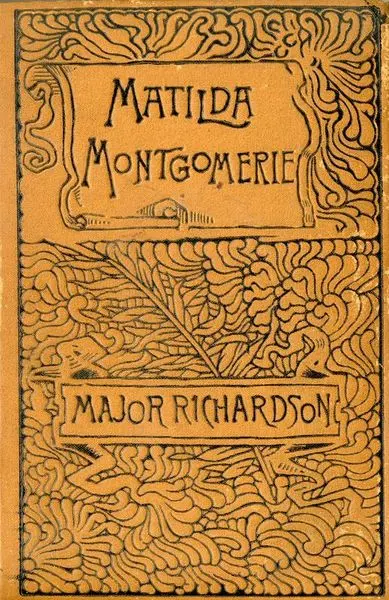
Matilda Montgomerie; Or, The Prophecy Fulfilled
Major (John) Richardson
THE CLASSIC COLLECTION · 1856
"Hardscrabble; or, The Fall of Chicago: A Tale of Indian Warfare" by John Richardson is a historical novel written in the early 19th century. The story unfolds during the tensions surrounding the War of 1812, specifically focusing on the precarious life on the frontier where settlers interact with Native American tribes. The narrative introduces several characters, including Mr. Heywood, a landowner; Ephraim Giles, his servant; and the boy Wilton, hinting at the challenges they face from the encroaching threats of war and conflict. At the start of the novel, readers are placed in a rustic farmhouse near Chicago, where the characters engage in daily life. The narrative highlights their interactions, revealing dynamics of social class amidst the backdrop of impending danger. Mr. Heywood's unease grows as he learns about a group of Native Americans spotted nearby, leading to escalating tensions in the area. Meanwhile, the characters' concerns about their safety intensify as they recognize that their lives may depend on how they navigate this precarious relationship with the Native tribes. The opening sets a rich tone of suspense and establishes the profound themes of survival and the complexities of frontier life during a time of turmoil.
Introduction adapted from the source catalogue; source summaries may be automatically generated.
Free to read · English · 57,561 words · No account needed
MAKE TIME FOR A GOOD BOOK
On by default. Untick to stop anonymous reading totals. Each page counts after 10 seconds in view. How this works.
Anonymous counting is on unless you have switched it off.
As he uttered this half rebuke, he rose abruptly from his chair, shook the ashes from his pipe, and drew himself to his full height, with his back to the fire. There had been nothing very remarkable in the observation made by the man to whom he had addressed himself, but he was in a peculiar state of mind, that gave undue importance to every word, sounding, as it did, a vague presentiment of some coming evil, which the very singular manner of the dog had created, although he would scarcely acknowledge this to himself.
The man made no reply, but continued whittling, humming, at the same time, the air of “Yankee Doodle.”
“Answer me, Ephraim Giles,” peremptorily resumed his master; “leave off that eternal whittling of yours, if you can, and explain to me your meaning.”
“Etarnal whittling! do you call it, Boss? I guess it's no such thing. No man knows better nor you, that, if I can whittle the smallest stick in creation, I can bring down the stoutest tree as well as ere a fellow in Michigan. Work is work--play is play. It's only the difference, I reckon, of the axe and the knife.”
“Will you answer my question like a man, and not like a fool, as you are?” shouted the other, stooping, and extending his left hand, the fingers of which he insinuated into the stock already described, while, with a powerful jerk, he both brought the man to his feet, and the blood into his usually cadaverous cheek.
Ephraim Giles, half-throttled, and writhing with pain, made a movement as if he would have used the knife in a much less innocent manner than whittling, but the quick, stern eye of his master, detected the involuntary act, and his hand, suddenly relinquishing its hold of the collar, grasped the wrist of the soldier with such a vice-like pressure, that the fingers immediately opened, and the knife fell upon the hearth.
The violence of his own act, brought Mr. Heywood at once to a sense of the undue severity he had exercised towards his servant, and he immediately said, taking his hand:
“Ephraim Giles, forgive me, but it was not intended. Yet, I know not how it is, the few words you spoke just now made me anxious to know what you meant, and I could not repress my impatience to hear your explanation.”
The soldier had never before remarked so much dignity of manner about his Boss, as he termed Mr. Heywood, and this fact, added to the recollection of the severe handling he had just met with, caused him to be a little more respectful in his address.
Your reading position is saved on this browser. Take it to another device with a library code. Reading pages adapt to text, rather than matching a printed edition.
Major (John) Richardson
Major (John) Richardson
Major (John) Richardson
Major (John) Richardson
BEHIND THE BOOK
This eBook is for the use of anyone anywhere in the United States and most other parts of the world at no cost and with almost no restrictions whatsoever. You may copy it, give it away or re-use it under the terms of the Project Gutenberg License included with this eBook or online at www.gutenberg.org. If you are not located in the United States, you will have to check the laws of the country where you are located before using this eBook. Read the source licence.
The original source file, including credits and licence, is retained by this library. Request an original-format copy at no charge. Please include the book title and Project Gutenberg identifier #5169.
KEEP YOUR CURIOSITY GOING
Cécile Tormay

Moritz Busch
Coulson Kernahan
John L. Ransom

Maurice Baring
Frances Wright