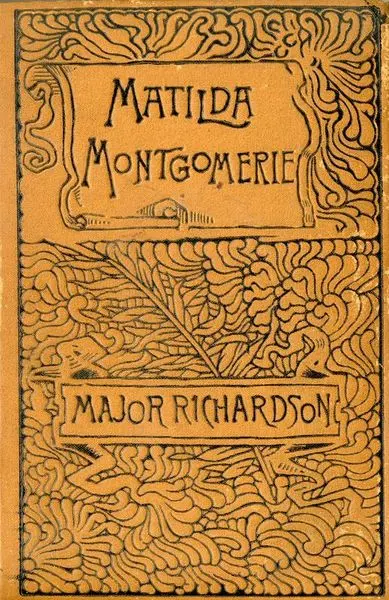
Matilda Montgomerie; Or, The Prophecy Fulfilled
Major (John) Richardson
THE CLASSIC COLLECTION · 1856
"Hardscrabble; or, The Fall of Chicago: A Tale of Indian Warfare" by John Richardson is a historical novel written in the early 19th century. The story unfolds during the tensions surrounding the War of 1812, specifically focusing on the precarious life on the frontier where settlers interact with Native American tribes. The narrative introduces several characters, including Mr. Heywood, a landowner; Ephraim Giles, his servant; and the boy Wilton, hinting at the challenges they face from the encroaching threats of war and conflict. At the start of the novel, readers are placed in a rustic farmhouse near Chicago, where the characters engage in daily life. The narrative highlights their interactions, revealing dynamics of social class amidst the backdrop of impending danger. Mr. Heywood's unease grows as he learns about a group of Native Americans spotted nearby, leading to escalating tensions in the area. Meanwhile, the characters' concerns about their safety intensify as they recognize that their lives may depend on how they navigate this precarious relationship with the Native tribes. The opening sets a rich tone of suspense and establishes the profound themes of survival and the complexities of frontier life during a time of turmoil.
Introduction adapted from the source catalogue; source summaries may be automatically generated.
Free to read · English · 57,561 words · No account needed
MAKE TIME FOR A GOOD BOOK
On by default. Untick to stop anonymous reading totals. Each page counts after 10 seconds in view. How this works.
Anonymous counting is on unless you have switched it off.
But even the small quantity of wine he had taken was acting potently on the fast animating Indian. “Dis no you squaw--dis Waunangee squaw,” he said, with strong excitement of manner. “Waunangee, see him beautiful, Waunangee got warm heart--love him very much!”
“Tolerably well for a modest youth!” exclaimed the laughing Mrs. Elmsley. “Who would have thought that one with those soft black eyes, more fitted for a woman than a man, would hazard so glowing a speech, after an acquaintance of barely five minutes?”
“Who says Chicago doesn't abound in adventure?” sneered Von Vottenberg, as he arose and passed into the apartment of his patient. “I shall certainly write a book about this when I get back into the civilized world, and entitle it 'The Loves of the Handsome Waunangee, and the Beautiful American.'”
“You had better write 'The Loves of the Fat Von Vottenberg, and his Mistress, Whisky Punch,'” remarked Ronayne, peevishly, for in spite of himself, he felt annoyed at an observation, which he thought delicacy might have spared. “Come, Waunangee, my good friend, we must go.”
But the young Indian was not so easily led. “Waunangee have him first dis nice squaw,” he said, with all that show of dogged obstinacy which so usually distinguishes his race, when under the influence of liquor, and bent upon the attainment of a particular object.
“Hear me, Waunangee,” replied the other, placing his hand upon his shoulder, and now, that Mrs. Elmsley only was present with his affianced, feeling less scruple in explaining to the young savage--“that is my squaw--my wife.”
“Why you no tell him so?” asked the youth, gravely, and with an air of reproach, while, at the same time, he fixed his soft and melancholy eyes upon Miss Heywood. “Waunangee love officer's squaw--but Waunangee good heart. Shake him hand, my friend,” he continued, walking up to her, and tendering his own, while, singular as it seemed to all, a tear dimmed his eye, and stole down his cheek. “'Spose no Waunangee wife--you Waunangee's friend?”
The generous but trembling girl, shook cordially the hand that rested in her own, and assured the youth, in a way easily intelligible to him, that, as the friend of her husband, and she blushed deeply, as the moment afterwards she became sensible she had used a word, she could not but feel to be premature, she would always regard him with friendship and esteem.
Your reading position is saved on this browser. Take it to another device with a library code. Reading pages adapt to text, rather than matching a printed edition.
Major (John) Richardson
Major (John) Richardson
Major (John) Richardson
Major (John) Richardson
BEHIND THE BOOK
This eBook is for the use of anyone anywhere in the United States and most other parts of the world at no cost and with almost no restrictions whatsoever. You may copy it, give it away or re-use it under the terms of the Project Gutenberg License included with this eBook or online at www.gutenberg.org. If you are not located in the United States, you will have to check the laws of the country where you are located before using this eBook. Read the source licence.
The original source file, including credits and licence, is retained by this library. Request an original-format copy at no charge. Please include the book title and Project Gutenberg identifier #5169.
KEEP YOUR CURIOSITY GOING
Cécile Tormay

Moritz Busch
Coulson Kernahan
John L. Ransom

Maurice Baring
Frances Wright