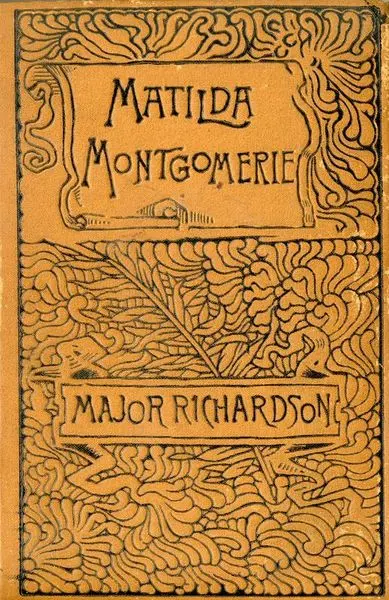
Matilda Montgomerie; Or, The Prophecy Fulfilled
Major (John) Richardson
THE CLASSIC COLLECTION · 1856
"Hardscrabble; or, The Fall of Chicago: A Tale of Indian Warfare" by John Richardson is a historical novel written in the early 19th century. The story unfolds during the tensions surrounding the War of 1812, specifically focusing on the precarious life on the frontier where settlers interact with Native American tribes. The narrative introduces several characters, including Mr. Heywood, a landowner; Ephraim Giles, his servant; and the boy Wilton, hinting at the challenges they face from the encroaching threats of war and conflict. At the start of the novel, readers are placed in a rustic farmhouse near Chicago, where the characters engage in daily life. The narrative highlights their interactions, revealing dynamics of social class amidst the backdrop of impending danger. Mr. Heywood's unease grows as he learns about a group of Native Americans spotted nearby, leading to escalating tensions in the area. Meanwhile, the characters' concerns about their safety intensify as they recognize that their lives may depend on how they navigate this precarious relationship with the Native tribes. The opening sets a rich tone of suspense and establishes the profound themes of survival and the complexities of frontier life during a time of turmoil.
Introduction adapted from the source catalogue; source summaries may be automatically generated.
Free to read · English · 57,561 words · No account needed
MAKE TIME FOR A GOOD BOOK
On by default. Untick to stop anonymous reading totals. Each page counts after 10 seconds in view. How this works.
Anonymous counting is on unless you have switched it off.
Mrs. Elmsley was endeavoring to dissipate the dejection of her friend by rallying her, as the young officer came to the door, on the evidently new conquest she had made. The Indian turned to look at the intruder upon his pleasant musings, when a “wah!” expressive of deep satisfaction escaped him, and at the same moment, Ronayne grasped, and cordially shook his hand.
“Ha! there is his formidable rival, and seemingly his friend,” whispered Mrs. Elmsley, in the ear of Maria--“handsome fellows, both of them, so much so, that were I single, like you, I should have some difficulty in choosing between them.”
As she uttered these words, a sharp and unaccountable pang, sudden and fleeting as electricity, shot through the frame of her friend. The blood suddenly receded from her cheek, and then rapidly returning, suffused it with a burning heat.
“What is the matter, my love? Are you ill, you looked so pale just now?” tenderly inquired Mrs. Elmsley.
“I cannot account for what I experienced. It was a feeling different from any I had ever known before--a strange, wild, and inexplicable dread of I know not what. But it has passed away. Take no notice of it, dear, before Ronayne.”
“Mrs. Elmsley,” said the latter, almost using force to induce the modest-looking young Indian to enter the room, “will you allow me first to introduce my friend Waunangee to you, and then to give him a glass of claret? Forgive the liberty I take, but I confess a good deal of obligation to him, and would fain do the civil in return.”
“Indeed! what a set speech for a glass of wine. Give it to him by all means, if it is only for his beautiful eyes--that is to say, if the doctor has left any--or stay, I will get another bottle.”
“By no means,” returned the young officer, “this unconscionable man has just left about half a tumbler foil, and I do not intend he shall have more. Waunangee,” he pursued, after filling and presenting him with the glass, “that is the lady of the house,” pointing to Mrs. Elmsley, “you must drink to her health.”
“And dis you handsome squaw,” remarked the Indian, a moment or two after having tossed off the wine, which quickly circulated through his veins. “Dis you wife!” he repeated, throwing his expressive eyes upon Miss Heywood, while a rich glow lighted up his dark, but finely formed features.
“Hush!” said Ronayne, making a sign to intimate that he was not to indulge in such observations.
Your reading position is saved on this browser. Take it to another device with a library code. Reading pages adapt to text, rather than matching a printed edition.
Major (John) Richardson
Major (John) Richardson
Major (John) Richardson
Major (John) Richardson
BEHIND THE BOOK
This eBook is for the use of anyone anywhere in the United States and most other parts of the world at no cost and with almost no restrictions whatsoever. You may copy it, give it away or re-use it under the terms of the Project Gutenberg License included with this eBook or online at www.gutenberg.org. If you are not located in the United States, you will have to check the laws of the country where you are located before using this eBook. Read the source licence.
The original source file, including credits and licence, is retained by this library. Request an original-format copy at no charge. Please include the book title and Project Gutenberg identifier #5169.
KEEP YOUR CURIOSITY GOING
Cécile Tormay

Moritz Busch
Coulson Kernahan
John L. Ransom

Maurice Baring
Frances Wright