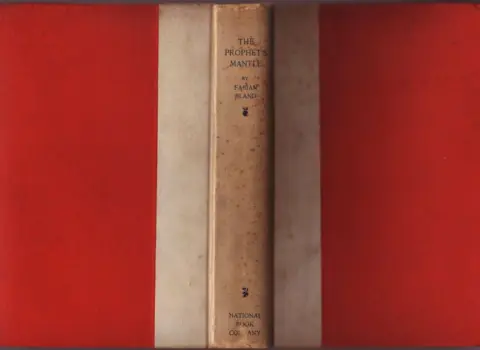
The Prophet’s Mantle
E. (Edith) Nesbit & Hubert Bland
THE CLASSIC COLLECTION · 1910
"Harding's Luck" by E. Nesbit is a novel written in the early 20th century. The story introduces readers to Dickie Harding, a young boy living in a grim environment with an unkind aunt, who struggles with lameness and dreams of adventure. The central theme revolves around Dickie's desperate longing for love and belonging, all while he navigates a world filled with misfortune and small joys, particularly his attachment to a cherished toy named Tinkler and his encounters with various characters, including a kind neighbor and a dubious man named Mr. Beale. The opening of "Harding's Luck" paints a vivid picture of Dickie's life and his sad background, beginning with the loss of his rabbit hutch, which leads to a burst of emotions that highlights his isolation. His lament over losing the hutch and how his aunt treats him sets the stage for Dickie's character—a boy yearning for kindness and adventure amid hardship. As he interacts with a stimulating neighbor and contemplates his secret dreams, Dickie's determination becomes apparent when he decides to sell moonflowers to regain his beloved toy from the pawnbroker. The chapter captures both the struggles and small triumphs of childhood, setting in motion Dickie's journey of self-discovery and adventure in a world that often seems unkind.
Introduction adapted from the source catalogue; source summaries may be automatically generated.
Free to read · English · 68,950 words · No account needed
MAKE TIME FOR A GOOD BOOK
On by default. Untick to stop anonymous reading totals. Each page counts after 10 seconds in view. How this works.
Anonymous counting is on unless you have switched it off.
"Poor little man!" said the lady; "you miss your mother, don't you?"
"Yuss," said Dickie sadly; "but farver, 'e's very good to me. I couldn't get on if it wasn't for farver."
"Oh, well done, little 'un!" said Mr. Beale to himself.
"We lay under a 'aystack last night," he said aloud, "and where we'll lie to-night gracious only knows, without some kind soul lends us a 'elping 'and."
The lady fumbled in her pocket, and the little girl said to Dickie--
"Where are all your toys?"
"I ain't got but two," said Dickie, "and they're at 'ome; one of them's silver--real silver--my grandfarver 'ad it when 'e was a little boy."
"But if you've got silver you oughtn't to be begging," said the lady, shutting up her purse. Beale frowned.
"It only pawns for a shilling," said Dickie, "and farver knows what
store I sets by it."
"A shillin's a lot, I grant you that," said Beale eagerly; "but I wouldn't go to take away the nipper's little bit o' pleasure, not for no shilling I wouldn't," he ended nobly, with a fond look at Dickie.
"You're a kind father," said the lady.
"Yes, isn't he, mother?" said the little girl. "May I give the little
boy my penny?"
The two travellers were left facing each other, the richer by a penny, and oh--wonderful good fortune--a whole half-crown. They exchanged such glances as might pass between two actors as the curtain goes down on a successful dramatic performance.
"You did that bit fine," said Beale--"fine, you did. You been there
before, ain't ye?"
"No, I never," said Dickie; "'ere's the steever."
"You stick to that," said Beale, radiant with delight; "you're a fair masterpiece, you are; you earned it honest if ever a kid done. Pats you on the napper, she does, and out with 'arf a dollar! A bit of all right, I call it!"
They went on up the hill as happy as any one need wish to be.
They had told lies, you observe, and had by these lies managed to get half a crown and a penny out of the charitable; and far from being ashamed of their acts, they were bubbling over with merriment and delight at their own cleverness. Please do not be too shocked. Remember that neither of them knew any better. To the elder tramp lies and begging were natural means of livelihood. To the little tramp the whole thing was a new and entrancing game of make-believe.
By evening they had seven-and-sixpence.
Your reading position is saved on this browser. Take it to another device with a library code. Reading pages adapt to text, rather than matching a printed edition.
E. (Edith) Nesbit & Hubert Bland
E. (Edith) Nesbit
E. (Edith) Nesbit
E. (Edith) Nesbit
BEHIND THE BOOK
This eBook is for the use of anyone anywhere in the United States and most other parts of the world at no cost and with almost no restrictions whatsoever. You may copy it, give it away or re-use it under the terms of the Project Gutenberg License included with this eBook or online at www.gutenberg.org. If you are not located in the United States, you will have to check the laws of the country where you are located before using this eBook. Read the source licence.
The original source file, including credits and licence, is retained by this library. Request an original-format copy at no charge. Please include the book title and Project Gutenberg identifier #28725.
KEEP YOUR CURIOSITY GOING
Coulson Kernahan

Maurice Baring
Frances Wright
Cécile Tormay
Francis Greenleaf Allinson & Anne C. E. (Anne Crosby Emery) Allinson

Frederic Jesup Stimson