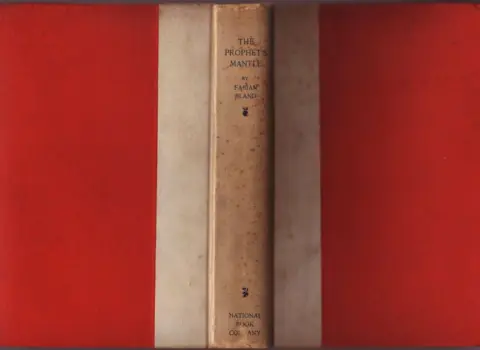
The Prophet’s Mantle
E. (Edith) Nesbit & Hubert Bland
THE CLASSIC COLLECTION · 1910
"Harding's Luck" by E. Nesbit is a novel written in the early 20th century. The story introduces readers to Dickie Harding, a young boy living in a grim environment with an unkind aunt, who struggles with lameness and dreams of adventure. The central theme revolves around Dickie's desperate longing for love and belonging, all while he navigates a world filled with misfortune and small joys, particularly his attachment to a cherished toy named Tinkler and his encounters with various characters, including a kind neighbor and a dubious man named Mr. Beale. The opening of "Harding's Luck" paints a vivid picture of Dickie's life and his sad background, beginning with the loss of his rabbit hutch, which leads to a burst of emotions that highlights his isolation. His lament over losing the hutch and how his aunt treats him sets the stage for Dickie's character—a boy yearning for kindness and adventure amid hardship. As he interacts with a stimulating neighbor and contemplates his secret dreams, Dickie's determination becomes apparent when he decides to sell moonflowers to regain his beloved toy from the pawnbroker. The chapter captures both the struggles and small triumphs of childhood, setting in motion Dickie's journey of self-discovery and adventure in a world that often seems unkind.
Introduction adapted from the source catalogue; source summaries may be automatically generated.
Free to read · English · 68,950 words · No account needed
MAKE TIME FOR A GOOD BOOK
On by default. Untick to stop anonymous reading totals. Each page counts after 10 seconds in view. How this works.
Anonymous counting is on unless you have switched it off.
Dickie saw, and the crown was set on his happiness. A rabbit. Like the ones that his fancy had put in the mouldering hutch at home.
"It's got loose," said Dickie, trying to scramble out of the perambulator; "let's catch 'im and take 'im along."
"'E ain't loose--'e's wild," Mr. Beale explained; "'e ain't never bin caught. Lives out 'ere with 'is little friendses," he added after a violent effort of imagination--"in 'oles in the ground. Gets 'is own meals and larks about on 'is own."
"How beautiful!" said Dickie, wriggling with delight. This life of the rabbit, as described by Mr. Beale, was the child's first glimpse of freedom. "I'd like to be a rabbit."
"You much better be my little nipper," said Beale. "Steady on, mate. 'Ow'm I to wheel the bloomin' pram if you goes on like as if you was a bag of eels?"
They camped by a copse for the midday meal, sat on the grass, made a fire of sticks, and cooked herrings in a frying-pan, produced from one of the knobbly bundles.
"It's better'n Fiff of November," said Dickie; "and I do like you. I like you nexter my own daddy and Mr. Baxter next door."
"That's all right," said Mr. Beale awkwardly.
It was in the afternoon that, half-way up a hill, they saw coming over the crest a lady and a little girl.
"Hout yer gets," said Mr. Beale quickly; "walk as 'oppy as you can, and if they arsts you you say you ain't 'ad nothing to eat since las' night and then it was a bit o' dry bread."
"Right you are," said Dickie, enjoying the game.
"An' mind you call me father."
"Yuss," said Dickie, exaggerating his lameness in the most spirited way. It was acting, you see, and all children love acting.
Mr. Beale went more and more slowly, and as the lady and the little girl drew near he stopped altogether and touched his cap. Dickie, quick to imitate, touched his.
"Could you spare a trifle, mum," said Beale, very gently and humbly, "to 'elp us along the road? My little chap, 'e's lame like wot you see. It's a 'ard life for the likes of 'im, mum."
"He ought to be at home with his mother," said the lady.
Beale drew his coat sleeve across his eyes.
"'E ain't got no mother," he said; "she was took bad sudden--a chill it was, and struck to her innards. She died in the infirmary. Three months ago it was, mum. And us not able even to get a bit of black for her."
Dickie sniffed.
Your reading position is saved on this browser. Take it to another device with a library code. Reading pages adapt to text, rather than matching a printed edition.
E. (Edith) Nesbit & Hubert Bland
E. (Edith) Nesbit
E. (Edith) Nesbit
E. (Edith) Nesbit
BEHIND THE BOOK
This eBook is for the use of anyone anywhere in the United States and most other parts of the world at no cost and with almost no restrictions whatsoever. You may copy it, give it away or re-use it under the terms of the Project Gutenberg License included with this eBook or online at www.gutenberg.org. If you are not located in the United States, you will have to check the laws of the country where you are located before using this eBook. Read the source licence.
The original source file, including credits and licence, is retained by this library. Request an original-format copy at no charge. Please include the book title and Project Gutenberg identifier #28725.
KEEP YOUR CURIOSITY GOING
Coulson Kernahan

Maurice Baring
Frances Wright
Cécile Tormay
Francis Greenleaf Allinson & Anne C. E. (Anne Crosby Emery) Allinson

Frederic Jesup Stimson