THE CLASSIC COLLECTION✦Hurrell Froude: Memoranda and CommentsCLASSIC FREE BOOKS
Hurrell Froude: Memoranda and Comments
Louise Imogen Guiney
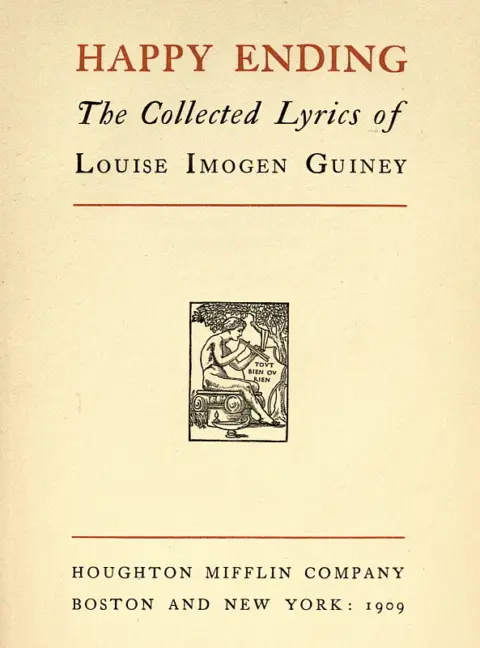
THE CLASSIC COLLECTION · 1909
"Happy Ending: The Collected Lyrics of Louise Imogen Guiney" by Louise Imogen Guiney is a compilation of poetic works written in the late 19th century. This collection brings together selected lyrics from Guiney's previous publications, showcasing her nuanced exploration of themes such as nature, love, and mortality, alongside various emotional landscapes. As a reflected representation of her literary career, the collection is likely to appeal to readers interested in the rich tradition of lyric poetry. The opening of this collection introduces a thoughtful preface where Guiney describes her selection process for the poems, emphasizing a theme of personal and collective introspection. It sets the tone for an anthology that interweaves myriad emotions, from longing and loss to moments of clarity and beauty. The first poems presented evoke a profound sense of spiritual and existential contemplation, suggesting that the collected works will encompass a journey through both the heart and mind. This initial glimpse into Guiney's poetic style invites readers to engage deeply with her artful language and the layered meanings within her verses.
Introduction adapted from the source catalogue; source summaries may be automatically generated.
Free to read · English · 17,222 words · No account needed
MAKE TIME FOR A GOOD BOOK
On by default. Untick to stop anonymous reading totals. Each page counts after 10 seconds in view. How this works.
Anonymous counting is on unless you have switched it off.
WHERE the bales thunder till the day is done,
And the wild sounds with wilder odours cope;
Where over crouching sail and coiling rope,
Lascar and Moor along the gangway run;
Where stifled Thames spreads in the pallid sun,
A hive of anarchy from slope to slope;
Flag of my birth, my liberty, my hope,
I see thee at the masthead, joyous one!
O thou good guest! So oft as, young and warm,
To the home-wind thy hoisted colours bound,
Away, away from this too thoughtful ground,
Sodden with human trespass and despair,
Thee only, from the desert, from the storm,
A sick mind follows into Eden air.
The Kings: P. 3.
II Kings, VI, 15, 16, 17.
His Angel to his Mother: P. 21.
One line of the refrain is taken from an old love song, "Sweet, if you Love me, Let me Go," set to a charming melody in D major, and to be found in Chappell's Popular Music of the Olden Time.
Beside Hazlitt's Grave: P. 47.
St. Anne's, Soho, boasts the "sorry steeple," one of London's architectural absurdities. Hazlitt's grave is grassed over and unmarked, but the epitaph which has now for some years stood in place of the interesting original one, may be read on the headstone set against the outer west wall of the church.
The Vigil-at-Arms: P. 48.
Suggested by the very simple but soldierly melody in Mendelssohn's Lied ohne Worte in A, Book I, Opus 19, No. 4, the last two lines coming in for repetitions.
A Friend's Song for Simoisius: P. 49.
Having to do with Iliad IV, 473-489.
The Inner Fate: P. 64.
It is perhaps too daring to force into Greek forms any sentiment so dead against the Greek spirit of determinism.
The Acknowledgment: P. 66.
"The Prætor." Brutus in Shakespeare, if not the historical
Brutus.
The Cherry Bough: P. 70.
"Si quis adhuc isthic meminit Nasonis adempti,
Et superest sine me nomen in urbe meum."
Tristia, Lib. III, El. X.
"Atque aliquis vestrum, Nasonis nomine dicto,
Deponat lacrymis pocula mista suis."
Idem, Lib. V, El. IV.
A Talisman: P. 87.
Many years after these lines were in print, it was pointed out to the author by a friend, a student of St. Bernard, how they have managed to echo in part a saying of that great Doctor, in his De Consideratione, Lib. I, Cap. VIII, Sec. 9:
"Prudentia item est quae inter voluptates et necessitates media, quasi quaedam arbitra sedens ... disterminat fines ... ex alterutris tertiam formans virtutem quam dicunt Temperantiam."
Fifteen Epitaphs: P. 91.
It may be well to state (as these have often been taken for translations), that they are only pseudo-Alexandrian.
A Footpath Morality: P. 121.
A sort of floral log-book of a walk from Oxford to Appleton
in Berkshire, May, 1908.
Your reading position is saved on this browser. Take it to another device with a library code. Reading pages adapt to text, rather than matching a printed edition.
Louise Imogen Guiney
Louise Imogen Guiney
Louise Imogen Guiney

Louise Imogen Guiney
BEHIND THE BOOK
This eBook is for the use of anyone anywhere in the United States and most other parts of the world at no cost and with almost no restrictions whatsoever. You may copy it, give it away or re-use it under the terms of the Project Gutenberg License included with this eBook or online at www.gutenberg.org. If you are not located in the United States, you will have to check the laws of the country where you are located before using this eBook. Read the source licence.
The original source file, including credits and licence, is retained by this library. Request an original-format copy at no charge. Please include the book title and Project Gutenberg identifier #54719.
KEEP YOUR CURIOSITY GOING

Eric Mackay
Edmund Gosse
Sophia Margaretta Hensley
Gilbert Parker
George MacDonald

Elizabeth Bibesco