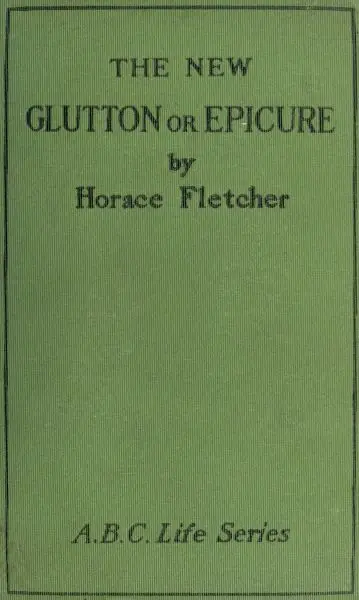
The New Glutton or Epicure
Horace Fletcher
THE CLASSIC COLLECTION · 1898
"Happiness as Found in Forethought Minus Fearthought" by Horace Fletcher is a philosophical treatise written in the late 19th century. The work explores the concepts of happiness, fear, and the importance of cultivating a positive mindset through the elimination of negative thoughts. Fletcher argues that understanding and improving one's mental habits can lead to true happiness, which he describes as a result of conscious usefulness and personal growth. The opening of the text introduces the central idea that everyone desires to be happy, and highlights the pervasive nature of fear in human experience. Fletcher shares personal anecdotes, emphasizing that happiness can be achieved through changing one’s mindset and behaviors. He discusses the duality of forethought (positive thinking) and fearthought (negative thinking), asserting that the latter can detract from growth and well-being. As he sets the stage for presenting methods to enhance happiness and eliminate fear, he draws upon historical and personal experiences to illustrate how individuals can cultivate a more harmonious and fulfilled life.
Introduction adapted from the source catalogue; source summaries may be automatically generated.
Free to read · English · 36,999 words · No account needed
MAKE TIME FOR A GOOD BOOK
On by default. Untick to stop anonymous reading totals. Each page counts after 10 seconds in view. How this works.
Anonymous counting is on unless you have switched it off.
Nervousness is the "scapegoat" for much cowardice, ignorance and perversion, sometimes of prenatal, but generally of post-natal, origin. It is not as respectable as scrofula, for the reason that scrofula may have been inherited or contracted by the accident or evil doing of another, and can be corrected only by process of regeneration; while nervousness is an expression or reflection of fearthought which can be corrected by one's own right-thinking.
Whoever is not nervous when he is asleep need not be nervous when he
is awake.
Eminent physicians have recently authorized the above assertions relative to nervousness. If it is evil and unnecessary, it is, therefore, not-respectable.
When nervous, seek within the habit-of-thought for a cause.
Attraction rules the universe.
The rivalry between attraction and counter-attraction is friendly.
Evolution is the result of being attracted to increase and to growth, and not the result of being pushed to growth.
All plant life inclines towards the light and the sun.
Plant life that is strong enough to withstand the storms, turns its
back in protest to the wind.
Pessimists snarlingly assert that attraction is the pushing of desire for change, but pessimists are diseased themselves, and therefore call things by wrong names, and give the wrong construction to everything.
Appreciation and resultant Love are caused by attraction, and not by
fear.
Whatever is attracted forward or upward, will remain in advance or
above.
Forethought is eagerly receptive and seeks progress through attraction.
Fearthought pushes to action by its own cowardice, and accomplishes
nothing useful.
Altruism is a powerful magnet; good men are "as true as steel."
Consideration is practical altruism.
Consideration for others is evidenced by desiring to do for them what is most desired by them, or, what is best for them. It assumes no superiority.
Consideration is "catching," and the easiest way to accomplish one's own desires, in connection with others, is to suggest consideration by consideration.
No one ever "lost a trick, or missed a meal," by being considerate; and simple, unaffected consideration has often been the means of adding great possessions to its own richness.
"After you," will unravel a crowd quicker than any pushing to be first.
Fearthought, and the selfishness growing out of it, are the origin of all lack of consideration for others; and contact with others, and the every-day amenities of life furnish constant opportunity for attacking one of the strongest expressions of the disease of fearthought by practice of altruistic consideration.
The first requisite of gentility is consideration.
Happy Day!
Your reading position is saved on this browser. Take it to another device with a library code. Reading pages adapt to text, rather than matching a printed edition.
Horace Fletcher

Horace Fletcher
Horace Fletcher
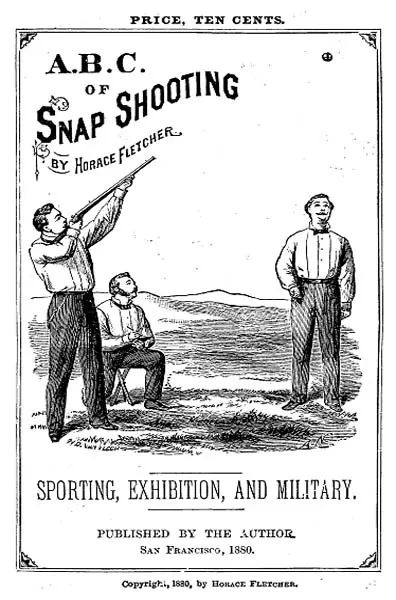
Horace Fletcher
BEHIND THE BOOK
This eBook is for the use of anyone anywhere in the United States and most other parts of the world at no cost and with almost no restrictions whatsoever. You may copy it, give it away or re-use it under the terms of the Project Gutenberg License included with this eBook or online at www.gutenberg.org. If you are not located in the United States, you will have to check the laws of the country where you are located before using this eBook. Read the source licence.
The original source file, including credits and licence, is retained by this library. Request an original-format copy at no charge. Please include the book title and Project Gutenberg identifier #46777.
KEEP YOUR CURIOSITY GOING

David Patterson (Spirit) Hatch
Coulson Kernahan

Ralph Waldo Emerson
Frances Wright

Edwin Abbott Abbott

Joseph Droz