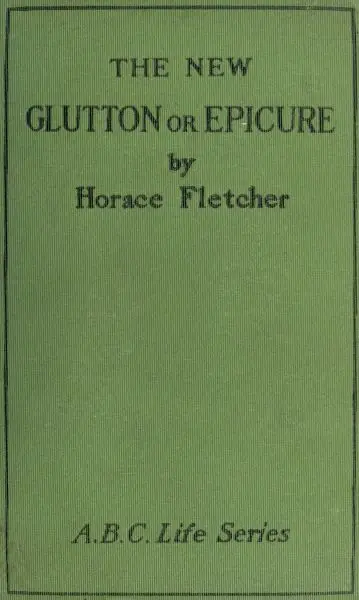
The New Glutton or Epicure
Horace Fletcher
THE CLASSIC COLLECTION · 1898
"Happiness as Found in Forethought Minus Fearthought" by Horace Fletcher is a philosophical treatise written in the late 19th century. The work explores the concepts of happiness, fear, and the importance of cultivating a positive mindset through the elimination of negative thoughts. Fletcher argues that understanding and improving one's mental habits can lead to true happiness, which he describes as a result of conscious usefulness and personal growth. The opening of the text introduces the central idea that everyone desires to be happy, and highlights the pervasive nature of fear in human experience. Fletcher shares personal anecdotes, emphasizing that happiness can be achieved through changing one’s mindset and behaviors. He discusses the duality of forethought (positive thinking) and fearthought (negative thinking), asserting that the latter can detract from growth and well-being. As he sets the stage for presenting methods to enhance happiness and eliminate fear, he draws upon historical and personal experiences to illustrate how individuals can cultivate a more harmonious and fulfilled life.
Introduction adapted from the source catalogue; source summaries may be automatically generated.
Free to read · English · 36,999 words · No account needed
MAKE TIME FOR A GOOD BOOK
On by default. Untick to stop anonymous reading totals. Each page counts after 10 seconds in view. How this works.
Anonymous counting is on unless you have switched it off.
Whoever teaches a child to be fearless, builds greater than she can ever know, for fearlessness in one inspires courage in many; and as courage inspires strength and causes action, there is no end to what may grow out of the fearless influence of the frailest and physically weakest of women, and any young mother, in the quiet and seclusion of a modest home, can set in motion vibrations of strength and fearlessness that may result in the building of a great city or the invention of some world-emancipating tool of progress.
All great accomplishments can be traced back to mother-influence. Mother-muscle may be wanting, but mother-thought rules the world.
Mother-thought is always brave-thought in one emergency, and therefore can be strong in all emergencies.
Mother-thought rules the world.
Mother-thought blesses life.
All water is pure water.
It is impurities within water that muddy it.
All men are innately good.
It is the presence of false impressions, the result of false suggestions, that makes men selfish and bad.
There is no impurity in water that cannot be removed by some means within the reach of chemistry, and there is likewise no bad suggestion impressed on a sane human mind that cannot be counteracted by some right and good suggestion.
In your judgment of men, judge the sum of their opportunities and the quality of their environing atmosphere, and not the individuals themselves. It will aid you to a more just appreciation of the possible goodness of your neighbors, and greatly help to conserve your own happiness, through the diffusion of the warm blood of charitable impulse.
Mould conditions aright, and men will grow good to fit them.
The perfect man is the harmonious man.
The perfection of anything is dependent upon the perfection of all its
parts.
Good society is made up of good individuals; individuals are measured by their qualities of mind and character; and mind and character are pure and good according as their constituent elements are pure and good.
Fearthought is a weak element of mind and its influence on character is
blighting.
In chemistry and in mechanics we analyse and test with greatest care the material we use, to learn its value as related to our purpose. If it have any element of weakness we discard it.
Measure, and weigh well, thought about the future; if it partake of fearthought, expel it from the mind, for it is evil; if it be filled with strength, and hope, and confidence, nurse it tenderly, for it is good.
Harmony is strength.
Forethought is strong thought.
Fearthought is weak thought.
Nervousness is frequently discreditable, and, therefore,
not-respectable.
Your reading position is saved on this browser. Take it to another device with a library code. Reading pages adapt to text, rather than matching a printed edition.
Horace Fletcher

Horace Fletcher
Horace Fletcher
Horace Fletcher
BEHIND THE BOOK
This eBook is for the use of anyone anywhere in the United States and most other parts of the world at no cost and with almost no restrictions whatsoever. You may copy it, give it away or re-use it under the terms of the Project Gutenberg License included with this eBook or online at www.gutenberg.org. If you are not located in the United States, you will have to check the laws of the country where you are located before using this eBook. Read the source licence.
The original source file, including credits and licence, is retained by this library. Request an original-format copy at no charge. Please include the book title and Project Gutenberg identifier #46777.
KEEP YOUR CURIOSITY GOING

David Patterson (Spirit) Hatch
Coulson Kernahan

Ralph Waldo Emerson
Frances Wright

Edwin Abbott Abbott

Joseph Droz