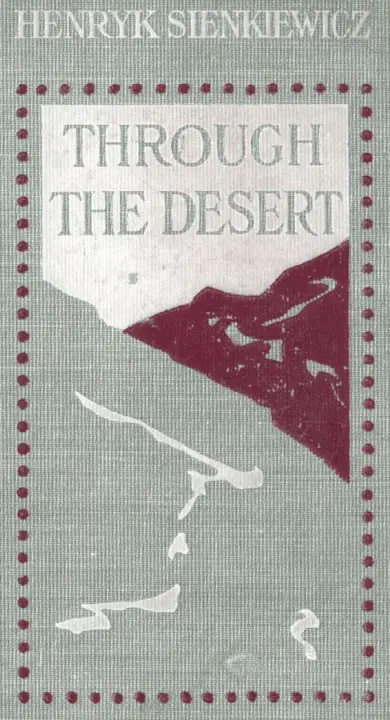
Through the Desert
Henryk Sienkiewicz
THE CLASSIC COLLECTION · 1897
"Hania" by Henryk Sienkiewicz is a historical novel written in the late 19th century. The narrative revolves around the titular character, Hania, the granddaughter of an old servant named Mikolai Suhovolski, and her relationship with Henri, the young heir now tasked with her guardianship after Mikolai's death. The story weaves themes of love, duty, and the transitions of life, set against a backdrop of Polish nobility and the complexities of familial responsibilities. The opening of "Hania" introduces the reader to Mikolai, an old servant who holds a significant place in the narrator's childhood memories. His character is depicted as both authoritarian yet affectionate, demonstrating a deep sense of duty and loyalty that profoundly influences the young narrator. Following Mikolai's passing, the narrator and Hania are left to navigate their new roles as guardian and ward, filled with sorrow yet bound by a shared history. The initial scenes capture the melancholy of loss while hinting at the care and affection that will evolve between Hania and her protector, setting the stage for a deep emotional journey intertwined with the notions of love and responsibility.
Introduction adapted from the source catalogue; source summaries may be automatically generated.
Free to read · English · 155,224 words · No account needed
MAKE TIME FOR A GOOD BOOK
On by default. Untick to stop anonymous reading totals. Each page counts after 10 seconds in view. How this works.
Anonymous counting is on unless you have switched it off.
The life seething there presented a marvellous contrast to the deep deadness of the naked, barren mountains, above which extended the sky, cloudless and so transparent that it was monotonous and glassy. Everything was dimmed and belittled amid that calm greatness; the carriage with its occupants seemed, as it were, a kind of beetle, clinging to the cliffs along which it was climbing to the summit with insolence.
"Here life ends altogether," said Svirski, looking at the naked cliffs.
Pani Elzen leaned more heavily on his shoulder and answered with a
drowsy, drawling voice,--
"But it seems to me that here life begins."
After a moment Svirski answered with a certain emotion, "Perhaps you are
right."
And he looked with an inquiring glance at her. Pani Elzen raised her eyes to him in answer, but dropped them quickly, as if confused, and, though her two sons were sitting on the front seat of the carriage, she looked at that moment like a maiden whose eyes could not endure the first ray of love. After that, both were silent; while from below came snatches of music.
Meanwhile, far away at sea, at the very entrance to the bay, appeared a dark pillar of smoke, and the quiet of the company was broken by Remus, who sprang up, and cried,--
"Tiens! le 'Fohmidable'!"
Pani Elzen cast a glance of displeasure at her younger son. She knew the value of that moment, in which every next word might weigh in her fate decisively.
"Remus," said she, "will you be quiet?"
"But, mamma, it is the 'Fohmidable'!"[13]
"What an unendurable boy!"
"Pouhquoi?"[13]
"He is a duhen[13] [duren, a simpleton]; but this time he is right," called out Romulus, quickly; "yesterday we were at Villa Franca,"--here he turned to Svirski. "You saw us go on velocipedes; they told us there that the whole squadron had arrived except the 'Fohmidable,' which was due to-day."
To this Remus answered with a strong accent on every last syllable,--
"Thou art a duhen,[13] thyself!"
[13] Romulus and Remus lisp or pronounce r in the Parisian manner, hence the use of h instead of r in the above words, both French and Polish.
The boys fell to punching each other with their elbows. Pani Elzen, knowing how Svirski disliked her sons' style of speech, and generally the manner in which they were reared, commanded them to be silent.
"I have told you and Pan Kresovich," said she, "not to speak among yourselves in any language but Polish."
Your reading position is saved on this browser. Take it to another device with a library code. Reading pages adapt to text, rather than matching a printed edition.
Henryk Sienkiewicz
Henryk Sienkiewicz
Henryk Sienkiewicz
Henryk Sienkiewicz
BEHIND THE BOOK
This eBook is for the use of anyone anywhere in the United States and most other parts of the world at no cost and with almost no restrictions whatsoever. You may copy it, give it away or re-use it under the terms of the Project Gutenberg License included with this eBook or online at www.gutenberg.org. If you are not located in the United States, you will have to check the laws of the country where you are located before using this eBook. Read the source licence.
The original source file, including credits and licence, is retained by this library. Request an original-format copy at no charge. Please include the book title and Project Gutenberg identifier #36583.
KEEP YOUR CURIOSITY GOING
Cécile Tormay

Moritz Busch
Coulson Kernahan
John L. Ransom

Maurice Baring
Frances Wright